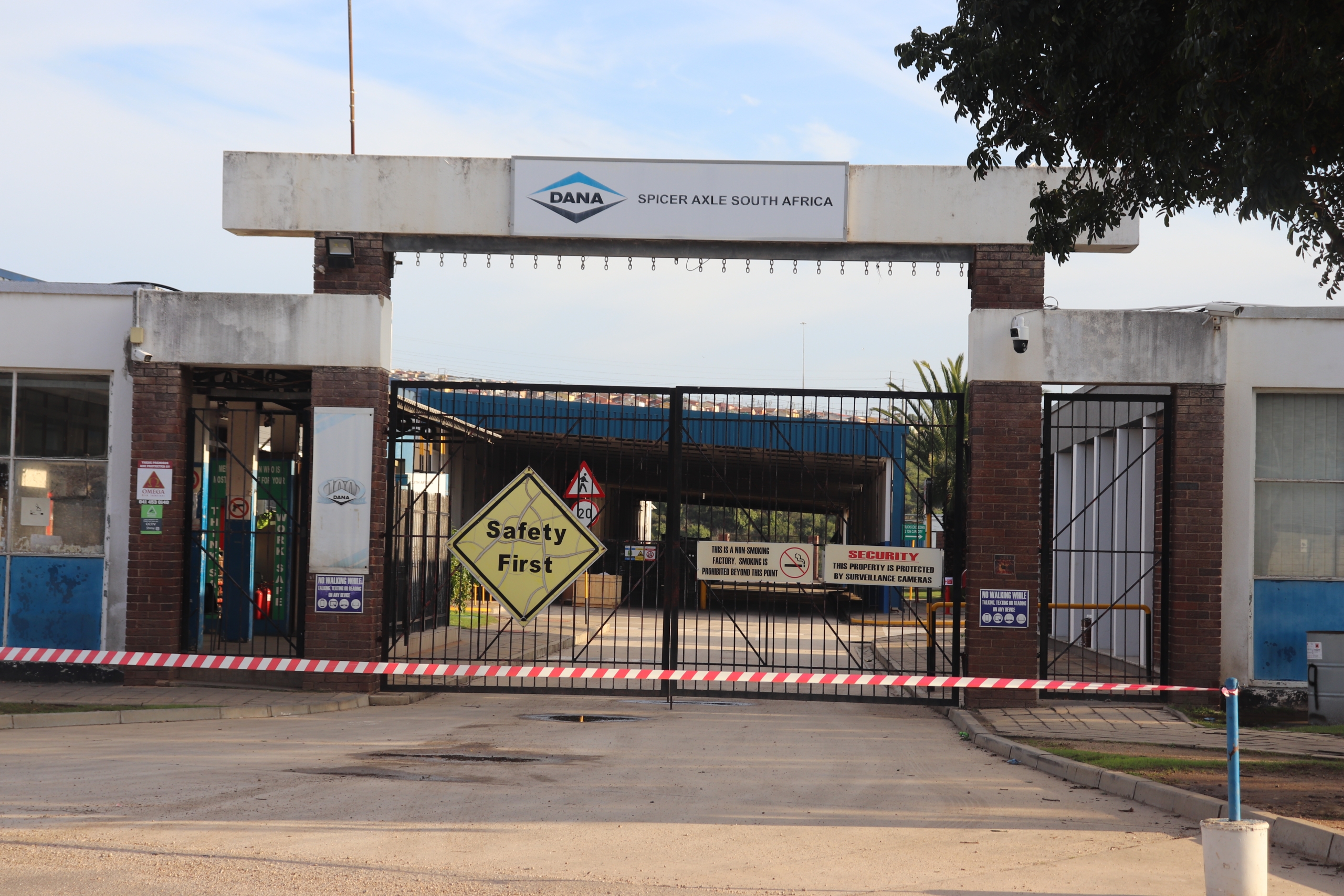
KARIEGA – Retrenchments at Dana Spicer Axle South Africa (DSASA) in Kariega have sparked industrial action and renewed concerns over the accelerating decline of Nelson Mandela Bay’s manufacturing sector, with unions and business leaders warning of the broader economic impact on the region.
Members of the National Union of Metalworkers of South Africa (NUMSA) and UASA The Union in Port Elizabeth embarked on strike action on 18 May following what NUMSA described as failed negotiations with management over retrenchments imposed on workers.
According to NUMSA regional secretary Mziyanda Twani, consultations between unions and the employer continued for two months before reaching deadlock. Twani said workers rejected the company’s retrenchment proposals, which included what NUMSA described as a non-negotiable gratuity payment of R5,000, while workers had demanded R200,000 with room for negotiation.
He further alleged that the company refused to disclose audited financial statements, making it difficult for unions to negotiate improved Voluntary Early Retirement (VER) and Voluntary Separation Packages (VSP). NUMSA also claimed management limited VER and VSP options to selected employees with shorter service periods, while workers’ demands for leave pay and bonuses up to the end of June 2026 were allegedly rejected.
“The employer approached the court late in the week for an urgent interdict and were granted it by the presiding judge,” said Twani. He added that NUMSA was consulting its legal team regarding possible next steps and would engage workers before deciding on a course of action. “As a worker-controlled union, we will pursue whatever the workers decide on regarding the options available,” he said.
The retrenchments have once again highlighted mounting fears over de-industrialisation in Nelson Mandela Bay, where the automotive and manufacturing sectors remain central to the regional economy.
According to the Nelson Mandela Bay Business Chamber (NMBBC), more than 6,000 manufacturing jobs have been lost in the metro over the past 18 months, with the automotive components sector among the hardest hit.
NMBBC CEO Denise van Huyssteen said the region’s manufacturing sector had been facing “an economic survival emergency for some time”, warning that Nelson Mandela Bay had been disproportionately affected by de-industrialisation compared to the rest of the country. Manufacturing currently accounts for approximately 22% of the metro’s GDP and employs more than 40% of workers in South Africa’s automotive sector.
“The hollowing out of the ecosystem surrounding automotive manufacturing is of major concern to us,” van Huyssteen said. She added that the Chamber had been lobbying local, provincial and national government stakeholders to urgently intervene in order to retain investment and protect jobs.
Among the challenges identified by the Chamber are declining localisation levels, rising imports of cheaper vehicles from Asian markets, high energy costs, unreliable electricity supply, logistics inefficiencies and poor municipal service delivery. The Chamber noted that imported vehicles accounted for 67% of vehicles sold in South Africa last year, placing further pressure on local manufacturers and component suppliers.
Van Huyssteen stressed the need for stable and predictable economic policies, stronger localisation measures and coordinated industrial strategies aimed at protecting South African manufacturing capacity.
“The automotive sector remains one of the biggest economic drivers in Nelson Mandela Bay, and any contraction across assemblers, component manufacturers or supporting industries has far-reaching implications for employment, investment confidence and economic stability in the region,” she said.
Meanwhile, the Economic Freedom Fighters have also raised concern over the retrenchments, describing them as part of a broader collapse of manufacturing employment in the Eastern Cape. The party also called for urgent government intervention to halt further job losses and support localisation in the automotive sector.
ALSO READ: Ford SA announces major layoffs to affect staff in Gqeberha