

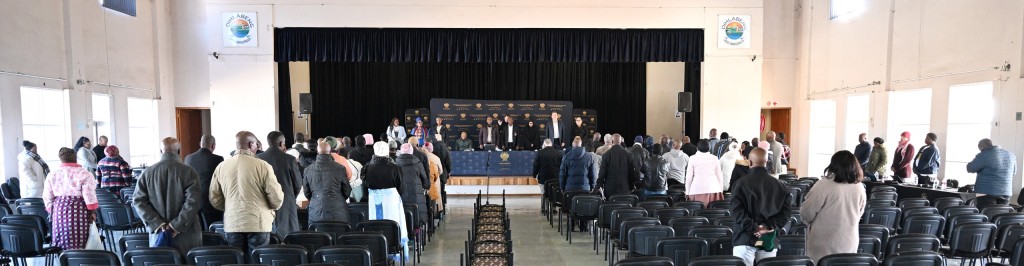
The Portfolio Committee on Home Affairs nears the end of its comprehensive nationwide public consultation on the Marriage Bill with the final Western Cape hearing at Oliver Tambo Community Hall in Khayelitsha yesterday (Wednesday 29 October).
The Bill, proposed and tabled by the Department of Home Affairs in Parliament on 13 December 2023, represents its ambitious attempt to consolidate South Africa’s marriage legislation. It sees the merging of three existing laws – the Marriage Act (civil marriages), Recognition of Customary Marriages Act (traditional African marriages) and Civil Union Act (same-sex unions) – into a single, inclusive legislative framework.
Key provisions of the Bill include setting a minimum legal marriage age of 18 years, criminalising child marriages, recognising both monogamous and polygamous marriages, expanding marriage-officer designation to include religious and traditional leaders, and establishing anti-fraud provisions for foreign national marriages.
WIDE CONSULTATION
The extensive consultation began with written submissions in January 2024 before it evolved into face-to-face engagements across all nine provinces. Gauteng launched the process in November 2024, followed by KwaZulu-Natal (February), Eastern Cape (March), Mpumalanga (April), North West (June), Free State (July) and Northern Cape (August). The process has been underway the Western Cape since Monday 27 October.
During consultations the most consistent calls from citizens mostly centred on the possibility of increasing the legal marriage age from 18 to 21 years. Arguments for this amendment included that 18-year-olds are likely to be school goers and have lack financial stability for marriage responsibilities.
Equally, there has been countrywide calls for the complete removal fine options payable for child-marriage violations, as participants argued that wealthy perpetrators could simply pay fines rather than face imprisonment.
The completed provincial hearing highlighted foreign marriage-fraud concerns, with communities reporting and alleging increased marriages of convenience that compromise the population register. High unemployment rates were linked to South Africans entering fake marriages for economic survival, prompting demands for minimum one-year waiting periods and intensive investigations.
COMPLEXITIES AROUND MARRIAGE’
Same-sex marriage provisions created heated debates. Religious and traditional organisations across five provinces expressed fears about inadequate protection under Section 11(4), which allows marriage officers to refuse ceremonies against their conscience. Constitutional rights advocates countered that every South African has the right to choose under Section 9 of the Constitution, leading to committee intervention in Northern Cape, where hate speech required active process guidance.
Complex gender issues have emerged around polygamous marriages. In the Northern Cape and KwaZulu-Natal, citizens questioned why Clause 6 recognises polygamy and not polyandry, viewing this as constitutionally discriminatory.
Concerns were also raised about written-consent requirements for polygamous marriages in KwaZulu-Natal, with communities claiming this could increase gender-based violence if women refuse permission for additional wives.
PROVISIONS FOR VIOLATION LEGAL REDRESS AND CENSURE
Marriage officers countrywide also expressed fears about liability for violations they may not be aware of, citing they lack training to assess mental capacity of those they wed and documentation verification, and could face criminal penalties for any violations in this regard.
Muslim communities raised marriage recognition concerns, arguing that the Bill does not explicitly make provision for Sharia law, as per the Constitutional Court ruling of 2022, which found that existing laws must be amended to recognise Muslim marriages. In Knysna in the Western Cape, Muslim citizens expressed concern that the Bill does not clearly distinguish between divine law and human law.
Furthermore, women’s property rights featured prominently in various provinces, particularly rural women’s vulnerability in dual marriage systems.
DISPOSAL OF MARRIAGE RESOURCES
Regional issues included North-West youth opposing lobola commercialisation and Free State proposing innovative 50/50 payment splits to prevent gender-based violence.
Following the sessions completion in the Western Cape, the Portfolio Committee is close to closing the hearings, with only Limpopo remaining after a two-year long process.
The challenge ahead lies in balancing constitutional rights with cultural traditions, ensuring practical implementation while maintaining legal certainty, and creating legislation that truly reflects South Africa’s diverse population will.





You must be logged in to post a comment.