

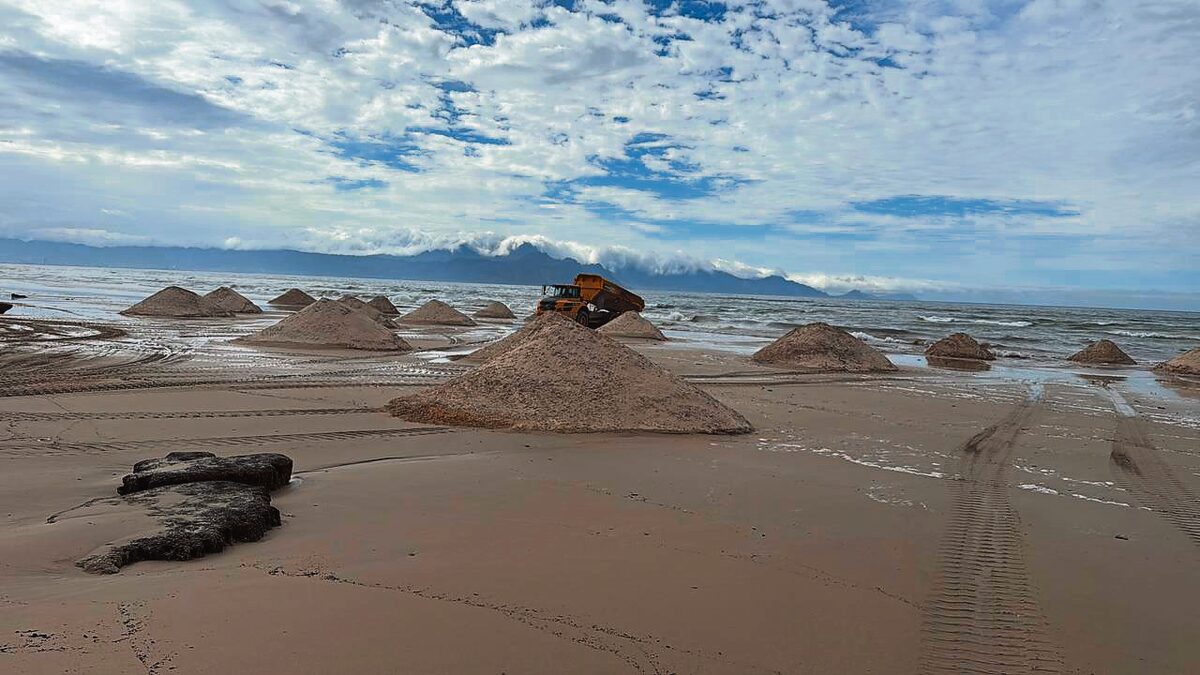
The City of Cape Town is trialling an innovative approach to combat windblown sand that regularly disrupts traffic on Baden Powell Drive, using brushwood and straw to stabilise coastal dunes.
The pilot project, launched on Monday 2 February, targets the Sandy Corner section near Monwabisi, where strong southeasterly winds deposit sand from local dunes onto the road during summer months.
Collaborative effort between departments
The city’s Coastal Management branch is working with the Roads Infrastructure Management Department to test whether natural materials can effectively trap sand and stabilise the dune system, whilst also reprofiling the dunes.
“We started the work on Monday and hope to be done by next week. Some people driving along Baden Powell Drive would have noticed the activity next to the road,” said deputy mayor and Mayco member for Spatial Planning and Environment, Eddie Andrews.
The project involves moving approximately 5 000 cubic metres of clean sand back into ocean circulation before installing the brushwood and straw barriers.

Critical transport link affected
Baden Powell Drive serves as a vital east-west connection for metro-south east commuters, but sand accumulation during prolonged windy periods sometimes forces road closures.
“Many commuters use this road for their daily commute. It really becomes a challenge in the summer months when sand accumulates on the surface, especially during long periods of strong southeasterly winds, at times forcing us to close the road,” said Mayco member for Urban Mobility, Rob Quintas.
The city requires continuous maintenance of this section to ensure road safety and prevent the roadway being overwhelmed by the advancing dune system.
Trial monitoring until 2026
Officials will monitor the dune system’s behaviour throughout the trial period, which concludes at the end of June 2026, to measure the effectiveness of this natural sand-trapping method.
Andrews described the initiative as “only a trial” and confirmed the city would “track the efficiency in coming months” to determine whether the approach could provide a long-term solution to the recurring problem.





You must be logged in to post a comment.