HANGZHOU, CHINA — Inside a sprawling facility in East China’s Zhejiang province, a unique class is in session. “Teachers” handle remote controls, precision sensors track every micro-movement, and “students” tirelessly drill the same physical tasks over and over until they achieve perfection.
These students, however, are made of steel, silicon, and sensors.
According to the China Daily, more than 140 robots are currently enrolled at the National Pilot Base for Embodied AI Applications in Hangzhou.
Designed as a “national vocational training ground” for embodied artificial intelligence, the facility is putting robots – machines that sense, move, and act in the physical world – through their paces across more than 40 real-world workplace scenarios, ranging from smart kitchens and automated warehouses to agricultural farms and a dimly lit mock mine tunnel.
Bridging the ‘sim-to-real’ gap
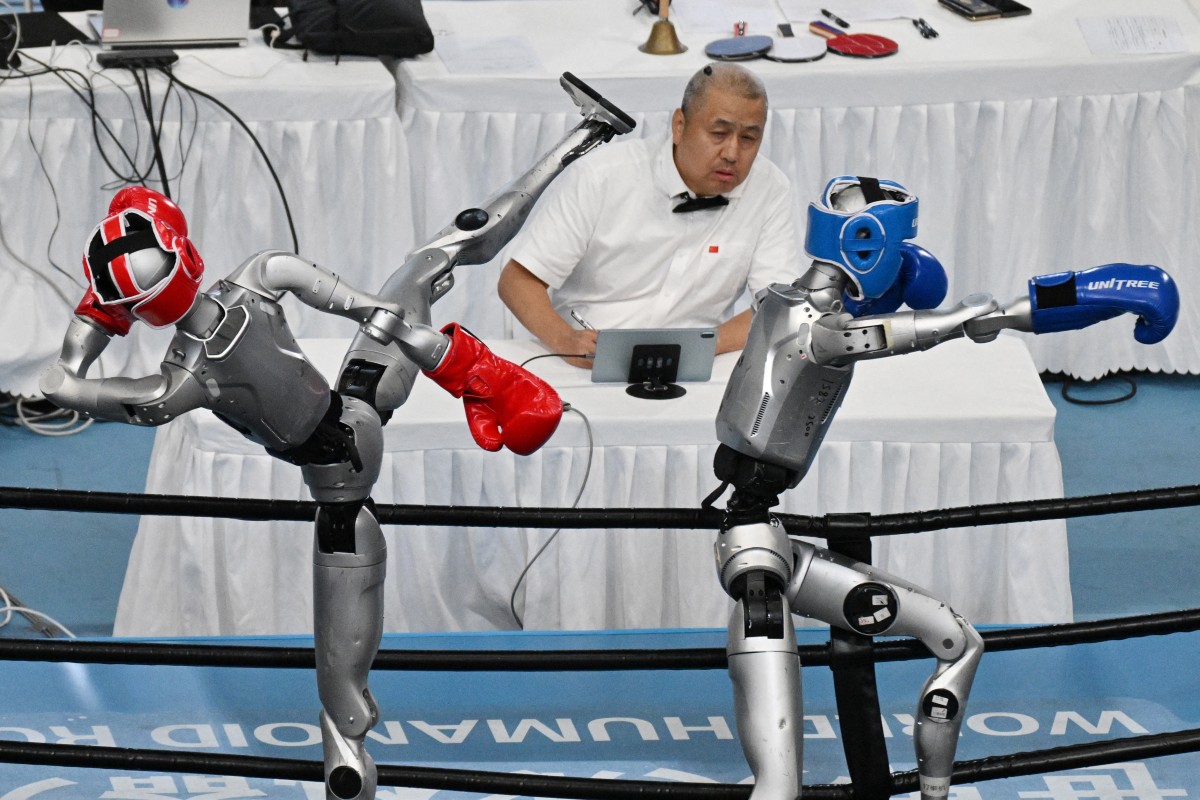
While Chinese robotics developers have previously captured global attention with viral videos of backflipping, boxing, and dancing humanoid models, the industry now faces a much harder test: reliably performing everyday labour.
A persistent challenge for engineers has been that robots excelling in clean, digital simulations often struggle when confronted with the unpredictable messiness of the real world.
The Hangzhou pilot base was built specifically to bridge the gap between lab research and commercial rollout as a shared testing and validation facility.
Inaugurated on 16 May this year, the base operates on a dual-track training system combining high-fidelity virtual simulations with hands-on physical scenarios:
- Physical teleoperation: Technicians guide robots through tasks repeatedly while sensors capture every successful movement as “raw teaching material” for model training.
- Virtual simulation: High-fidelity digital environments allow software models to rapidly refine their algorithms at scale.
Even before its official plaque arrived, the facility was bustling. Nearly 40 embodied-AI enterprises alongside more than 10 universities and research institutes had already set up operations on site during its trial run.
From stir-frying to precision stacking
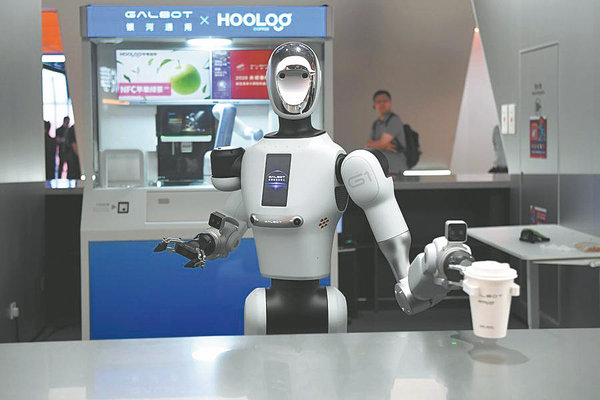
Inside a mock smart kitchen, developer Hangzhou Big Data Cloud AI Technology has been training robots since last November to master an end-to-end restaurant routine. The machine takes customer orders, fetches ingredients, cooks a stir-fry dish in three to four minutes, plates the meal, and clears dirty dishes.
Developing such specialised applications from scratch used to be prohibitively expensive.
In the past, developing a single application scenario could cost a company more than 10 million yuan ($1.5 million) in training data alone. Now companies based here get one-stop access to the resources they need.
— Zhang Haiwei, Founder of Chingmu
Yang Jiandang, cofounder of Hangzhou Big Data Cloud AI Technology, noted that building a custom catering application independently could run into millions of yuan in R&D. By utilising the shared infrastructure provided by the pilot base, his team can conduct feasibility testing at a fraction of the cost.
Elsewhere on campus:
- Logistics and warehousing: A joint project between logistics firm Transfar and robot manufacturer Unitree features wheeled humanoid robots picking, scanning, and transporting irregularly shaped cargo.
- Heavy machinery and agriculture: Smart forklifts stack goods with positioning accuracy down to 1 millimeter, while automated harvesting robots pick ripe fruit continuously 24 hours a day.
The ‘library’ for robotics innovation
For robotics startups, the primary appeal of the pilot base is the rapid ecosystem integration it provides. Zhou Chen, CEO of dexterous-hand developer DexRobot, compared the industry’s fragmented past to a famous line from an ancient Chinese ballad about equipping a warhorse piece by piece.
You buy the saddle from one vendor, the harness from another, the reins from a third, but end up with a pile of parts and no idea how to assemble them. That’s exactly why we need a platform… The base is like a library for robotics, you come here because everything you need is on the shelves.
— Zhou Chen, CEO of DexRobot
This spatial proximity translates into unprecedented speed. Motion-capture firm Chingmu and DexRobot, located in the same building, established a joint laboratory to accelerate product development.
“Upstairs and downstairs are upstream and downstream. Our next-door neighbour is our partner,” Zhou remarked, explaining that proximity drastically slashes decision-making costs and allows instant testing of new hardware iterations.
Li Xingteng, deputy general manager of the base’s operator, Hangzhou Embodied Intelligence Pilot Base Technology, emphasised that the ultimate goal is to convert individual company strengths into end-to-end industrial solutions.
A 100-Billion-Yuan AI Ecosystem
The base represents just one piece of Hangzhou’s broader ambition to dominate the next era of robotics. The city is currently home to more than 700 robotics-related enterprises, with its embodied-AI cluster generating an industrial output of 106.8 billion yuan in 2025.
According to Li, the mature embodied-AI solutions perfected at the Hangzhou base will next be deployed into experimental real-world communities, where they will face their final test in public daily life.