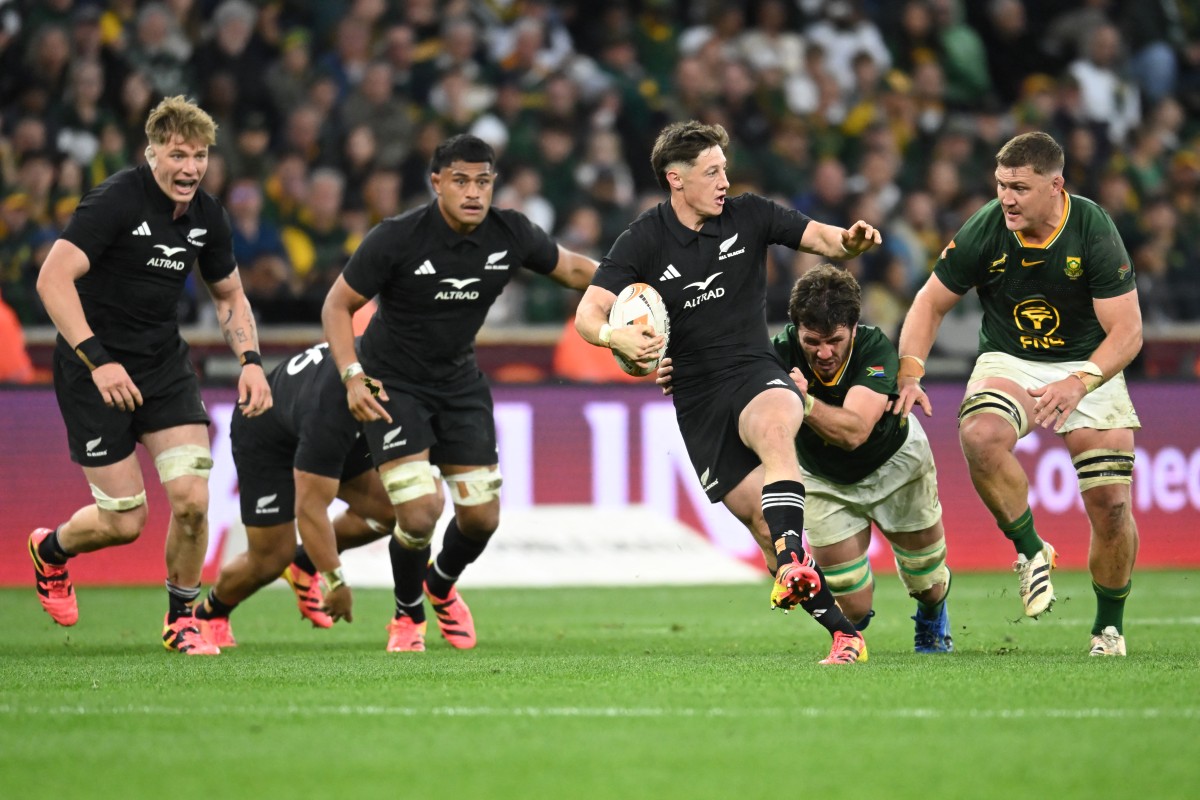
The theatre was FNB Stadium. The performance was worthy of an Academy Award. And Cam Roigard was the leading man who left rugby purists absolutely fuming.
Also read: Boks turn the screws to seal thriller against All Blacks
When the New Zealand scrumhalf hit the deck on Saturday after Cobus Reinach shrugged him off, writhing around like he’d been shot by a sniper in the stands, rugby’s age-old tolerance for “shithousery” collided head-on with a boundary that should never be crossed, faking injury for competitive advantage.
The dive was textbook football. The outrage was quintessentially rugby.
The performance that crossed the line
Referee Nika Amushukeli had already blown for a penalty try, but Roigard’s theatrical collapse still earned New Zealand a penalty to restart the match.
Former Springbok midfielder Jean de Villiers wasn’t having any of it. In commentary, he called out Roigard’s antics with the kind of directness that only a man who’s survived 109 Test matches can muster.
“A lot has been said about gamesmanship, and I will call it out there. This game of ours is a pride one. Taking a dive. Yes, (Reinach) kind of ripped him backwards but it was certainly not a tip-tackle. A penalty at most,” De Villiers stated.
And he’s absolutely right. Rugby’s currency has always been toughness, honesty in the physical contest, and getting up when you’re knocked down. Roigard’s dive devalues that currency.
A repeat offender
This isn’t Roigard’s debut in amateur dramatics. According to KickOff.com, the New Zealand number nine has previous form. In the Super Rugby semi finals between the Blues and Hurricanes, Roigard went down from a contesable kick, won the penalty, then miraculously recovered in time to take a quick tap and launch an attack.
It’s the rugby equivalent of a footballer rolling around for three minutes before sprinting back into position. It stinks.
The comparison to Nic White’s Oscar-worthy performance against Faf de Klerk is unavoidable. When De Klerk’s hand brushed White’s very manly moustache, the Australian scrumhalf collapsed like he’d taken a Mike Tyson uppercut. De Klerk saw yellow. White probably saw stars, from laughing all the way back to the halfway line.
Both incidents expose the same rot creeping into rugby union: players importing football’s most despised trait into a sport that has always prided itself on being different.
The beautiful line of shithousery
Now, let’s be clear, rugby has always embraced a certain level of gamesmanship. The late tackle that’s just borderline enough to avoid sanction. The verbals at the breakdown designed to get under an opponent’s skin. The strategic slowing of ball at the ruck. This is all part of rugby’s dark arts, the acceptable shithousery that adds spice to the contest.
If you’ve ever attended a koshuis rugby match in Potchefstroom, you’ll know that spectator shithousery reaches levels that make your teeth itch. The sledging, the mind games, the outrageous banter, it’s all part of the koshuis rugby experience, woven into the fabric of the occasion.
But there’s always been a line. And that line is injury.
Rugby players wear their toughness like a badge of honour. They get up when they’re hurt. They play through pain. They save the physio for genuine injuries because respect for the physical contest demands nothing less. There is a difference between being hurt and being injured.
Faking injury betrays everything rugby stands for.
The Cockerill principle
Former England lock Martin Bayfield once illustrated the cultural chasm between rugby and football with a brilliant comparison from 1998.
England faced Argentina in the football World Cup. David Beckham was sent off for a “vicious tackle” on Diego Simeone. “The poor lad fell down, mud on his shorts, one of his socks rolled down and his alice band fell out of his hair. The press destroyed Beckham for the next few years,” Bayfield recounted.
Around the same time, South Africa played England at Ellis Park. England hooker Richard Cockerill – “a man voted most likely to marry outside his own species” according to Bayfield – punched his opposite number James Dalton, broke his nose, blood everywhere. Dalton didn’t fall over, didn’t cry, didn’t run to the referee. “He just twatted him back, broke his nose. The press described it as a minor altercation.”
That’s the difference. Not condoning grievous bodily harm from rugby’s darker days, but the culture has always valued honest physicality and getting on with it.
Time for World Rugby to act?
Football introduced rules to punish simulation precisely because it was destroying the integrity of the game. Referees can now book players caught diving, and VAR has added another layer of scrutiny.
Rugby union finds itself at a crossroads. World Rugby has spent years making the game safer, HIA protocols, red cards for high tackles, stricter TMO interventions for foul play. The focus has been on protecting players from genuine harm.
But if serious injury is a very real probability on a rugby pitch, and it absolutely is, shouldn’t rugby also protect against players weaponising the fear of injury?
The current situation is untenable. Players like Roigard and White are getting rewarded for behaviour that undermines everything the sport claims to stand for. They’re exploiting the very thing that makes rugby special, the physical contest, the respect for injury, the toughness that separates rugby from other sports.
World Rugby needs to follow football’s lead on this one specific issue. Introduce sanctions for simulation. Empower TMOs to review obvious dives. Make it clear that faking injury will result in yellow cards, bans, and public censure.
Because if rugby allows this cancer to spread, the sport will lose the very thing that makes it unique. The pride De Villiers spoke about. The toughness Bayfield described. The honest physicality that has always set rugby apart.
Cam Roigard might have won a penalty on Saturday. But in doing so, he lost something far more valuable, respect. And in rugby, that’s supposed to matter more than anything else.