

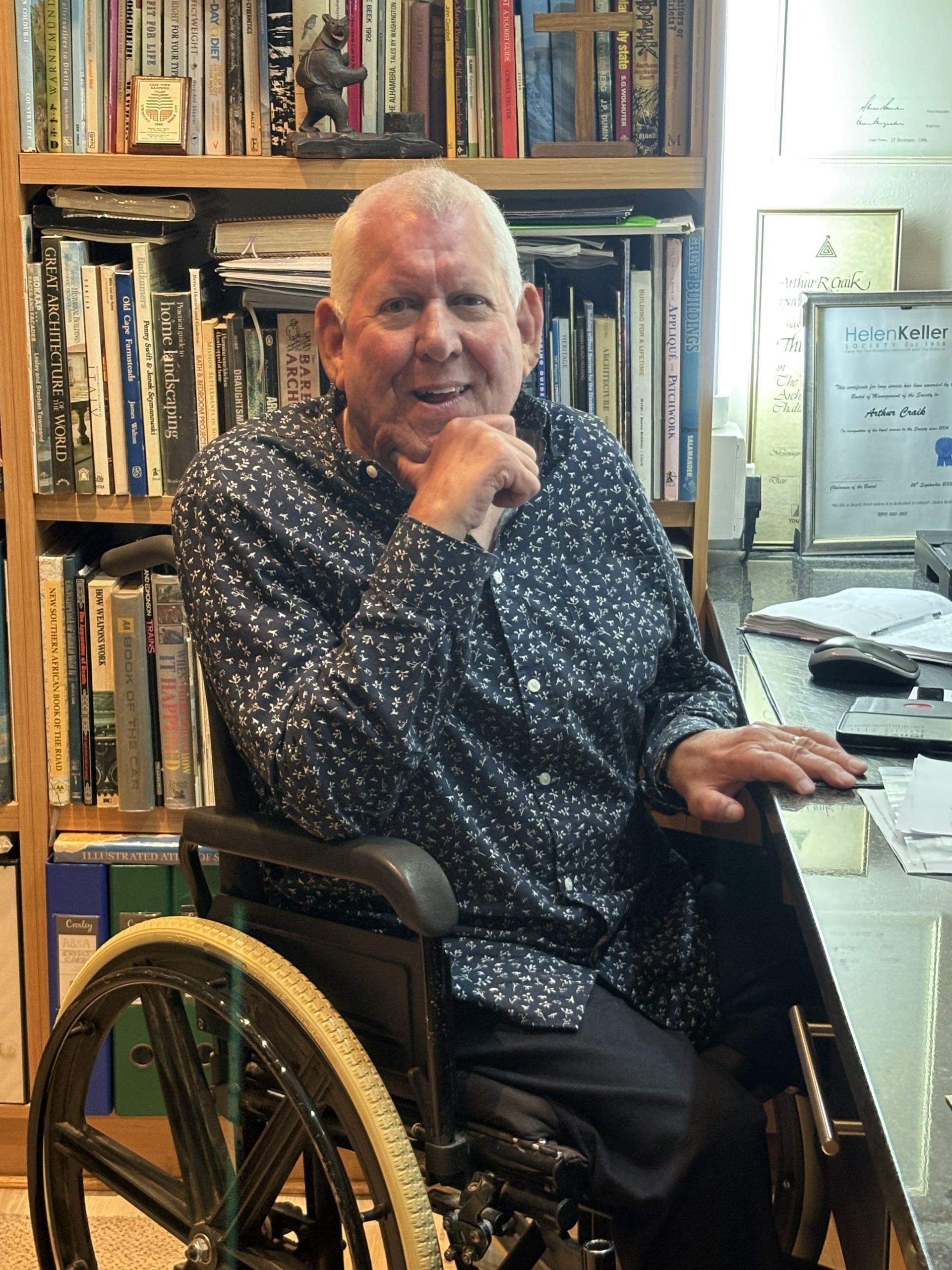
At just four years old, Arthur Craik contracted polio during the 1956 outbreak in Cape Town. The disease left him with permanent physical challenges, but it did not stop him from becoming an architect who would help shape some of the city’s most familiar landmarks.
Now, nearly 70 years later, the Bellville polio survivor is using his experience to urge parents to vaccinate their children.
His message comes ahead of World Polio Day on Saturday 24 October, as health organisations continue efforts to eradicate the disease. “It is a priority as a parent to ensure children are vaccinated,” Craik said.
A childhood changed by polio
Craik was four when he fell ill in October 1956, shortly after undergoing a tonsillectomy at the then newly opened Karl Bremer Hospital.
He was admitted to the infectious diseases section at Somerset Hospital, where children with polio were kept in isolation.
His parents were allowed to visit on Wednesday and Sunday afternoons. Other relatives had to remain behind a fence. “I think it must have been really hard for them, especially for my Mum,” he recalled.
He was later transferred to the Princess Alice Home in Retreat, where he spent a year undergoing rehabilitation.
Treatment included physiotherapy, swimming therapy and occupational therapy. He also had to wear heavy braces and callipers to support his weakened limbs.
Craik credits his mother for making sure his disability did not prevent him from enjoying his childhood.
“She did everything and more to make sure I had as normal a life as all my other friends,” he said.
He attended an ordinary school, made friends and took part in activities wherever possible. “I have her to thank for never missing out on life’s experiences and for giving me the best opportunities for a life lived to the fullest.”
45 years of shaping Cape Town
After matriculating, Craik joined the City of Cape Town as a learner draughtsman.
His interest in drawing eventually led him to study architecture at the University of Cape Town, after completing a BA degree in Geography and Sociology through Unisa.
He qualified as an architect in 1987 and registered as a professional architect the following year.
Over his 45-year municipal career, Craik worked on several projects across Cape Town. These included planning work in Mitchells Plain, the restoration and conversion of the Old Drill Hall into a city library, the Mitchells Plain Civic Centre and the Muizenberg Pavilion.
In the northern suburbs, he was involved in planning the entrance to the Rose Garden along Durban Road and a chlorinator building near Glengarry Shopping Centre in 2017. He also worked on major infrastructure projects, including the Faure Water Treatment Plant.
Craik spent the final 10 years of his career as the City’s Head of Architecture.
ALSO READ: The Marlene mocktail raises a toast to resilience and inclusion
Call for more accessible public spaces
Having spent much of his working life designing public buildings, Craik believes more needs to be done to make these spaces accessible to people with disabilities.
He wants better access to dropped kerbs, ramps and bathrooms designed for people with mobility challenges. “My body does not disable me. My environment is what disables me,” he said.
Craik also credits his Christian faith and his mother for helping him deal with the challenges brought on by polio.
He said he never spent much time asking why the disease had affected him. “If I did, I tried to change it too: Why NOT me?”
Polio still a threat
Although polio cases have fallen sharply worldwide, the disease has not been eradicated.
Afghanistan and Pakistan remain the two countries where wild poliovirus continues to circulate.
Vaccination remains the most effective way to prevent the disease, which can cause permanent paralysis.
Rotary International has played a major role in global eradication efforts since 1979 and became a founding partner of the Global Polio Eradication Initiative in 1988.
The Rotary Club of Tygerberg is among the clubs marking World Polio Day on 24 October.
Craik says the occasion is a reminder of how far medical science has come, but also of the importance of protecting children against preventable diseases. He takes inspiration from the late Paul Alexander, an American polio survivor who spent more than 70 years using an iron lung.
“We are not victims. We are survivors,” he concludes.
ALSO READ: Bold Beauty Project makes African debut in Cape Town


