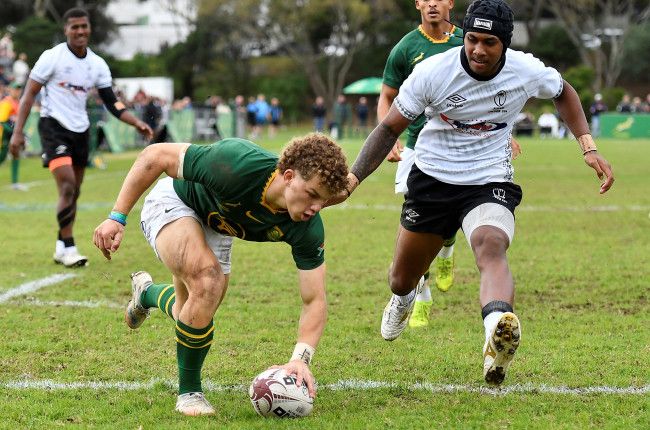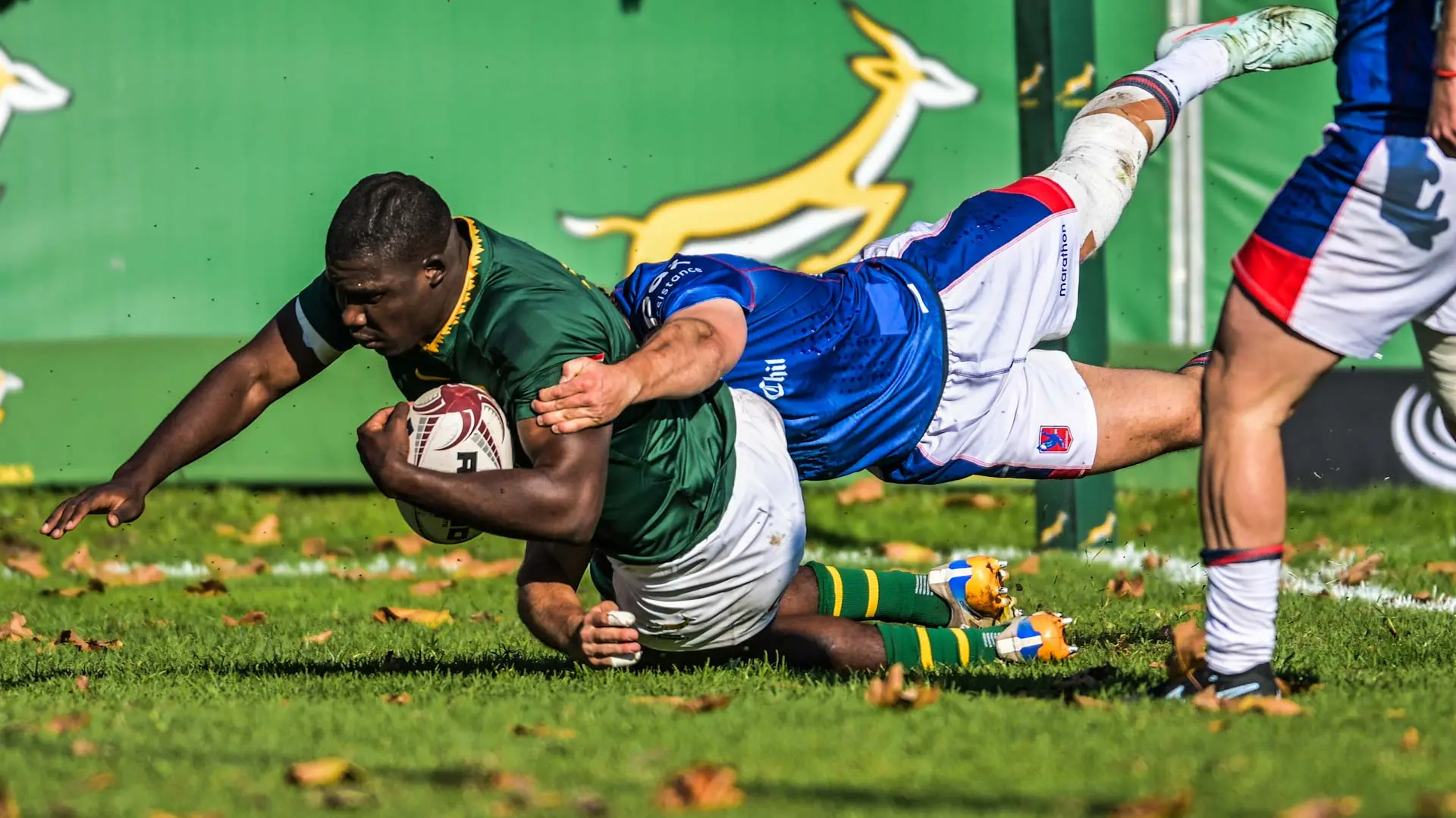
Melusi Mthethwa’s attacking vision came to life as the Junior Springboks showcased a free-flowing offensive masterclass in their 97-0 demolition of Chile
Attack is like water flowing. It finds the space and flows into it with force. That’s the philosophy Melusi Mthethwa, the Junior Springboks’ assistant coach in charge of attack, has instilled in this Baby Boks side. On Thursday afternoon at Rondebosch, Chile discovered exactly what happens when that philosophy meets execution, a 97 point torrent that washed away any resistance.
The U20 international series opener wasn’t just about the scoreline. It was a 80-minute showcase of rugby’s most fundamental principle: find space, exploit space, score points.
Water finds its path
Within five minutes, the floodgates opened. Alzeadon Felix spotted space from a quick tap penalty, setting the attacking currents in motion. The ball flowed through Felix to Lindsey Jansen before Jayden Brits surged through to score. Simple. Clinical. Devastating.
It was the first trickle that would become a deluge.
Mthethwa’s philosophy isn’t about forcing the issue or battering away at defensive walls. It’s about reading the landscape, identifying where the gaps exist, and flooding into those spaces with numbers and pace. Against Chile, those gaps appeared everywhere, wide channels, tight corridors, midfield seams, and the Baby Boks exploited every single one.
The beauty of water is its adaptability. It doesn’t fight obstacles, it flows around them. When Chile compressed their defence, the Baby Boks went wide. When they spread out to cover the edges, the forwards punched through the middle. When they kicked for territory, the back three counter-attacked with devastating effect.
Creating the current
For water to flow with force, it needs pressure. The Baby Boks generated that pressure through their forward dominance, with flanker Gert Kemp leading the charge. His bruising carries consistently put the South Africans on the front foot, creating the momentum that turned possession into points.
The clinical work at the breakdown from the entire forward pack ensured quick ball, the lifeblood of any attacking system. Fast ruck ball meant the backs had time and space to operate, defenders were caught on the back foot, and attacking options multiplied exponentially.
This is where Mthethwa’s philosophy truly came alive. Quick ball created opportunities. The Baby Boks didn’t force plays, they simply identified where the space was and flowed into it. Sometimes that meant captain Risima Khosa providing the extra man on the edges to put wingers away. Other times it meant the skipper himself exploiting gaps, which he did three times en route to a hat-trick.
The back three: Rivers in full flow
If the forwards created the pressure, the back three of Felix, Jansen and Muller were the rivers that carved through Chile’s landscape. Exceptional on the edges and lethal on the counter-attack, this trio embodied the water philosophy perfectly.
Chile’s struggled to get on the front foot which forced them to kick for territory. Every kick became an invitation to counter-attack, and the Baby Boks accepted eagerly.
Felix, Jansen and Muller fielded the ball with confidence, identified space with precision, and attacked it with pace.
The halftime torrent
By halftime, the scoreboard read 52-0, and Chile were drowning. Gert Kemp finally got his reward on the stroke of the break, bursting through tackles to score. It was a fitting end to a half that had seen the attacking philosophy executed to near-perfection.
Every time Chile attempted to stem the flow, another gap appeared. They plugged one leak only to spring another. The Baby Boks’ ability to identify and exploit space from anywhere on the pitch meant there was no respite, no safe zone, no opportunity to regroup.
Fresh energy, same flow
After the break, the introduction of Rabe and Kai Pratt brought fresh legs without disrupting the flow. If anything, the grunt up front became more prominent as the match wore on, with the Baby Boks scoring multiple maul tries in the second half.
The tempo didn’t wane because the philosophy remained constant. New players entered the system, understood their roles within the attacking framework, and executed. The water kept flowing, kept finding space, kept applying force.
Rabe’s brace demonstrated how deeply the attacking principles had been embedded across the entire squad. This wasn’t about individual brilliance overriding a system; it was about 23 players buying into a philosophy and executing it collectively.
Philosophy meets reality
By fulltime, the 97-0 scoreline represented more than just a lopsided victory. It was validation of an attacking philosophy that prioritises reading the game, identifying opportunities, and exploiting them with pace and precision.
Mthethwa’s water analogy isn’t just catchy rhetoric; it’s a fundamental imagining of how attacking rugby should be coached and played. Don’t force the ball into contact unnecessarily. Don’t bash away at walls. Instead, scan the defensive landscape, find the cracks, and flood through them before defenders can reorganise.
Against Chile, the Baby Boks demonstrated what happens when that philosophy meets quality execution and superior skill levels. The result was a free-flowing attacking display that will serve as a blueprint for what this side can achieve.
The Junior Springboks face Fiji on 26 May at Wynberg.
Elsewhere in the U20 international series, Georgia edged Fiji 29-23 in a far tighter contest.