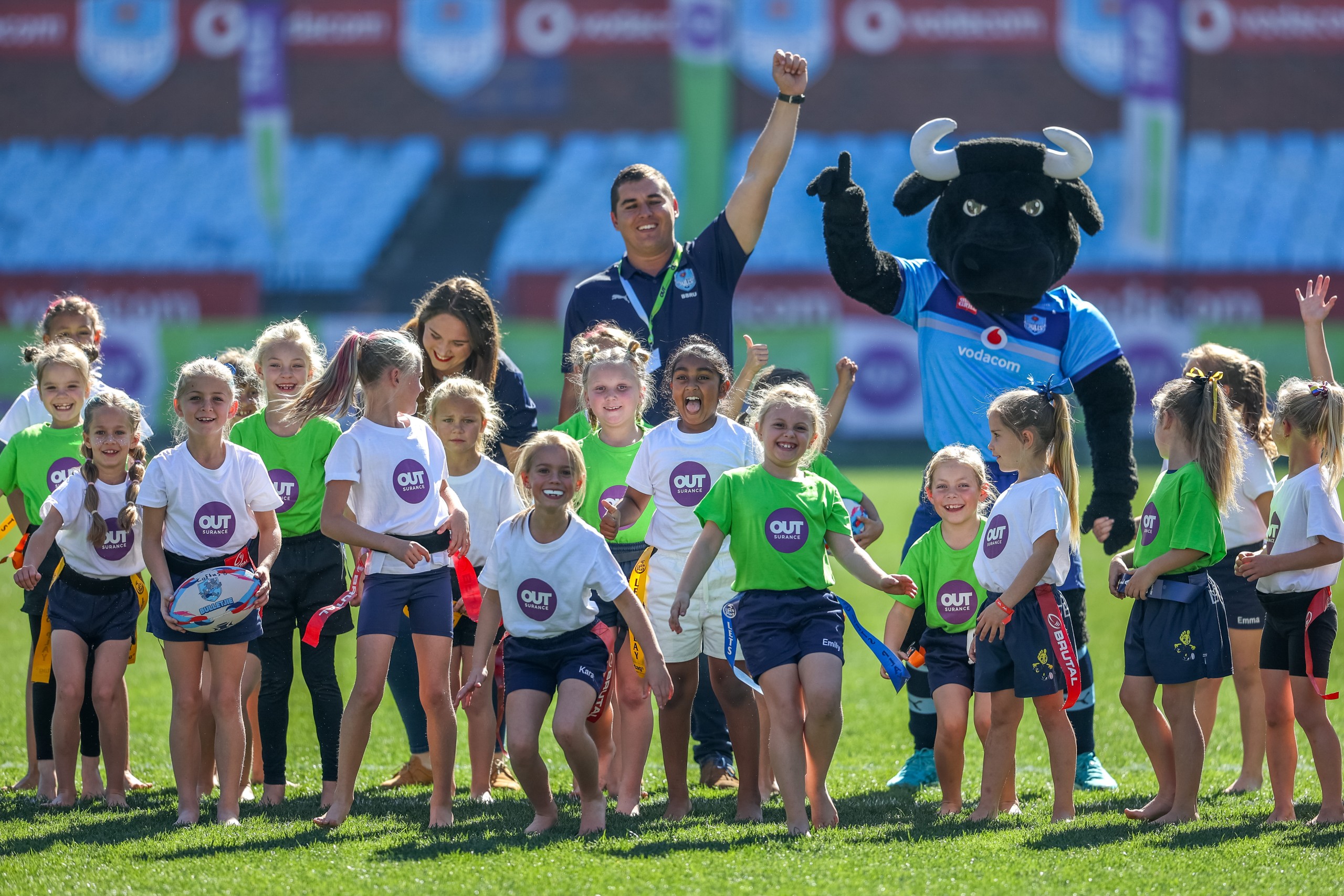
Thirty girls ran onto Loftus Versfeld on Saturday, 13 June, changeing the course of Blue Bulls rugby history. For the first time in 33 years of Bulletjie rugby, young girls had their own dedicated matches at the iconic stadium, a watershed moment disguised as a mini-rugby festival.
It’s a revolution wrapped in oversized rugby jerseys.
Whilst 5,673 youngsters from 82 schools across the Blue Bulls region descended on Loftus for one of South Africa’s largest mini-rugby festivals, the biggest story isn’t the staggering numbers. It’s the 30 trailblazers who’ll prove what Esjé Esterhuyse, Chairperson of Blue Bulls Bulletjie Rugby, has witnessed for years on pitches across the region.
Girls belong on the rugby field. And they’re damn good at it.
The spark that lit the fire
Esterhuyse’s motivation came from observation, not ideology. Year after year at Bulletjie festivals, he spotted the same pattern, one or two girls scattered amongst the boys’ teams, matching them stride for stride.
“For years I noticed one or two girls in many Bulletjie teams,” Esterhuyse explains. “These girls consistently matched the boys in skill, commitment and passion. The question became: if they can compete with the boys, why not provide a platform where they can also play against other girls?
“When I became chairperson, I wanted to introduce something new and create opportunities that would benefit the next generation of players. This initiative gives young girls the chance to showcase their talent and enjoy rugby alongside their peers.”
Saturday’s inaugural girls-only fixture planted that flag.
The numbers tell their own story
The scale of Loftus Bulletjie Day 2026 beggars belief. Across 26 mini-fields scattered around the hallowed Loftus Versfeld turf, 537 teams played 457 matches throughout the day. That’s 165 Under-6 teams, 188 Under-7 teams, and 184 Under-8 teams creating organised chaos in the best possible way.
For many of these 5,673 youngsters, it was their first experience of organised rugby. The first time wearing a proper jersey. The first try scored. The first tackle made. The first post-match orange quarters shared with teammates who’ll become lifelong friends.
It’s grassroots rugby on an industrial scale, yet somehow retaining the intimacy and magic that makes mini-rugby special.
Three decades of development
Blue Bulls Bulletjie Rugby didn’t arrive overnight. The programme launched in 1993 with a straightforward mission, introduce young children to rugby in a safe, enjoyable, development-focused environment. No league tables. No relegation battles. Just kids discovering whether rugby speaks to them.
The first Bulletjie Day at Loftus Versfeld followed in 1996. What started with approximately 1,500 players has mushroomed into one of South Africa’s largest mini-rugby programmes. Tens of thousands of youngsters have come through the system over 33 years, many progressing to Craven Week, provincial rugby, and beyond.
But the real success isn’t measured in future Springboks produced. It’s in the thousands who played Bulletjie rugby, loved it for a few years, then moved on to other sports or pursuits, carrying with them the values, friendships, and memories forged on mini-rugby pitches.
2026 celebrates 33 years of that development philosophy. And introduces the missing piece that should have been there all along.
Building towards 2027 and beyond
The response to the girls’ initiative has exceeded expectations. Schools and parents submitted additional enquiries as the event approached, desperate to get daughters involved. Thirty participants is just the beginning.
“The response from schools and parents has been extremely positive,” says Esterhuyse. “We received additional enquiries as the event approached. The goal for 2027 is to grow participation from 30 girls to at least 60 girls.
“The long-term vision is to establish a dedicated girls’ mini-rugby festival within Loftus Bulletjie Day, with multiple fixtures throughout the day.”
The people behind the passion
Events of this magnitude don’t materialise through magic. Esterhuyse pays tribute to the infrastructure that makes Loftus Bulletjie Day possible – schools, coaches, teachers, parents, volunteers, and sponsors who commit time, energy, and resources.
Special recognition goes to the Bulletjie management team – Boitumelo Pooe, Jean Gouws, Aldrigh Botha, and Jamie Maddocks – whose year-round commitment creates opportunities for thousands of young players.
But the real stars took the field on Saturday morning.
“A special thank you goes to the players themselves,” Esterhuyse emphasises. “Their passion, excitement and love for rugby are what make Loftus Bulletjie Day such a special occasion.”