When Stellenberg toppled Paarl Gim this past weekend, it was the thunderous arrival of a 20-year project that’s been simmering in the Northern Suburbs. The Rugby Factory’s latest episode captured the seismic shift reverberating through South African schoolboy rugby, where traditional hierarchies are crumbling and the gap between the elite and the ambitious is narrowing faster than a wing sprinting for the corner flag.
Host Andy Daniel didn’t just chronicle results , he excavated the stories behind them, sitting down with the architects of Stellenberg’s historic upset, Affies’ championship-calibre programme, and Wynberg’s refusal to accept mediocrity. What emerged was a masterclass in modern schoolboy rugby: ruthlessly competitive, strategically sophisticated, and evolving at breakneck speed.
The 20-year siege finally breached
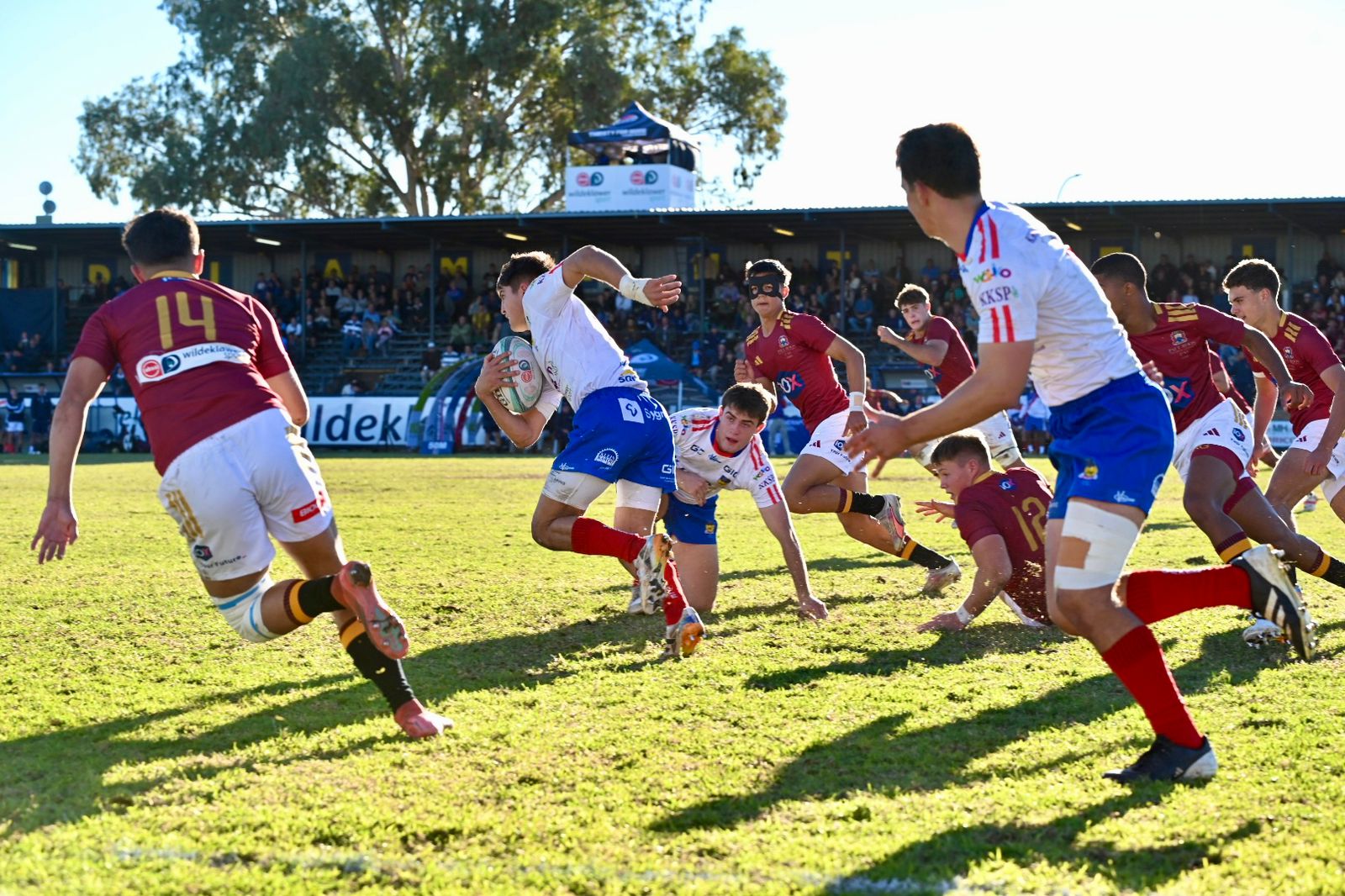
Stellenberg’s victory over Paarl Gim wasn’t an upset , it was an earthquake. For Stellenberg’s head coach Divan Batt and head of sport Andras Molnar, Saturday’s triumph represented the culmination of two decades spent building something capable of toppling the Boland giants.
“It’s been coming for 20 years, the last 15 years we’ve planned to get the rugby at Stellenberg to a place where we can compete with schools like the Paarl Gims,” Batt revealed, his words carrying the weight of countless training sessions, recruitment battles, and near-misses. “As a coaching staff it is something we have worked hard for. The expectation is now so much that we do it again and again. It’s a good start but it’s history.”
The irony wasn’t lost on Molnar. Stellenberg’s own catchment area regularly sees talent bypass their gates for the Paarl schools. “We know the talent pool that sits in the primary schools in our area. Often the strongest kids will drive passed Stellenberg to go to the Paarl schools,” Molnar admitted with remarkable candour. “We had a laugh on Saturday morning about how it’s a home game for Paarl Gim, with all the learners from this side from the Northern Suburbs.”
But Saturday proved that stars aren’t everything , systems are. Batt emphasized the collective nature of their breakthrough, pointing beyond captain Ethan van Biljon to defensive general Juvan Burden and a squad built on cohesion rather than individual brilliance. “It’s not just Ethan leading the team, defensively we have Juvan Burden almost captaining the defence. So now it’s about where we go from here and not just being a one hit wonder.”
The foundation wasn’t laid overnight. Stellenberg have spent four years in the Western Province Premier A league, but their exposure to elite competition stretches back nearly a decade. “Before that we still played all the English schools, we played a season opener against Paarl Gim, we played Boland Landbou, we played in the same tournaments where we played against Affies,” Molnar explained. “So our boys have been exposed to these teams for the last 8-9 years. Maybe for the public it’s something different but what I think you are seeing is the belief is more there to start beating these teams.”
Belief forged in the fire of repeated exposure.
Affies: Where fine margins define greatness
While Stellenberg celebrated breaking through, Affies remain the benchmark, the programme others measure themselves against. Head of rugby Ruan Jacobs knows that operating at this altitude means living with razor-thin margins between perfection and frustration.
An undefeated 2025 season slipped through their fingers, just as it had in 2024. But Jacobs isn’t dwelling on what-ifs. “But that is life when you play against the big boys, the margins are small. Hopefully the guys who played last year, they can learn from that,” he reflected with the philosophical air of someone who’s seen countless seasons unfold.
After dispatching Waterkloof in their season opener, Affies face a pilgrimage to Paul Roos for their second fixture , exactly the kind of test Jacobs craves. “Looking at the Paul Roos game, it is a great opportunity to test our programme against one of the schools that go as deep as we do. There will be no easy games for our first team. Especially as programmes get better and better. That is how you see if you are at the races or not.”
Jacobs is acutely aware that standing still means falling behind. The arms race in SA schoolboy rugby demands constant evolution. “The resources at schoolboy level are increasing, more schools are driving very good rugby programmes. For us it keeps us on our toes. If you want to keep being the best, you are going to have to evolve in the way you coach, the way you recruit, the way you build a programme at school. Otherwise these programmes are going to go passed.”
It’s a reality unique to South African schoolboy rugby, where the intensity and sophistication would make professional setups in other countries blush. “It’s a special thing for schoolboy rugby in South Africa, I don’t think anywhere in the world they can sit and talk about it like we do,” Jacobs noted with unmistakable pride.
With seven returnees from last year’s 1st XV and a talented Under-17 group that went toe-to-toe with Grey College, beating them at their own expansive game, Affies are plotting a more balanced approach for 2026. “It is a nice mix, we were not as expansive as we wanted to be last year. This year we are more balanced, but if it isn’t broke don’t fix too much. We are Affies, there is a certain identity that comes with us, we will never go too far away from it.”
Identity matters. At schools like Affies, it’s non-negotiable.
Wynberg welcoms old boy a new coach
Dylan Frylinck didn’t make the move from Bishops to Wynberg to oversee a rebuilding project. The concept doesn’t compute in his rugby philosophy. When Andy caught up with him at the WP schools rugby day, Frylinck was unequivocal about his expectations.
“I think it’s tough to say it’s a building year, a lot of schools will use that as an excuse. In schoolboy rugby you have to go every year,” Frylinck stated with the conviction of someone allergic to excuses. “The culture that Wynberg have is massive. Big defence, huge hearts, punching very far above their weight, and always staying in the fight, has always been part of the school’s DNA, even when I was at Wynberg. I want to see if we can unlock that natural talent that these boys have got.”
Frylinck’s ambitions aren’t limited to mere competitiveness , he wants his charges improving and enjoying the journey while competing with anyone. But he’s also realistic about the shifting landscape that’s making life harder for traditional powerhouses and easier for ambitious programmes.
“The gap in schoolboy rugby is closing, parents are realizing that they don’t need to go to a specific school to make a Craven Week side. The competitive edge of everyone is huge,” Frylinck observed, identifying a trend that’s democratising SA schoolboy rugby faster than many anticipated.
It’s a phenomenon that feeds into everything Stellenberg’s Molnar described, talent no longer automatically gravitates to the established names. Programmes, coaching, culture, and opportunity matter just as much as tradition.
The Rugby Factory episode also featured the D&A breakdown, delivering Afrikaans-language analysis of the weekend’s seismic results – Stellenberg’s upset of Paarl Gim, DHS’s triumph over Michaelhouse, and Grey College’s demolition of Oakdale.
Watch all the episodes here: The Rugby Factory
What ties these stories together is the relentless upward trajectory of SA schoolboy rugby. Resources are increasing, coaching is professionalising, recruitment is intensifying, and the competitive ecosystem is becoming more ruthless than ever.