

US President Donald Trump has urged Australia to grant asylum to Iran’s women’s football team after the players refused to sing their national anthem in a show of defiance against the Islamic republic.
Writing on his Truth Social platform, Trump warned that Australia would be making a “terrible humanitarian mistake” by forcing the team to return to Iran, where they would “most likely be killed”.
“Don’t do it, Mr. Prime Minister, give ASYLUM. The US will take them if you won’t,” Trump said, addressing Australian Prime Minister Anthony Albanese directly.
The Iranian women’s team made headlines last week when they refused to sing their national anthem before an Asian Cup match, in what was widely seen as a protest against the country’s clerical regime.
Trump’s intervention comes amid escalating tensions across the Middle East, with US Secretary of State Marco Rubio accusing Iran of holding the world “hostage” through retaliatory strikes.
“I think we are all seeing right now the threat this clerical regime poses to the region and to the world. They are trying to hold the world hostage,” Rubio said.
New leadership in Iran
The crisis has deepened following the appointment of Mojtaba Khamenei as Iran’s new supreme leader, succeeding his father Ayatollah Ali Khamenei, who was killed during US-Israeli strikes.
Iran-backed Hezbollah has pledged allegiance to the new leader, with the organisation extending “warmest congratulations and blessings” whilst renewing its “pledge of loyalty”.
The Lebanese group entered the conflict a week ago by attacking Israel, further complicating an already volatile situation.
Regional diplomatic moves
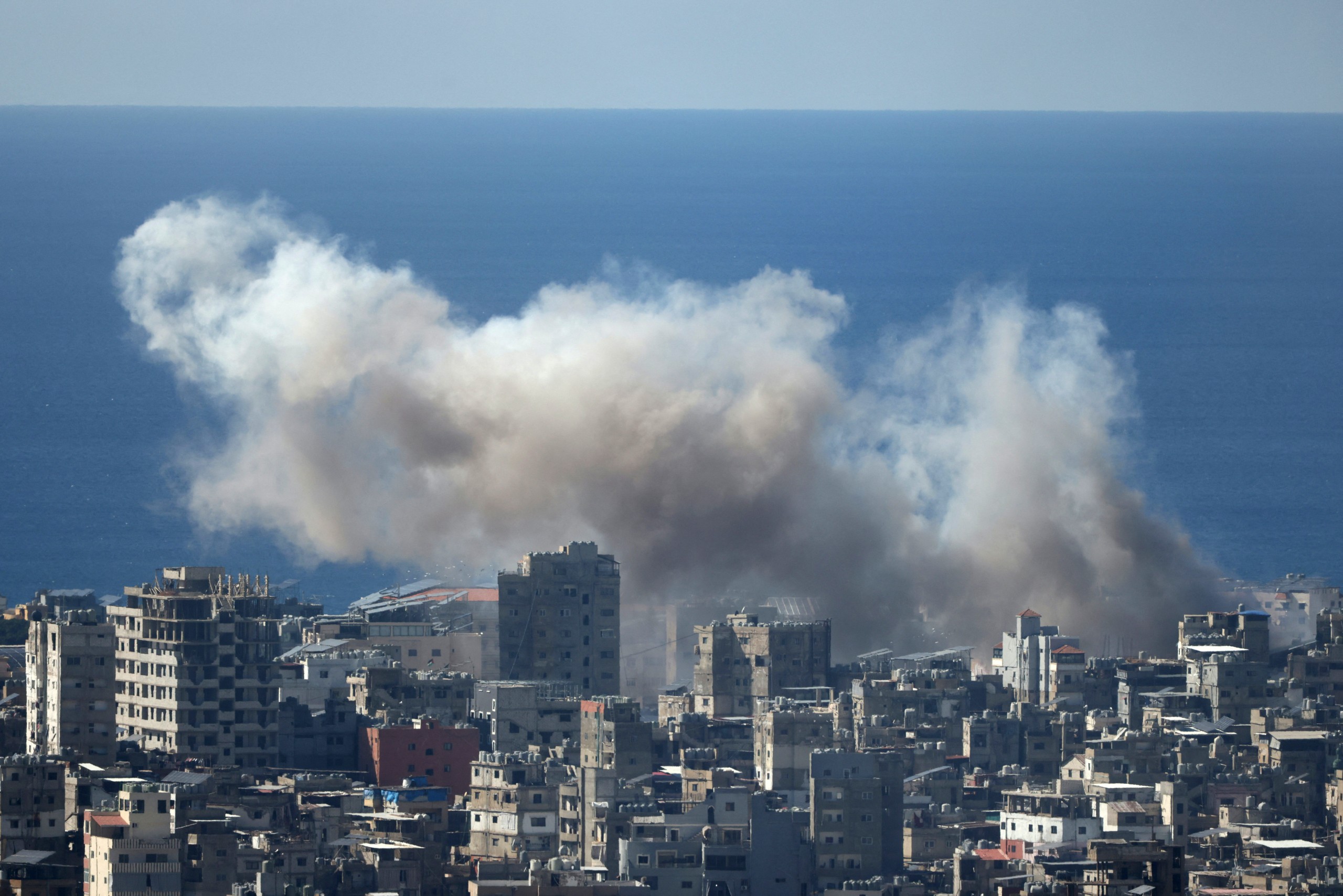
Lebanon’s president has indicated the country wants “direct negotiations” with Israel to end attacks on its territory. This comes as new airstrikes continue to hit Beirut’s southern suburbs, with large plumes of smoke visible after Israel targeted branches of a firm linked to Hezbollah.
Meanwhile, European Union leaders said the bloc was ready to “enhance” its maritime operations in the Middle East to protect shipping routes. French President Emmanuel Macron announced that France and its allies were working on a “purely defensive” mission to reopen the Strait of Hormuz, a vital shipping lane for global fuel supplies.
Global economic impact
The escalating conflict has sent shockwaves through global markets. US stocks followed European and Asian markets lower, with all three major American indices down at least 1% in opening trade.
Japan’s Nikkei index closed down more than 5% and South Korea’s Kospi fell nearly 6%. The war has driven oil and gas prices higher, with crude prices surging past $100 a barrel.
Macron said the G7 would discuss a possible release of strategic oil reserves, though French Finance Minister Roland Lescure later said the group was “not there yet” on releasing their reserves.
International military responses
NATO confirmed it intercepted a ballistic missile fired from Iran in Turkish airspace, the second such incident in five days. Some fragments fell in open territory in the southern Gaziantep area but caused no injuries.
Ukrainian President Volodymyr Zelensky revealed that 11 countries have approached Kyiv for assistance on countering Iranian drones, which Tehran has been launching across the Middle East. Ukraine has developed world-class drone defence capabilities whilst defending against nightly Russian attacks using Iran-style weapons.
In Iraq, an airstrike hit a base belonging to the Hashed al-Shaabi coalition in northern Iraq. Officials from the former paramilitary alliance, which includes pro-Iran factions, blamed the United States for the strike near Mosul, though no casualties were reported.
Public support in Tehran
Despite the international pressure, thousands gathered in a central Tehran square to show support for the new Ayatollah Mojtaba Khamenei, demonstrating continued backing for the regime amongst some segments of the population.
The developments mark a significant escalation in Middle East tensions, with implications stretching from sports and human rights to global economics and international security.

