

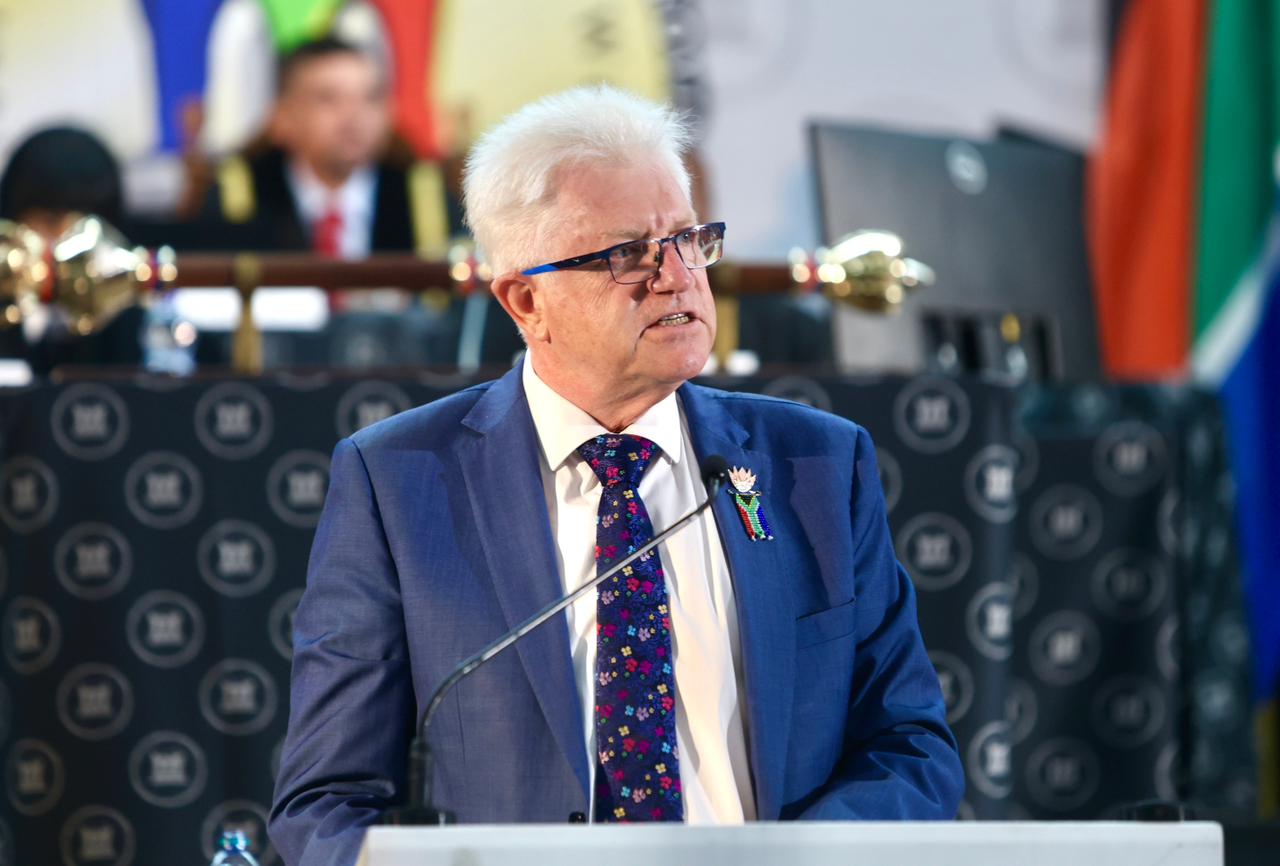
GEORGE – At the tip of Africa, there is a place where nearly nine out of every ten new jobs created in South Africa over the past five years are born. That place is the Western Cape, and Premier Alan Winde used his 2026 State of the Province address – delivered in George – to paint a picture of a province pulling away from the national pack, while sounding an urgent alarm about crime, crumbling national police infrastructure, and the looming threat of Foot-and-Mouth Disease.
The economy: A province apart
The headline numbers are striking. Western Cape unemployment now sits at 18.1%, the lowest in the country and less than half the national rate of 31.4%. Of the 404 712 net jobs created nationally over the past five years, 360 347 originated in this province. In the last quarter alone, 93 000 new jobs were recorded.
Winde pointed to 48 000 new jobs in trade and hospitality, 22 000 each in agriculture and construction, and 13 000 in manufacturing – painting each statistic in grassroots terms: the grape picker in Worcester buying herself a new dress, the carpenter in Hermanus putting down a deposit on a home.
Small business growth underscored the broader story. Since 2022, the number of small businesses grew by 143 119 – a 55% increase compared to only 18% nationally.
Exports have surged 49% over three years, from R43.1 billion to R64.1 billion. Building plans passed in the Western Cape reached nearly R35 billion last year, the highest in the country, ahead of Gauteng’s R28.2 billion. Investment in Cape Town’s CBD alone exceeded R9 billion, with a further R24 billion mixed-use development planned at Granger Bay.
Five major investment projects from last year’s inaugural investment summit are nearing financial close, including R600 million in green hydrogen, R1.8 billion in manufacturing, and R400 million in solar energy.
The economy: A province apart
The headline numbers were striking. Western Cape unemployment now sits at 18.1%, the lowest in the country and less than half the national rate of 31.4%. Of the 404 712 net jobs created nationally over the past five years, 360 347 originated in this province. In the last quarter alone, 93 000 new jobs were recorded.
Winde pointed to 48 000 new jobs in trade and hospitality, 22 000 each in agriculture and construction, and 13 000 in manufacturing – painting each statistic in human terms: the grape picker in Worcester buying herself a new dress, the carpenter in Hermanus putting down a deposit on a home.
Small business growth underscored the broader story. Since 2022, the number of small businesses grew by 143,119 – a 55% increase compared to only 18% nationally.
Exports have surged 49% over three years, from R43.1 billion to R64.1 billion. Building plans passed in the Western Cape reached nearly R35 billion last year, the highest in the country, ahead of Gauteng’s R28.2 billion. Investment in Cape Town’s CBD alone exceeded R9 billion, with a further R24 billion mixed-use development planned at Granger Bay.
Five major investment projects from last year’s inaugural investment summit are nearing financial close, including R600 million in green hydrogen, R1.8 billion in manufacturing, and R400 million in solar energy.
Tourism: Record skies and seas
Tourism delivered another bumper year. Cape Town International Airport recorded its busiest December ever, with over 11 million two-way passengers in 2025 and more than 200 international flights landing weekly. George Airport, meanwhile, recorded almost one million passengers – its best year yet.
The cruise economy contributed R1.8 billion to provincial GDP during the 2024/25 season, up 18%, with passenger spending rising 32%. Payment data showed Cape Town, Stellenbosch, and Plettenberg Bay accounting for 67% of all international visitor card payments nationally during December, with R500 million flowing into local businesses.
Fiscal road forward: Infrastructure, blended finance, and a R152 billion pipeline
Winde framed fiscal strategy around infrastructure-led development, with Provincial Treasury under Minister Deidré Baartman steering what he described as a “nimble” financial ship. Nearly R5 billion in government procurement flowed to women-owned businesses last year – 34% of all procurement – with close to R4 billion reaching small and medium enterprises.
The Department of Infrastructure has developed a first-of-its-kind single integrated pipeline of provincial projects valued at R152 billion, with 52 investment-ready. Blended finance – drawing private sector and foreign direct investment into public projects – is increasingly central to delivery.
Flagship road projects include the R11 billion N1 Wingfield Southern Upgrade Scheme, the R300 Ring Road, and the George Western Bypass. Over 2.27 million square metres of road are set for maintenance this year. The province is also advancing a Freight Rail Revitalisation Framework linking the Overberg to ports, with the business case presented to stakeholders this week.
Housing investment continues, with the FLISP first-time buyer subsidy programme set to triple to over 3 000 subsidies this year. Social housing projects at Leeuloop (341 units) and Founders’ Garden (up to 1 178 units) are advancing, while the Conradie Park Phase 2 will deliver 1 225 residential units.
Health infrastructure is receiving R2.4 billion over three years, including a R255 million expansion of Groote Schuur Hospital’s emergency centre, 63 new mobile clinics, and planning underway for the redevelopment of Tygerberg Hospital. Education spending stands at R1.5 billion for new schools and classrooms, with 15 schools under construction and matric pass rates reaching an all-time high of 88.2%.
Safety: Fury at SAPS, action on the ground
In one of the Premiers most stern addresses, Winde turned his fire on the South African Police Service. With over 345 murders recorded in the Western Cape in January alone, he described SAPS stations as “set up to fail” — citing the example of Kraaifontein detectives, each managing 150 dockets, sharing a single desktop computer, with no official phones or email access.
“How can it be that the SAPS VIP Protection budget is over R4 billion a year, solely to protect politicians, while the anti-gang unit’s operational budget is around R30 million?” he demanded.
The Western Cape Government, he said, contributes more annually to initiatives like the Law Enforcement Advancement Programme (LEAP) than SAPS has allocated to its Anti-Gang Unit in five years. He warned that if the acting Police Minister failed to act, the province would approach the courts to compel SAPS reform.
Provincial responses include the launch of a Gang Observatory in partnership with the Global Initiative Against Transnational Organised Crime, expansion of LEAP to 994 officers, K9 unit rollouts, and the funding of two lawyers at Mitchells Plain Police Station to strengthen conviction-ready dockets – following a successful Grassy Park pilot.
ALSO READ: Winde’s war plan – building job ecosystem while battling 12 daily murders
Climate, water, and FMD: Urgent fronts
Winde declared water security a priority equivalent to the province’s earlier battle against load-shedding. The province is on track to secure an additional 310 million cubic metres of water by 2035, with the Clanwilliam Dam wall raising set to add 69.5 million cubic metres annually. A R250 million provincial investment has leveraged billions more in municipal water infrastructure.
On Foot-and-Mouth Disease – classified as a national disaster – Winde confirmed daily JOC updates, vehicle checkpoints across 13 municipalities, 12 000 vaccines administered, and 30 000 additional doses en route. He called on national government to ensure the Western Cape receives its fair share.
Fire seasons are intensifying. The province deployed 27 helicopters and spotter planes during the season, invested over R30 million in aerial firefighting, and made arrests in connection with suspected arson in Drakenstein and Overstrand.
A call for kindness – and a coming election
Winde ended his address with a unifying appeal, urging residents toward “genuine and meaningful acts of kindness” in a world increasingly defined by division and polarisation. He also issued a pointed call ahead of local government elections: “Every vote matters.” The disparity between well-run and failing municipalities, he argued, was ultimately a leadership and ballot-box problem.
At the tip of Africa, the Premier concluded, there is a place getting to work – and getting it done.

