

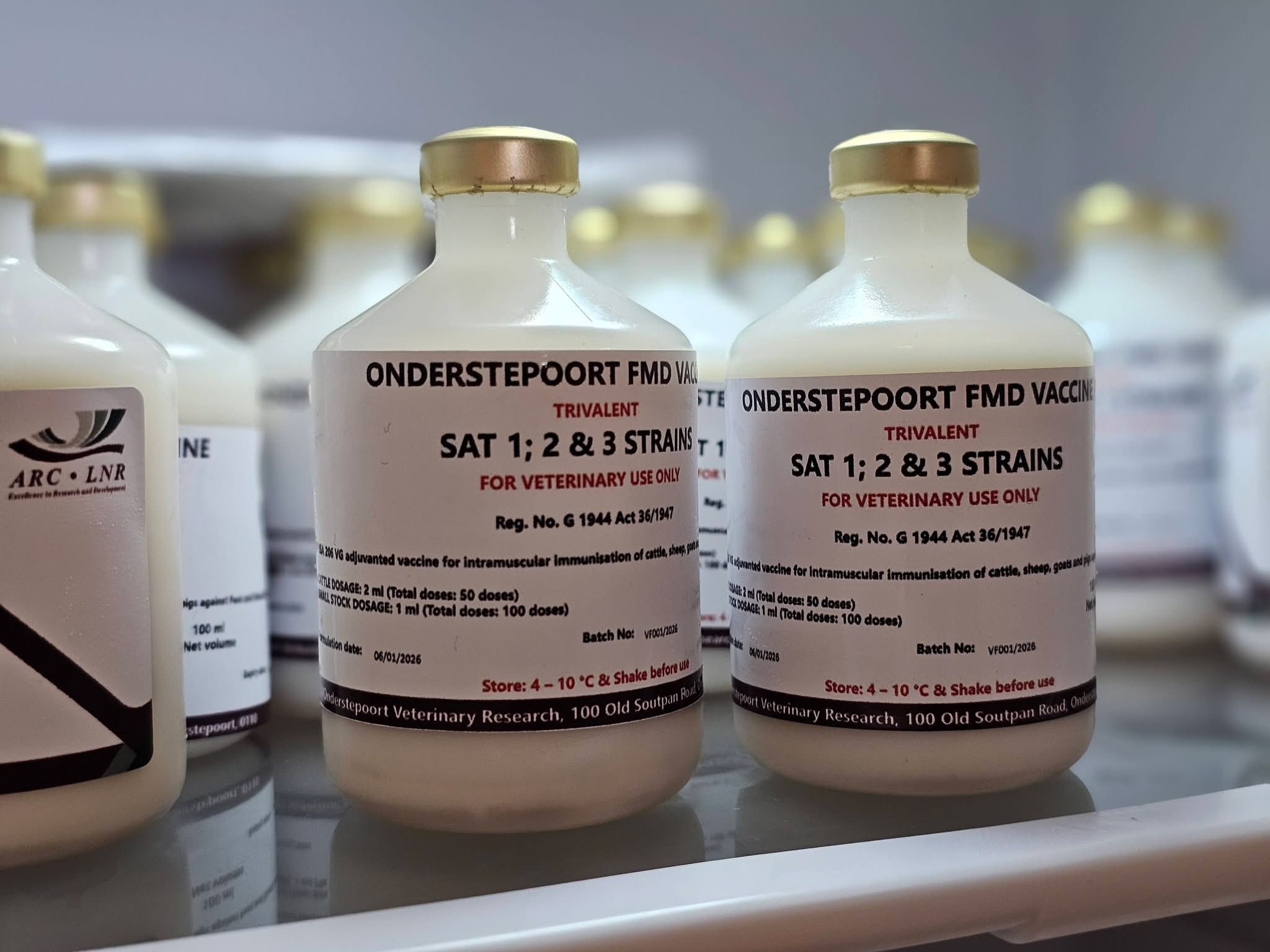
In a landmark moment for South African agriculture, the country has officially resumed local production of foot and mouth disease (FMD) vaccines, ending a 20-year reliance on foreign supplies.
The minister of Agriculture, John Steenhuisen, visited the Agricultural Research Council (ARC) Onderstepoort Veterinary Research facility on Friday 6 February to witness the finalisation of the first batch. This milestone is being hailed as the start of a “science-led war” to reclaim the country’s FMD-free status from the World Organisation for Animal Health (WOAH).
A 20-year wait ends
South Africa ceased local vaccine production in 2005 after aging infrastructure and technology fell out of sync with international Good Manufacturing Practice (GMP) standards. Since then, the country has been “chasing” outbreaks rather than preventing them.
After nearly two decades of research and modernisation, ARC scientists have successfully utilised modern bioreactor technology to produce an initial proof-of-concept batch of 12 900 doses. These vaccines are specifically designed to target regional strains, providing high potency and long-lasting immunity.
This milestone signals a shift from reactionary disease chasing to a proactive, science-led war on FMD, the Ministry of Agriculture stated.
Immediate relief for farmers
Minister Steenhuisen addressed the heavy emotional and financial toll the disease has taken on the farming community, acknowledging the “exhausting road” many have walked as they watched their livelihoods disappear.
“My department and I will stop at nothing to ensure this disease is completely eradicated,” Steenhuisen said.
“While the path to full recovery will take time… we are finally moving from defense to offense. Help is not just coming; it is here.”
Initial distribution strategy
The first batch of 12 900 doses will be deployed across six provinces:
| Province | Allocation (doses) |
| Eastern Cape | 2 600 |
| Free State | 2 300 |
| North West | 2 000 |
| Gauteng | 2 000 |
| Limpopo | 2 000 |
| Mpumalanga | 2 000 |
By March 2026, the ARC expects to scale production to 20,000 doses per week, with a target of 200,000 doses per week by 2027.
Securing the pipeline: Imports and strategy
While local production ramps up, the government is securing a “bridge” of millions of imported doses to ensure no gaps in the vaccination schedule:
- Botswana (BVI): 700 000 doses due by late February 2026.
- Turkey (Dollvet): 1,5 million doses arriving in February; 5 million in March.
- Argentina (Biogénesis Bagó): 1 million doses arriving soon; 5 million in March.
The ministry also issued a stern warning against “reckless” unregulated vaccine imports, citing serious risks already observed in KwaZulu-Natal. To regain international FMD-free status, the state must maintain centralised monitoring and prove zero virus transmission for at least 12 months.
The road ahead
The department has finalised a memorandum to declare a national state of disaster, which will be presented to the cabinet shortly. This move is expected to unlock emergency funding for mass vaccination campaigns across affected provinces.
Furthermore, local strains have been sent to the Pirbright Institute in the UK for international matching to ensure the highest scientific rigor in the ongoing rollout.

