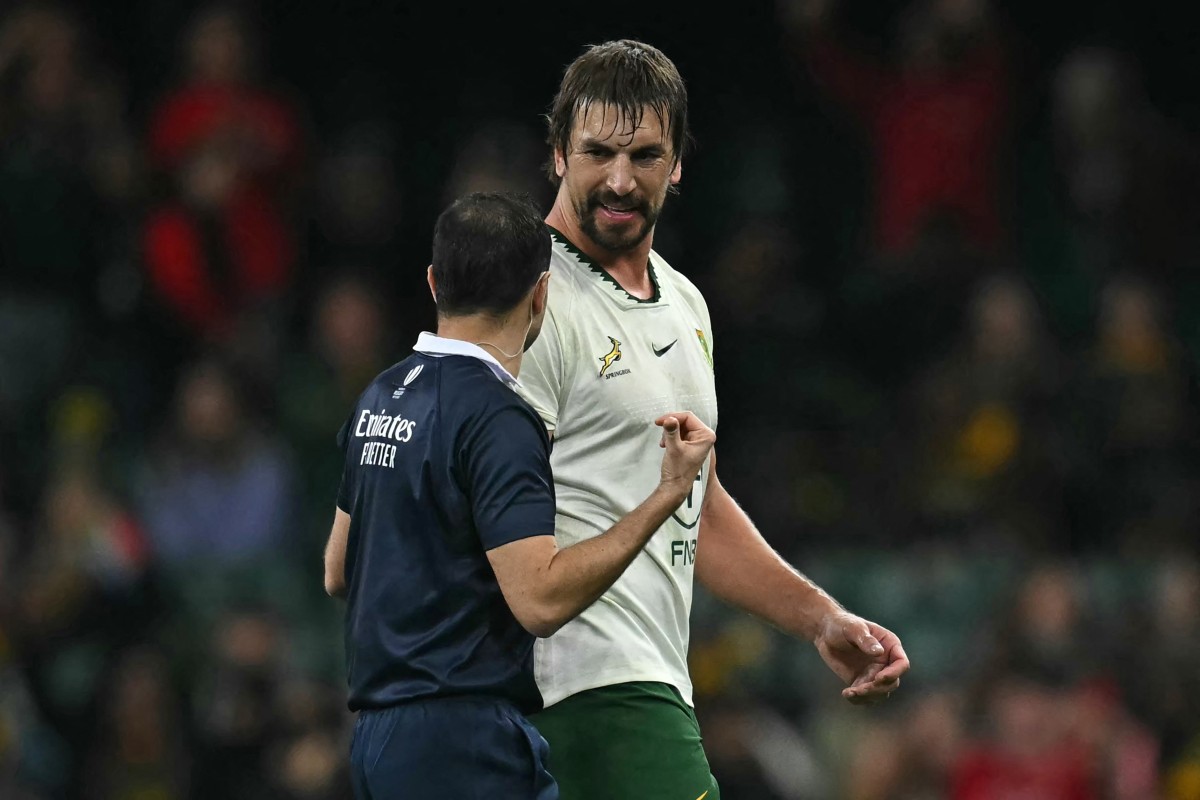
Eben Etzebeth will have to wait until Sunday 7 December to learn his fate following his red card for eye-gouging during South Africa’s 73-0 victory over Wales.
In an unusual turn of events, World Rugby’s independent disciplinary panel was unable to reach consensus on the appropriate punishment for the 141-Test Springbok lock after a marathon hearing that began Tuesday evening (2 December) and was adjourned just before midnight.
According to media reports, the panel, chaired by Christopher Quinlan KC, requested additional time to deliberate due to the complexity of the case and the significance of the decision.
The delay suggests serious disagreement among panel members regarding the severity of Etzebeth’s actions and the corresponding sanction, with World Rugby’s disciplinary guidelines offering a vast range of punishments depending on whether the offence is deemed reckless or intentional.
The 32-year-old forward received the first red card of his career in the dying moments of Saturday 29 November’s match at the Principality Stadium when referee Luc Ramos, acting on advice from TMO Eric Gauzins, determined that Etzebeth had deliberately made contact with Welsh flanker Alex Mann’s eye area during a ruck situation.
The incident was clearly captured on camera, showing Etzebeth pressing his thumb into Mann’s eye socket.
Etzebeth’s legal team argued that his actions were reckless rather than intentional, while also citing potential provocation from Mann during an earlier ruck – though Mann was cleared of any wrongdoing by match officials.
WATCH:
What the panel must consider: A complex web of factors
The severity spectrum
World Rugby’s disciplinary framework for eye-gouging presents the panel with a dramatic range of potential punishments. If deemed reckless, Etzebeth faces a minimum suspension of four weeks.
However, if the panel determines his actions were intentional, sanctions can extend up to an extraordinary four years – reflecting rugby’s absolute intolerance for such dangerous conduct.
Former Ireland referee boss Owen Doyle highlighted the gravity of the situation in his Irish Times column, stating: “Rugby cannot afford its judiciary to tread lightly on this one, there’s too much to lose.”
His commentary underscores the pressure on the panel to set a precedent that reinforces player safety above all else.
ALSO READ: WATCH | Etzebeth faces ban after red card for eye gouging
Mitigating and aggravating factors
Several factors complicate the panel’s decision-making process:
Potential mitigating factors:
- Etzebeth’s previously clean disciplinary record over his long international career;
- claims of provocation by the defense team;
- the possibility of an early guilty plea and genuine remorse; and
- his apology to Alex Mann following the incident.
Potential aggravating factors:
- the clear and deliberate nature of the contact captured on video;
- the timing of the offense in an already-decided match;
- the vulnerability of the victim in the ruck situation; and
- the need to send a strong deterrent message.
Rugby analysts are divided on the expected outcome, though most agree that substantial punishment is inevitable. Some experts have predicted a suspension ranging from 12 to 16 weeks, with potential reductions based on mitigating factors.
However, others have expressed scepticism that any ban would be sufficient given the severity and public nature of the offence.
The consensus among commentators is that the panel faces a delicate balancing act: delivering justice that reflects the seriousness of eye-gouging while considering the individual circumstances of Etzebeth’s case and his previously exemplary disciplinary record.
- Sources: The South African; Irish Times; Rugby Pass