

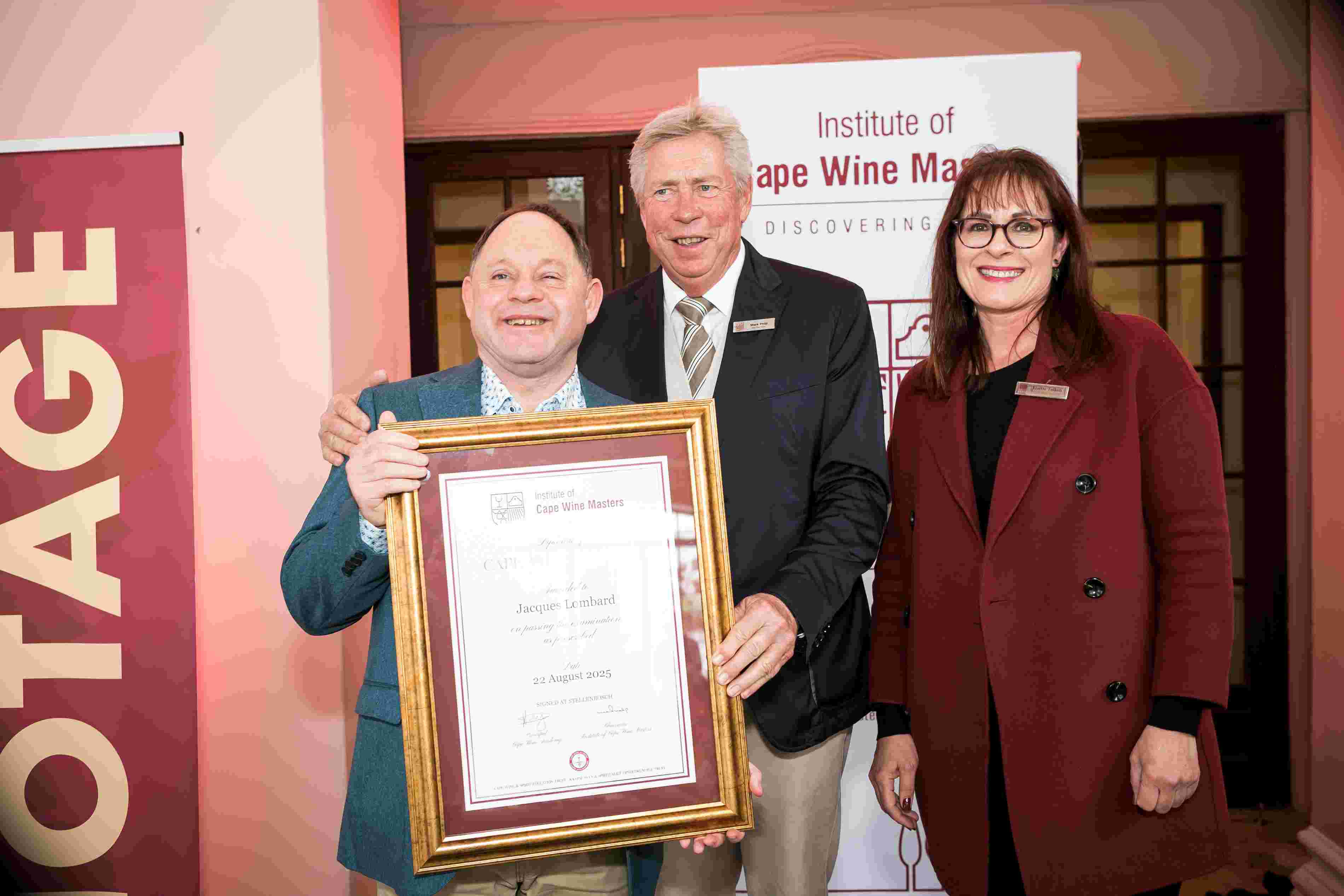
South African wine history was rewritten this year as Jacques Lombard became the first blind person to achieve the prestigious Cape Wine Master (CWM) qualification, joining three other exceptional graduates who completed the demanding five-year self-study programme.
The historic achievement was celebrated at a prestigious awards luncheon on Friday, 22 August, hosted by the Pinotage Association and Lanzerac Hotel and Spa in partnership with the Institute of Cape Wine Masters (ICWM). The event, which marked the 100th anniversary of Pinotage, brought together the four new graduates who have raised the total number of Cape Wine Masters to 120 since the programme’s inception in 1983.
Lombard’s path to becoming a Cape Wine Master is one of remarkable resilience. After losing his sight in 1996 at age 26, he discovered his passion for wine through a tasting group for visually impaired enthusiasts, founded by Hermann Kirschbaum, then winemaker at Buitenverwachting. Twenty years later, in 2016, Lombard established Winebrands Pty and pursued formal studies with distinction at the Cape Wine Academy.
His dissertation tackled a complex scientific topic – examining the formation, health effects, and mitigation of biogenic amines in wine. The research dispelled common myths about sulphites while highlighting amine compounds as a key cause of wine-related discomfort, contributing valuable insights to the wine industry’s understanding of wine chemistry and consumer health.
Joining Lombard in this year’s graduating class is Bradley Wood, a Johannesburg-based specialist urologist who dominated the awards ceremony by claiming three trophies. Wood received recognition for Sparkling Wine (presented by Villiera Wines), Viticulture (presented by Jordan Winery), and Research Paper Excellence (presented by Kleine Zalze Wines). His dissertation explored whether South Africa’s Cape South Coast offers the country’s most favourable terroir for producing quality Syrah, concluding that the region delivers distinctive, world-class expressions shaped by its cool maritime climate and unique soils.
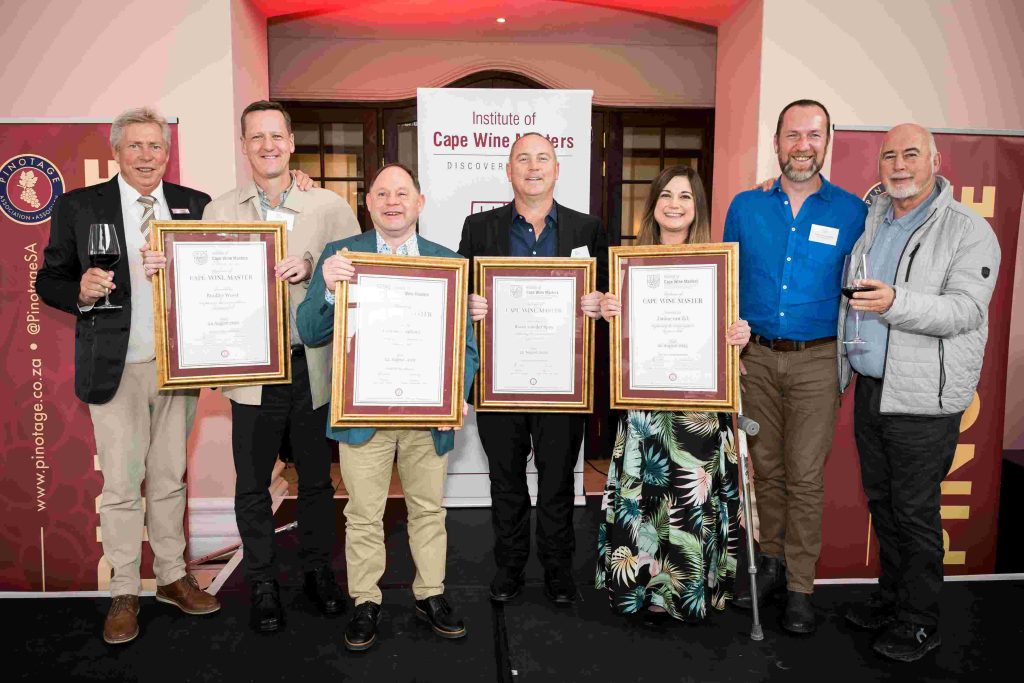
Riaan van der Spuy, cellar master at Swartland Winery, brought practical industry experience to his studies. His dissertation reviewed high-altitude viticulture internationally and in South Africa, assessing its benefits, challenges, and potential as a collective marketing strategy to enhance the country’s wine industry. His research provides valuable insights for South African producers looking to differentiate their wines in global markets.
The fourth graduate, Janine van Zyl, a sommelier and international account manager at global wine and spirits social media agency FirstPour, received the trophy for Brandy (presented by Van Ryn Brandy). Her dissertation investigated how South African wineries can harness digital marketing, social media, and influencer collaborations to strengthen brand presence, engage consumers, and drive sales – research particularly relevant in today’s digital marketplace.
The success of this year’s graduates reflects the growing strength of the CWM programme. Nine new candidates entered the programme during the past year, bringing total enrollment to 29 students – the highest figure in the programme’s history. This growth demonstrates the increasing recognition of the qualification’s value in the wine industry.
The Institute of Cape Wine Masters also announced significant honours at their annual black-tie dinner held at Beyerskloof in Stellenbosch on Saturday, 23 August. Ken Forrester, affectionately known as “Mr Chenin,” was named the 2025 Wine Personality of the Year in recognition of his extraordinary contribution to the South African wine industry and his unwavering dedication to championing Chenin Blanc.
Dr Winifred (Winnie) Bowman received the Dave Hughes Trophy for her dedication to the wine industry as an international and local judge, wine writer, and mentor in the ICWM educational sphere. The trophy, instituted in 2020 in honour of the late co-founder of the Cape Wine Academy, recognises exceptional contribution to wine education.
The Institute’s Vision 2030 programme continues to build momentum with strategic partnerships aimed at creating a more diverse wine community. Three candidates joined the development programme in 2024: Narissa Pieters (junior winemaker at Rustenberg Wine Estate), Kelsey Shungking (assistant winemaker at Mullineux & Leeu Family Wines), and Lerato Molekeki (Gauteng territory manager for Beck Family Estates).
International funding and industry partnerships are being strategically used to ensure a sustainable pipeline of qualifying candidates. The first two candidates from this initiative, Lethabo Komana and Xolani Mancotywa, have now settled into the intensive self-study programme.
Vice-Chairman Jacques Steyn highlighted the Institute’s collaboration with the Gerard Basset Foundation, describing it as crucial to building momentum in their diversity goals. “We are proud and privileged to be working with the world’s leading charitable foundation dedicated to using the wine, spirits and hospitality industries as a vehicle for change,” Steyn said.





You must be logged in to post a comment.