At a public talk on 19 August 2023 at the West Coast Fossil Park, Xavier Middleton exposed a different side to a notorious creature: the rabbit.
After digging through layers of stories, myths, perceptions and misperceptions, he finally pulled a rabbit out of the hat by getting down to earth, literally. He told us about the rabbits and hares we see today and asked what the Fossil Park fossils may tell us about how they got here.
Xavier surprised us by revealing that rabbits and hares arrived in the West Coast region just in time to be fossilised in the 5-million-year-old deposits. Their ancestors originated in Asia, where they disappeared while proliferating and differentiating in North America. Then, some 7 million years ago, with legendary rabbit rapidity they expanded their populations from North America via Asia through Africa. Today, in South Africa, we have eight species of Leporidae (the taxonomic family of rabbits and hares), namely our common Cape Hare and Scrub Hare (Lepus), four Rock Rabbits (Pronolagus), the critically endangered Riverine Rabbit (Bunolagus), and one recent arrival, the domestic European Rabbit (Oryctolagus).
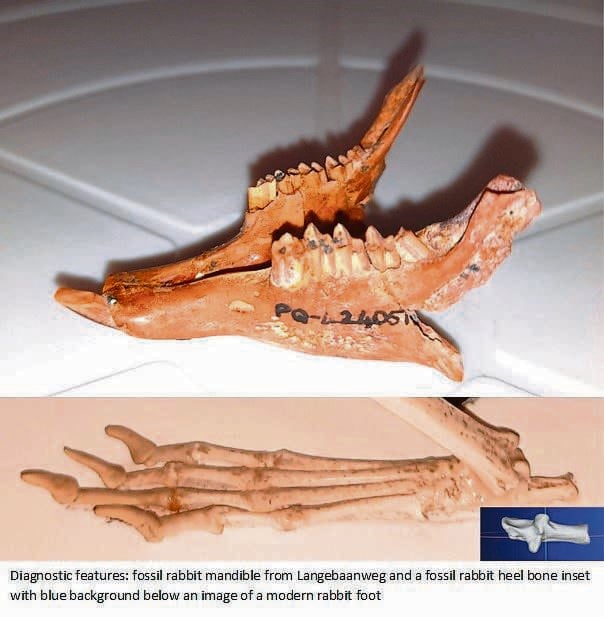
Middleton is busy examining rabbit fossils from Langebaanweg that were too tricky for their discoverer, Dr Brett Hendey, four decades ago to pin down conclusively besides indicating that they look somewhat like Pronolagus rabbits.
Rabbits are not only smaller than hares, but they also have relatively shorter ears and legs, and they feed differently. Middleton, therefore, focuses on the rabbits’ leg bones and teeth, using techniques such as geometric morphometrics (comparing shapes and sizes of bone and dental features). He intends to determine how many species there were among these fossils and how these were related to our modern species. He has already recognised some differences that could indicate that there were several species. Furthermore, he hoped the premolar teeth would reveal details of their chewing process and indicate how their diet compared with that of living rabbits and relate that to the environment of their time.
This study sets out to illuminate the past and prompt further research on our non-extinct endemic rabbit species, which we seem to know far less scientifically than the numerous and current myths and legends that have proliferated across the aeons.
For one species, the Riverine Rabbit (Bunolagus monticularis), insufficient knowledge required to improve the conservation of its populations in the face of anthropogenic pressures could push this species across the brink of extinction. Xavier Middleton intends to reveal better knowledge of long-extinct rabbits, hopefully contributing to better understanding and appreciation of living rabbits as they really are, facilitating their conservation.
. The series of interesting public talks at the WCFP will continue.