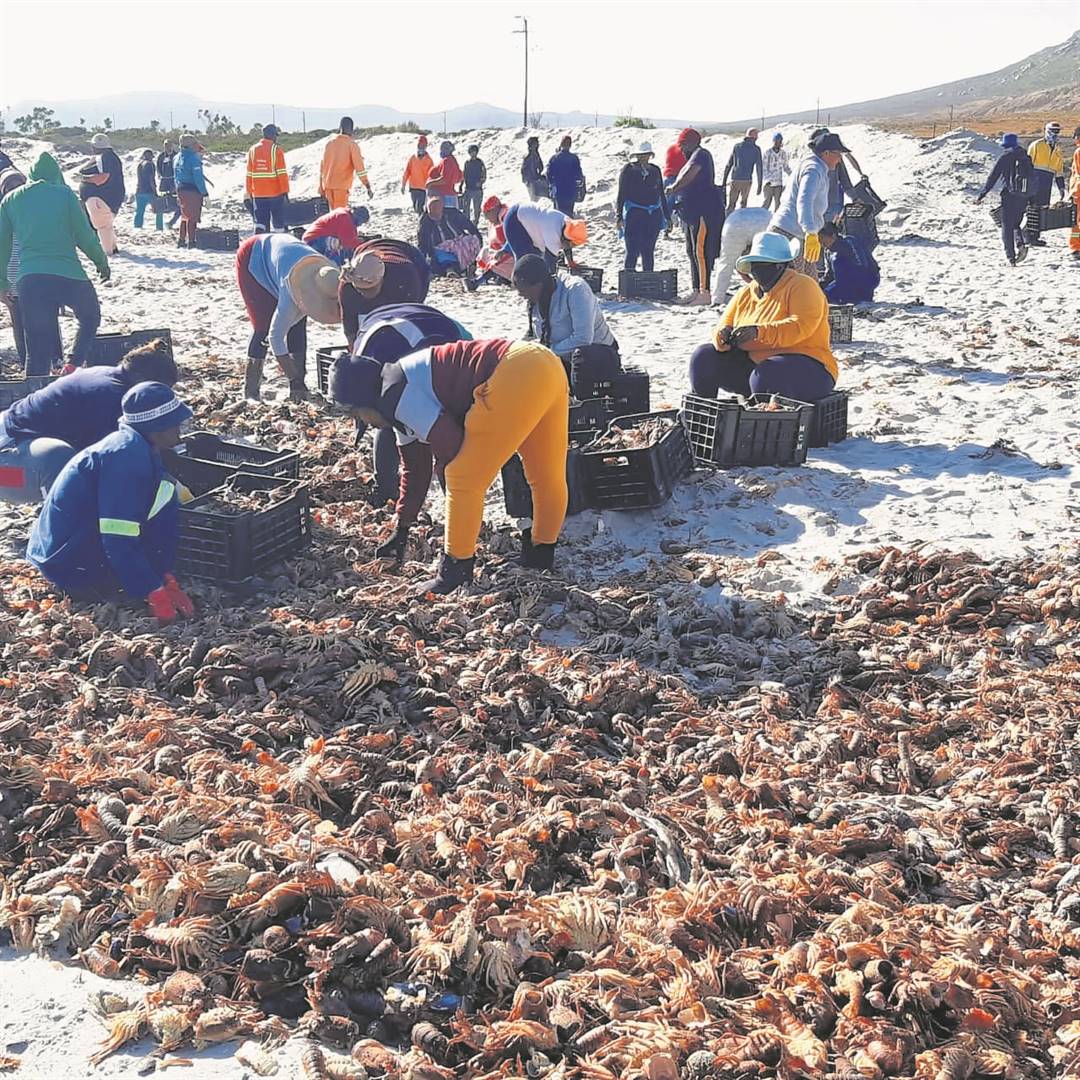
The Department of Forestry, Fisheries and the Environment has activated the West Coast Rock Lobster contingency plan and issued a situation red alert following the harmful algal bloom that has been developing.
According to the Department government role-players in the sector are on full alert and ready to deploy on short notice to activate measures.
The red tide has been developing and has led, according to the Department’s estimates, to 5 tons of West Coast Rock Lobster walking out since Tuesday 7 February.
In terms of the contingency plan, the department takes the lead, supported by the West Coast District Municipality, Cederberg Municipality, police, the SA National Defence Force, the provincial government and the local communities adjacent to the affected areas.
“Department officials, together with the local municipalities and law enforcement are working together to assist in rescuing live lobsters and with clean-up operations,” the department explained in a statement.
“The department will also work closely with the local communities in assisting with the beach clean-up and recovery of live west coast rock lobster, washed up due to the red tide. All recovered live lobster will be rehabilitated and safely returned to sea once the red tide threat has abated.”
As it is often the case in summer and late summer, there has been a build-up of large red tides in the greater St Helena Bay region over the past few weeks. These blooms of phytoplankton presently extend 50-60 km, dominating waters in the vicinity of Elands Bay, Lambert’s Bay and Doring Bay.
The department explains the blooms are dominated by a group of phytoplankton, known as dinoflagellates, and their inshore accumulation, particularly during periods of calm, often leads to their decay and the subsequent development of low oxygen conditions which cause marine mortalities.
Such mortalities were observed on the beaches of Elands Bay last week. With the prediction of light westerly winds over the next few days, the risk of further mortalities is high.
Some of these dinoflagellates are also capable of producing toxins that may accumulate in shellfish and may pose a risk to human health.
For this reason members of the public are warned not to collect and consume any dead or decayed fish and shellfish washed ashore as a result of the red tide, as this could pose a serious health hazard.