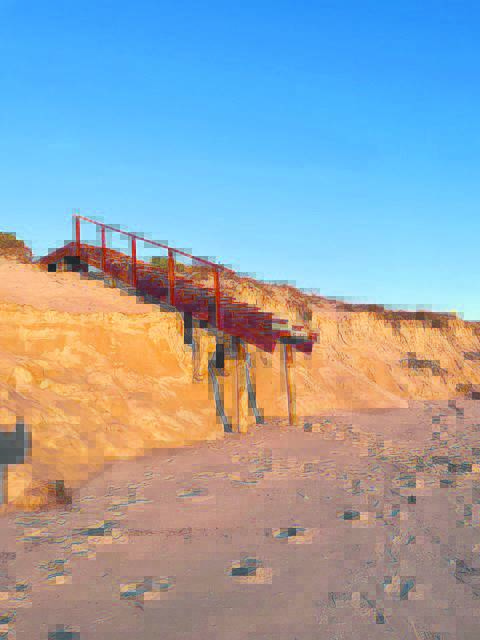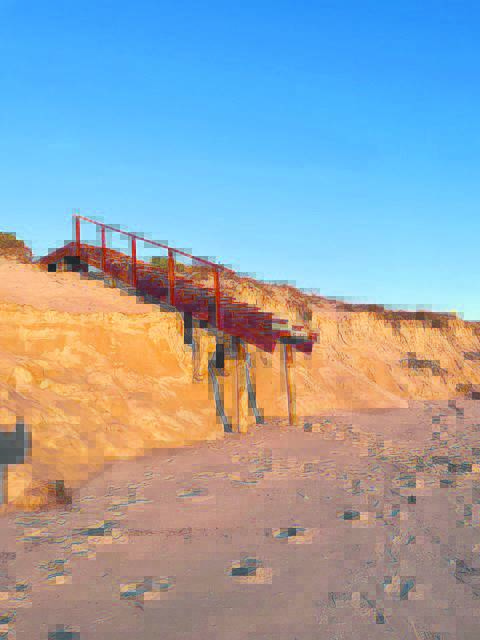
Many of the beaches in Saldanha Bay, the deepest natural harbour in South Africa, have experienced severe erosion in recent decades, to the extent that valuable infrastructure is severely threatened in some areas.
One of the main causes is the construction of the Saldanha Harbour in the 1970s, altering the tidal flow and wave patterns in the bay, altering where sediment (sand) was normally deposited and eroded.
In 1969, Saldanha Bay was chosen for an extensive iron-ore export operation. Construction of the harbour began in May 1973, and the first iron ore was loaded in September 1976.
A feasibility study was conducted, but it is unknown whether the planning process in those years included detailed studies on how the construction will impact the natural ecosystem of the Bay and the Langebaan Lagoon.
The construction of the harbour, breakwater and causeway as well as the dredging fundamentally changed the hydrodynamics of the bay.
In the past, the water flowed in a clockwise direction and deposited sand on Langebaan’s beaches, whereas now it flows anticlockwise along man-made obstacles such as the ore terminal, carrying sand from the beaches.
Recent publications indicate much of the sediment used to build the breakwater and causeway was dredged from the historic ebb-tide delta at the Langebaan Lagoon’s outflow. This is a location where lagoon sediment has accumulated over thousands of years.
The removal of sediment from this location decreased the absorption of incoming wave energy, resulting in a 50% increase in the wave energy deposited (wave height) along the Langebaan Littoral (the area along the shore). This is the leading cause of the current erosion of Langebaan’s shorelines, necessitating the construction of groynes to preserve the beaches.
Even though natural processes such as storm surges, associated seasonal weather, tides and natural sediment transport can contribute to coastal erosion, numerous studies have attributed the current erosion patterns to harbour construction and dredging activities. Regular, long-term environmental monitoring by organisations such as the Saldanha Bay Water Quality Forum Trust (SBWQFT) is crucial for identifying and enabling the effective management and mitigation of these impacts on the bay and its natural ecosystem. For instance, the construction of the breakwater has increased the number of wave-protected areas in Small Bay. The region between Bluewater Bay and the fishery facilities is one of these. This reduced wave action led to the deposition of the mud (silt) where coarser sediment (sand) had previously predominated.
In contrast, the wave exposure on some Big Bay beaches, such as Paradise Beach, Club Mykonos, Donkergat and the entrance to Langebaan Lagoon has increased, resulting in coastal erosion. Erosion at Paradise Beach and Leentjiesklip directly affects the fauna and flora of these areas and poses a hazard to coastal properties.
Inadequate provisions were also made for buffer zones along these shores, resulting in properties that are now close to the intertidal zone. In 2022, an analysis of wave height (energy discharged onto the littoral) and the trajectory of ocean surface waves revealed an increase in wave height.
The 1980s were marked by an increase in the frequency of higher waves, the maximum frequency observed in 2020.
The average energy of waves striking a coastline can be used to estimate the erosion rate of that coastline.
If waves are large and frequent the coastline will erode more quickly, whereas waves that are smaller and less frequent will result in delayed coastal erosion.
The SBWQFT makes recommendations to all local stakeholders regarding the Bay’s water quality, activities and discharges affecting the Bay’s health, water and sediment quality, and ecological indicators including benthic macrofauna, fish, birds, and seals.
On 10 November, attend the Annual State of the Bay Open Day to learn more about these issues.
In addition, the 24th State of the Bay Report will be launched, detailing data that has been carefully monitored, documented and analysed throughout the year.
To attend, email Christo van Wyk at manager@sbwqft.org.za or visit the website at sbwqft.org.za to register.
Sources: ScienceDirect, MIT News, CoastAdapt, News24 and Insider Inc, Andrew Alan Mather (doctoral degree, 2012, University of KwaZulu-Natal).