At the West Coast Fossil Park’s monthly public talk on 20 May 2023, an enthralled audience joined Dr Hayley Cawthra of the Council for Geoscience Minerals and Energy Unit on a virtual cruise across the Cape’s seafloor.
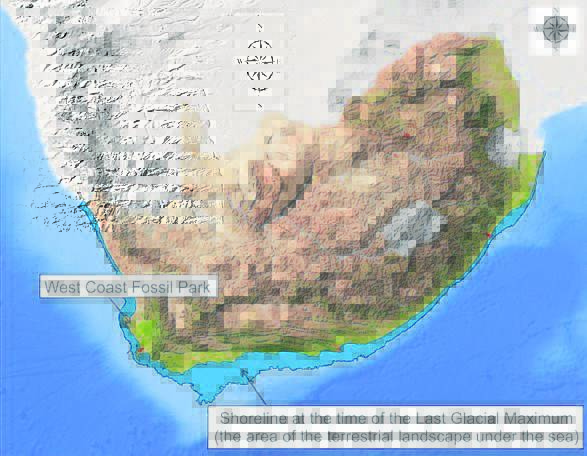
Against a background of the Western Cape Floristic Region of South Africa being a world-renowned evolutionary hotspot and the smallest, most enigmatic of the world’s six floristic Kingdoms, Hayley highlighted this region is also home to many archaeological sites in which the earliest evidence of modern human cognitive evolution has been unearthed. However, the Cape as it is seen today provides only part of these important evolutionary stories, the larger part being the flat and fertile Palaeo-Agulhas Plain, an area of 115 000 km² now submerged by the ocean. This area was a unique ecosystem unlike any existing in the world today.
During the Quaternary Period of the past 2,5 million years the earth experienced rapid and abrupt climate changes associated with sea-level fluctuations of varying duration and amplitude.
Sea levels shifted between a maximum low-stand depth of 130 m below and a maximum high-stand elevation of 13 m above the current sea level approximately every 100 000 years since 900 000 years before the present.
During the glacial ice ages in the northern hemisphere what is now the seafloor was exposed as a terrestrial landscape. A small vertical change in sea level translated to vast exposure or drowning of a low-gradient plain on the broad continental shelf of South Africa.
During the time of human occupation, the sea levels were significantly lower than at present for about 90% of the glacial period. So, understanding this shelf is critically important.
Geophysical and marine geological data sets were used to compile a geological map of the Palaeo-Agulhas Plain from the Last Glacial Maximum. These data show that Mesozoic sedimentary deposits cropped out near the surface on this current-swept shelf. The submerged landscape was a unique terrestrial environment, and the expansion of this plain was coupled with exaggerated floodplains, meandering shallowly incised rivers and wetlands and extensive calcareous dune fields. Fertile soils derived from siltstone and shale bedrock were prominent when the coast was up to 64 km distant from the modern shoreline at its maximum point.
The Palaeo-Agulhas Plain is the offshore extension of today’s Cape Coast. The presently submerged component makes up 94% of the total area of the plain, the remaining exposed remnants being the relatively slim slivers of Western Strandveld of the Fynbos Biome, a unique plain with a diverse array of endemic plants and evidence of systematic shellfish exploitation by prehistoric people. Research on this submerged landscape continues.
The next public talk in this monthly series will be at noon on the West Coast Fossil Park’s Market Day on Saturday, 17 June 2023, when Dr Joh Henschel will talk about “The brown locust refocussed – relevance to Karoo ecosystems and farming”.
. This article was adapted from text provided by Hayley Cawthra.