Residents of the Saldanha Bay Municipality have increased by nearly 31 000 since the previous census and of the 52 393 residential houses in the area, more than 17% are dwellings in “informal settlements”, notoriously high-risk areas concerning health, fire and crime.
These numbers occur in the draft budget served before the Saldanha Bay Council on Thursday 28 March.
The Western Cape government’s Informal Settlements Handbook defines informal settlements as residential areas that do not comply with local authority requirements for conventional (formal) townships.
They are, typically, unauthorised and invariably located on land that has not been proclaimed for residential use.
The Handbook also states that informal settlements tend to be characterised by inadequate infrastructure and dwellings, unsuitable environments, uncontrolled population densities and poor access to health and education facilities and employment opportunities.
According to the newest census the population in the Saldanha Bay area has increased from 129 788 to 160 725, an increase of 30 937 people.
“Informal” dwellings in the area now stands at 7 161.
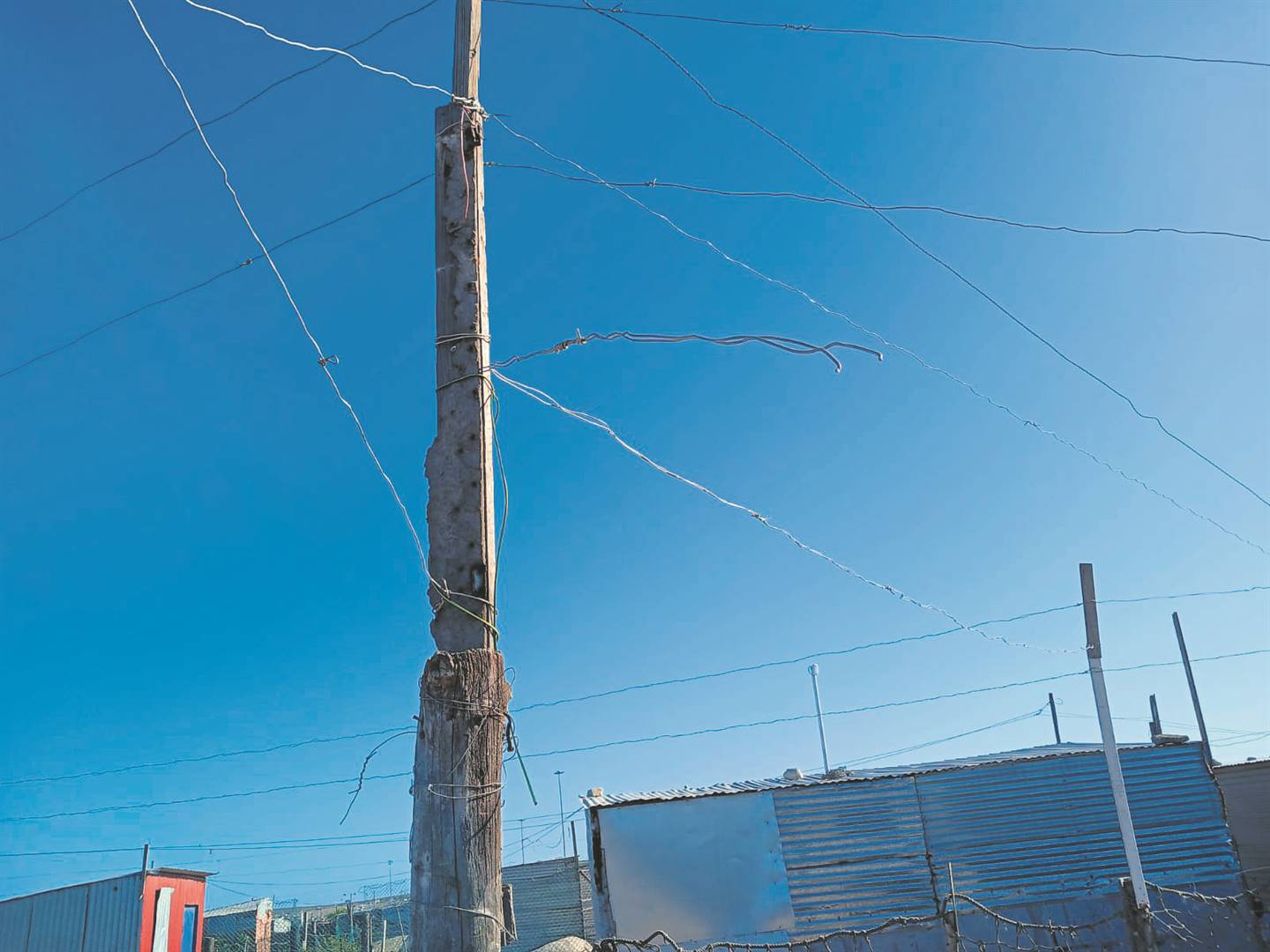
With the erection of informal dwellings outside regulated municipal neighbourhoods comes literal webs of illegally connected power cables straddling the shacks.
Some are so low a car can’t safely pass under it.
Little “Coolerbox”, as Oyintando Bathuli (4), was known to the community of Marikana, a part of the Middelpos informal settlement at Saldanha, touched one of these illegal cables and was electrocuted and died on Sunday 31 March (“Boy electrocuted”, Weslander 4 April).
Jaconeline Solomons, the woman who looked after Bathuli since he was 4 months old, said living in an informal settlement leaves one with one choice: to use these illegal power supplies or live in the dark. For single mothers and children this is a dire situation, as Bathuli’s death shows.
However, the municipality’s mandate is primarily to its ratepayers and residents living within formal town boundaries that fall under their area of jurisdiction.
According to Tereza Burger, a spokesperson for the municipality, with the support of members of the public order policing unit (POP), officials are constantly launching operations in informal settlements, as far as it is safe for municipal staff to enter, to remove illegal electrical connections.
“The municipality is committed to providing electrical supply services to formal plots. Various projects, such as currently in the Joe Slovo area in Middelpos, Saldanha, where formal plots are demarcated and provided with services, are continually planned and executed by the municipality.”
She encourages the public at all times to report illegal activities observed in their area to the South African Police Services or the municipal Law Enforcement Unit.
Solving the problem of ever-growing informal settlements around the West Coast and the unsafe illegal power connections that come with them is a complex situation.
Informal settlements are also characterised by a strong sense of community, as is seen in Bathuli’s case where his dad, Siyabonga Rolomana, as a working single parent had a network of women in the community who looked after his son when he had to go to work.
Solomons told Weslander that the unsafe cables are a huge concern for all mothers in the settlement.
“But we have to make do with what we have – and that is these unsafe illegal power connections.”