My good friend Pierre, the gentleman farmer on whose farm in the Anysberg area we occasionally test bakkies, recently bought a hybrid HiLux, having driven an Amarok for a quarter of a million kilometres.
He works around the peninsula but regularly drives to the farm, making him an excellent source for insights on how a bakkie performs in real life.
It has been three months now since Pierre purchased the bakkie. Fuel consumption has decreased and is now averaging around 9.5 L/100km (although Toyota claims 7.4 L/100 km is achievable). He has adapted to the new driving style and remains satisfied with his purchase. He reports an average consumption of 9.5 L/100km with skaaptralies and 9.1 L/100km without them. Pierre says, “The HiLux is great on gravel and nice to drive in town; even the stop/start system works very, very well. It’s not as comfortable as the Amarok on an eight-hour highway stint, though. The bakkie has more than enough power – all the power feels very usable and readily available.”
The new mild-hybrid HiLux is all about refining the ride and preparing owners for a future that offers more than just a choice between petrol or diesel. At the same time, it subtly enhances the driving experience and slightly reduces fuel consumption. A great start to the new bakkie era, it’s a bit of a tech tour de force.
Toyota has been selling HiLuxes in South Africa for 50 years (since 1968) and across eight generations. For the first time, they offer a mild hybrid option, featuring a 4.3 amp-hour, 7.6 kg lithium-ion battery. This generates power (7% more grunt) during braking or deceleration and uses the electric assist during acceleration. Turbo lag seems completely eliminated, and the bakkie feels more responsive than a standard HiLux.
The GD-6 48V is rated at 150 kW and 500 Nm, delivering more than enough power for most applications. This model features Multi-Terrain Select, enhancing performance on various off-road conditions with six settings: Sand, Mud, Rock, Dirt, Deep Snow, and Auto. For low speeds, idle speed reduces to 600 RPM, a 20% decrease. It also boasts a limited-slip differential at the rear and is equipped with 265/65R17 Dunlop Grandtreks tyres.
The electric motor-generator replaces a conventional starter motor and is always active. Drivers can set the stop/start system’s performance, choosing between NORMAL or LONG modes. In LONG mode, the engine maintains idling for extended periods when the air conditioning is running.
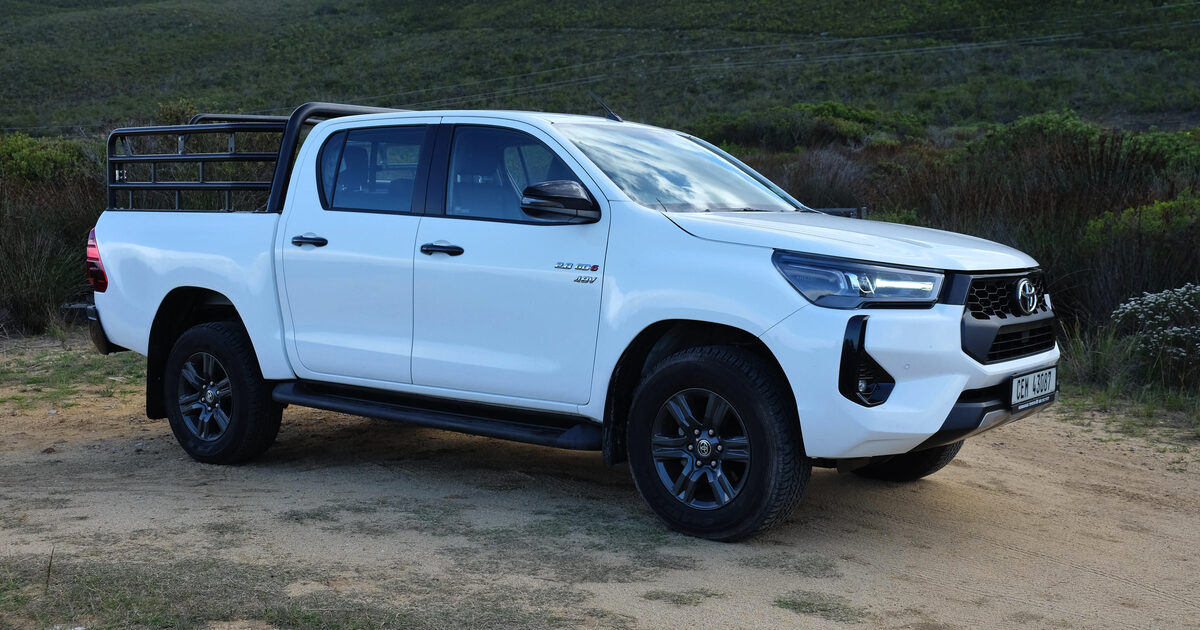
With a towing capacity of 3500 kg (braked) and 750 kg (unbraked), as well as a 700 mm wading depth, the hybrid system has not compromised the HiLux’s capabilities.
The Gen 8 HiLux includes impressive safety features such as six airbags, pre-tensioned seatbelts, EBD, ABS, stability control, trailer sway control, and park distance control.
On the inside, it feels more like an SUV. From leather-clad seats and a four-spoke multifunction leather-wrapped steering wheel to proper air conditioning with physical buttons, it prioritises comfort. It also features 220V and 12V power outlets, USB connectivity, an 8-inch touchscreen, and is Toyota Connect-enabled. The smart, comfortable ambience is complemented by numerous storage compartments.
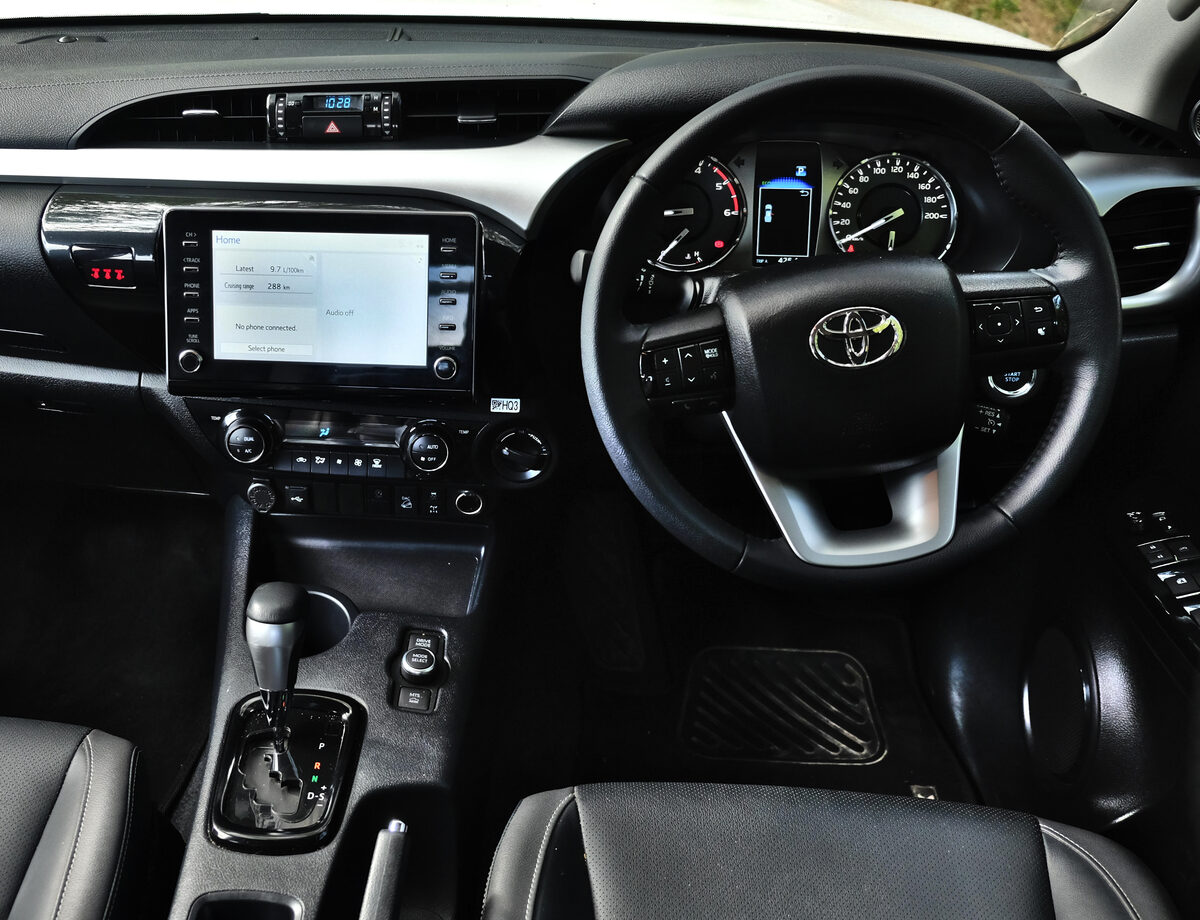
This bakkie delivers like a workhorse but drives like an SUV. Toyota’s engineers have achieved an exceptional balance of comfort, practicality, performance, and economy.
The Toyota HiLux 2.8 GD-6 48V Double Cab 4×4 Raider (as tested) retails from R876,600. It competes with big names, including the VW Amarok 2.0 BiTDI Double Cab Life 4Motion (R871,200), the D-Max 3.0TD Double Cab V-Cross (R873,300), the Ford Ranger 2.0 BiTurbo Double Cab XLT 4×4 (R888,500), and the more affordable Mitsubishi Triton 2.4D-D Double Cab Xtreme 4×4 (R849,990).
There are four models available, starting from the 4×2 Raider at R785,400 up to the 4×4 Legend at R921,800.
The bakkie comes with a 3-year/100,000 km warranty and a service plan covering nine services or 90,000 km, whichever comes first.