


NAIROBI – Kenyan men recruited under false pretences to work in Russia say they were forced to fight in Ukraine, with some suffering serious injuries and others dying in combat.
Four men who returned to Kenya described to AFP a recruitment scheme that promised well-paid civilian jobs but delivered military service on Ukrainian battlefields. Their names have been changed for security reasons.
Victor (28) shows scars on his forearm from a Ukrainian drone strike. He was told he would work as a salesman in Russia. Mark (32) and Moses (27) expected to become security guards. Erik (37) believed he had secured a position in professional sports.
All were promised between $1 000 (R16 000) and $3 000 (R48 000) monthly — substantial sums in Kenya where unemployment is high and the government promotes labour migration to increase remittances.
The men joined WhatsApp groups where other Kenyans, writing in Swahili, confirmed the opportunities were legitimate.
Victor’s first day in Russia was spent in an abandoned house three hours from St Petersburg. The following day, he arrived at a military base where soldiers presented him with a contract in Russian.
“They told us: ‘If you don’t sign, you’re dead’,” Victor said, displaying his Russian military service record and combat medallion.
Victor later encountered some WhatsApp group members in a military hospital. “Some had no legs. Some were missing an arm… They told me they were threatened with death if they wrote a negative message on the group,” he said.
Mark said new arrivals were offered the option to pay approximately $4 000 (R64 000) to return home — an impossible amount for most.
“We had no option but signing the contract,” he said.
Erik’s first day involved basketball training. He signed a contract believing it was for a professional sports club, not knowing it was a military agreement. The next day he was in an army camp.
Mark and Moses said they received minimal payment during their year of service. Victor and Erik said they received nothing.

Recruitment agency under investigation
All four men travelled to Russia through Global Face Human Resources, a Kenyan recruitment agency that advertises on its website: “Let our HR wizards connect you to exciting opportunities”.
The agency has relocated several times within Nairobi in recent months and could not be reached for comment.
One employee, Edward Gituku, faces human trafficking charges following a September police raid on an apartment he rented in the city’s outskirts. Twenty-one young men preparing to fly to Russia were found during the operation.
Gituku, who was released on bail, denies the charges, according to his lawyer Alex Kubu.
All four returnees said they met Gituku and identified him as central to the operation. Erik and Moses said Gituku drove them to Nairobi airport.
Gituku’s former lawyer, Dunston Omari, told Citizen TV in September that Global Face Human Resources had sent “more than 1 000 people” to Russia, all former Kenyan soldiers who had “voluntarily” joined the Russian army.
Around the same time, Russian citizen Mikhail Lyapin, implicated in the case, was expelled from Kenya “to stand trial in Russia” at the request of Russian authorities, Kenyan Foreign Secretary Abraham Korir Sing’Oei said.
The Russian embassy in Kenya stated in a press release that Lyapin had left Kenya voluntarily and had “never been an employee of Russian governmental bodies”. The embassy did not respond to emailed questions from AFP.
In December, Kenyan authorities said approximately 200 citizens had been sent to fight in Ukraine, with 23 since repatriated.
The four recruits said this figure underestimates the true number. One Nairobi clinic that conducted pre-departure medical examinations told AFP it saw 157 potential migrants to Russia in just over one month last year.
“The majority were former Kenyan soldiers” who knew what awaited them in Russia, said a worker at the clinic.

Whilst some former Kenyan soldiers may have knowingly accepted mercenary work, Mark and Erik, who were examined at the clinic, said they received no information about military service.
Victor and Moses attended another clinic, Universal Trends Medical and Diagnostic Centre, which declined to disclose how many individuals were referred by Global Face Human Resources.
AFP identified two additional recruitment agencies sending Kenyans to Russia but was unable to contact them.
A source close to the Russian embassy in Uganda said Festus Omwamba, founder of Global Face Human Resources, visited the facility several times last year. Omwamba did not respond to calls from AFP.
Russian casualties mount
In the early stages of its invasion of Ukraine, Russia was accused of using ethnic minorities from regions including Chechnya and Dagestan as expendable forces, deploying large numbers against Ukrainian defences.
Western intelligence services estimate Russia has suffered more than 1.2 million casualties, twice Ukraine’s losses. This has prompted Moscow to recruit from further afield.
Ukraine’s ambassador to Kenya, Yurii Tokar, said Russia initially targeted former Soviet republics in Central Asia, then India and Nepal, before approaching Africa.
The four returnees said they encountered dozens of Africans in training camps and on battlefields, including people from Nigeria, Cameroon, Egypt and South Africa.
Russia exploits the “economic desperation” of young Africans, Tokar said. “They are looking for people for cannon fodder everywhere it is possible.”
Combat experiences
Victor described conditions at the front near Vovchansk in the Donbas region.
“We had to cross two rivers, with many dead bodies floating. Then there was a big field, which was covered with hundreds of bodies. We had to run to cross it. With drones everywhere,” he said.
“The commander tells you: ‘Don’t try to escape or we shoot you’.”
Of the 27 people in his unit, two made it across the field. Victor survived by hiding under a corpse but was hit in the right forearm by drone fire.
After two more weeks of missions, during which he could not carry his weapon and maggots were crawling in his wound, he was allowed medical treatment behind the lines.
Weeks later, despite the heavy casualties, the Russian army sent Erik to the same location using the same tactics.
ALSO READ: Prominent SABC journalist appears in court over Russia-Ukraine war recruitment
Of 24 men in his operation, only three made it across the field — a Pakistani who ended up with “both legs broken”, a Russian with “his stomach ripped open”, and Erik.
The 37-year-old escaped that incident uninjured but was later hit in the arm and leg by drones.
Mark’s shoulder bears scars from a grenade launched by a Ukrainian drone whilst he was heading to the front in September. He does not know his location at the time.
All three eventually reached a Moscow hospital and escaped to the Kenyan embassy, which assisted their return home.
Moses managed to escape his unit in December and contacted Kenyan officials. Though physically uninjured, he is traumatised. A flying bird is now enough to trigger anxiety, he said.
Families affected
The men said many Kenyan families face worse outcomes.
Grace Gathoni, now a single mother of four, learned in November that her husband Martin, who planned to work as a driver in Russia, died in combat.
Moscow has “destroyed my life”, she said.
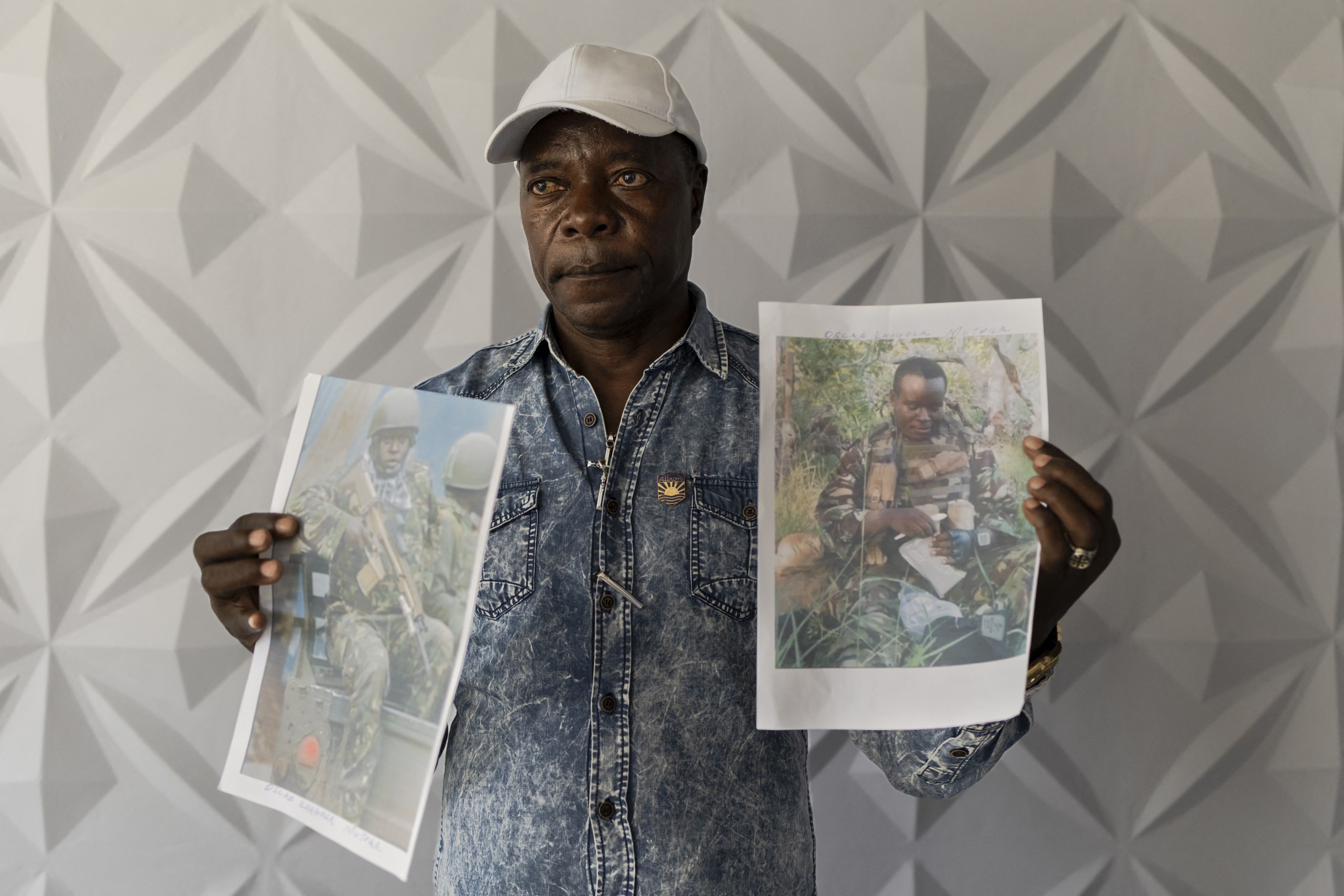
Charles Ojiambo Mutoka (72) learned in January that his son Oscar was killed in August. His remains are in Rostov-on-Don.
The Russian authorities “should be ashamed”, he said. “We only fight our own wars and we never bring Russians to fight for us… so why take our people?”
ALSO READ: Five suspects appear in court for alleged Russian military recruitment


You must be logged in to post a comment.