In the midst of today’s technological era, in which accessing information is literally at our fingertips, it is reassuring to know that people still feel the need to access and handle books, as well as share them with one another.
Fostering a love of reading leads to greater insight into and a deeper understanding of the world and those around us. Not only do our present stories shape the fabric of society, but the retelling of past narratives also strengthens the threads that build a community.
Frances Richardson, a Richmond Hill resident and retired librarian and teacher commented, and rightly so, “Having worked in all the different types of libraries the focus has always been primarily on the people who use them. It is a space that draws people.
“A place where the lonely come for company and conversation, where those that live in noisy, crowded conditions come to find a quiet spot to read or just to be, and where those who can’t afford to buy newspapers and magazines come to keep in touch with the world around them.”
Even though libraries are still in use rendering valuable services to communities, it is heartening also to see and hear of micro-libraries and small public book exchange stations, like unexpected delights, being erected across towns and cities.
Libraries don’t need to be stationary. In fact, travelling through rough terrain to get the written word to others, even with the help of animals, is the serious business of some amazing individuals and mobile libraries all over the world.
In Norway, for example, boats provide books to small communities that live on islands in the fjords. Kenya’s camel library, run by the Kenyan National Library Service, consists of nine camels ensuring that the nomadic communities in the desert have access to the written word. In rural Columbia, Luis Soriano uses his two library donkeys to bring books to thousands of children. Many of these journeys are hugely unsafe but people, like Luis Soriano, are determined and unstoppable in their resolve.
These amazing brave feats show the lengths people will go to keep the written word circulating, however improbable.
And then there are people’s personal libraries, the bookshelves that adorn our homes. People’s bookshelves are as much a reflection of them, their inner spaces, as are their homes. On our bookshelves we store the books, stories and words dear to us, that touched our hearts, that opened other worlds to us. It often is a physical manifestation of a lifelong reader’s history, not only the book-buying customs or collecting habits of the reader.
And Richmond Hill has a vast assembly of bookworms and book collections; a suburb filled with interesting residents who attach a lot of meaning to their books.
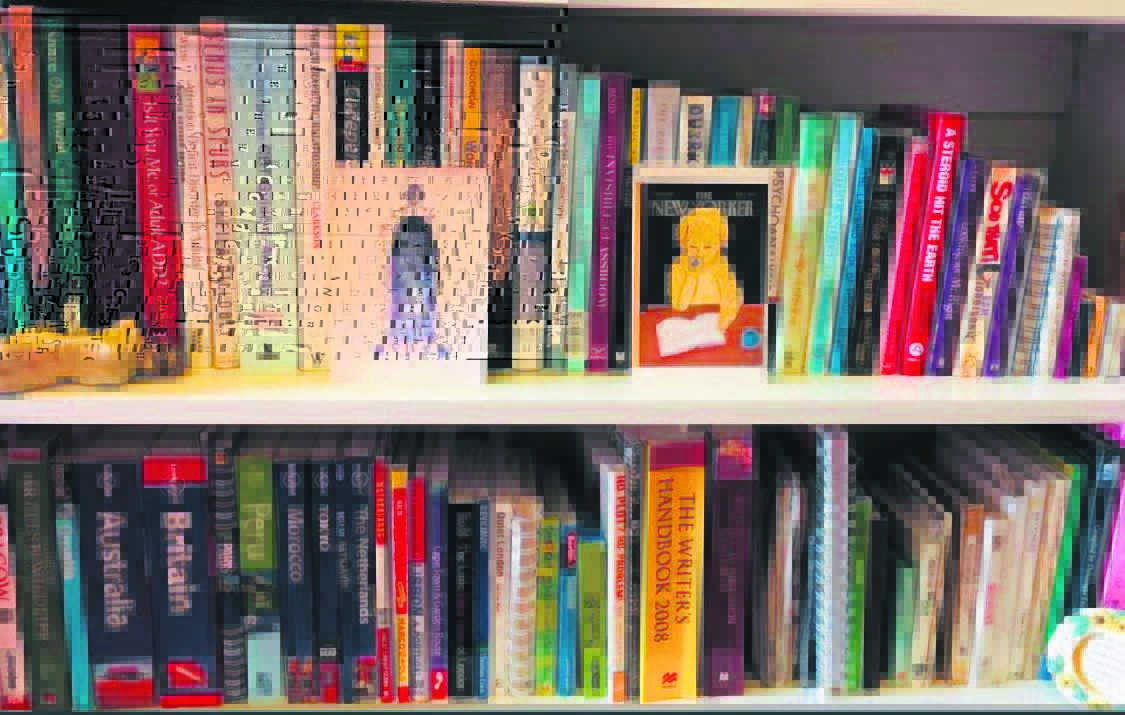
A haphazard, seemingly untidy collection of books, that some might regard as a disorganised and messy labyrinth to plough through in order to find a specific source, is often a portrayal of the creative and busy mind of the book owner.
Many individuals use their wide variety of books and dictionaries daily– be they academics, teachers, crossword puzzle addicts or researchers– which shows a close engagement with their wordy book friends.
Nicole Laws, Richmond Hill resident and Airbnb owner, said, “My shelf is a wild mix of inherited books, some from the previous house owner: German books, crime novels, spiritual books, travel books, books dealing with physical and mental health. My books allow me to dive into another world and help me to become the best version of myself. I will always prefer reading a physical book to an e-book.”
Then there are those meticulous book lovers who arrange their books methodically, with great love and care, decorating their bookshelves with knickknacks, ornaments, art and weird and wonderful bookends.
Claire Warneke, who also lives in Richmond Hill, shared her thoughts on the topic: “My sister and I were raised with a love of words, and a certain reverence for books. We were taught to look after them so carefully that I still have some of the first books I ever owned. On our bookshelves, our books are joined by various curiosities from our travels, some sentimental trinkets and antiques, and some of my favourite decorative ceramics. The bookshelf is not just a storage space. It’s a snapshot of past adventures– read and lived– and still holds a few open shelves for adventures to come.”
Be it classics, contemporary works, non-fiction, magic realism, thrillers, science fiction, dictionaries or academic works, all in all, a diverse and well-stocked bookshelf is a reflection of a well-rounded person.
Libraries (in whichever form they might present themselves), books and stories allow us to see life through the eyes of others; they empower us also to tell our own stories and foster local communities, characterised by a collection of diverse narratives.
In today’s world with its focus on speed, efficiency and social networking, opening a book that a friend recommended, turning its physical pages and losing yourself in someone else’s words, still is a timeless and worthwhile, wholly sensory, experience.