

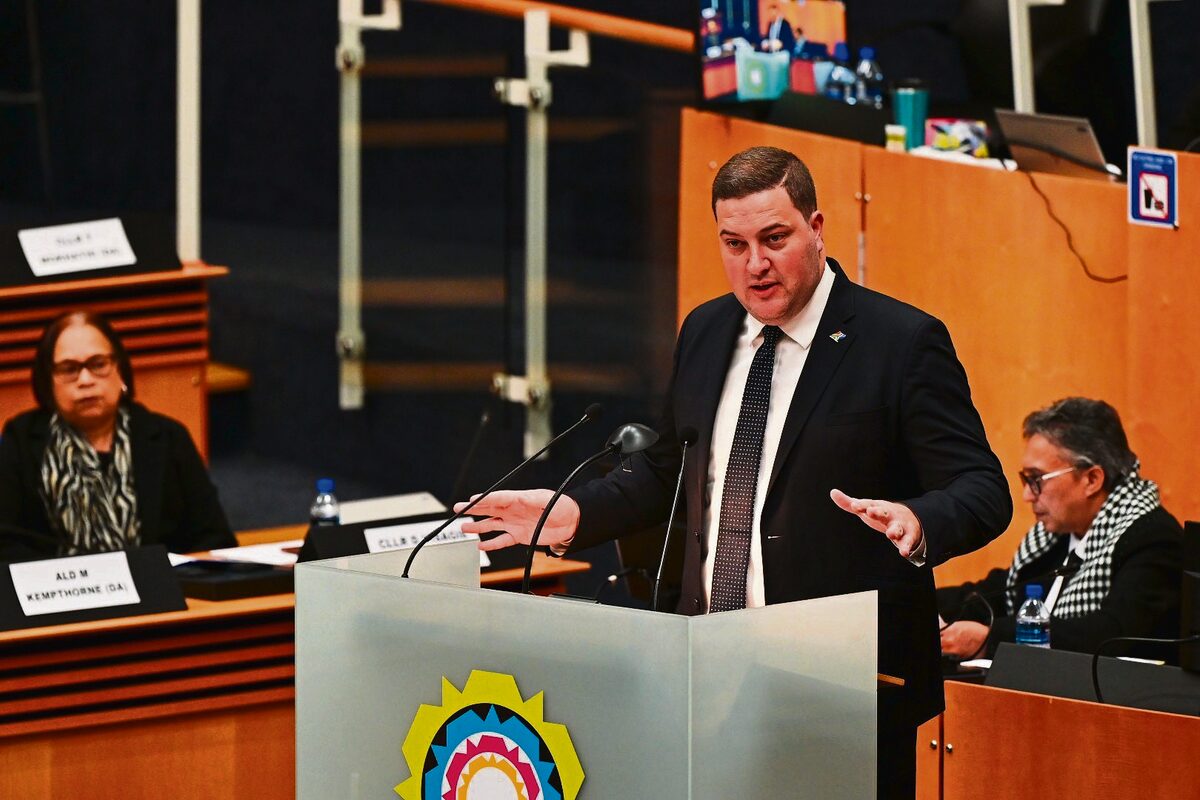
Despite strong opposition, the Cape Town Council on Thursday adopted the City’s controversial budget by a majority vote of the ruling party. Proving to be unpopular among rate-payers the budget introduced four fixed charges for sanitation, electricity, water and a new cleaning charge linked to property values that is set to increase most municipal bills to far above the current inflation rate of 7,98%.
In his address to the Council, Mayor Geordin Hill-Lewis stated that while the record-breaking R84,1 billion budget asks a little more of those who can afford it, it protects basic services for those who can’t afford it.
“The budget was largely welcomed by lower income residents, and we’ve also managed to significantly lower increases for middle class residents, in the end building broad support for the budget across the city.”
The said budget named the Budget of Hope, the mayor says will protect the City’s infrastructure investment programme, while being able to invest in over 700 new law enforcement officers spread across every ward in the city.
“This is not just a budget. It is a declaration of intent, that Cape Town will not wait for crisis to force our hand. That we will not let our children inherit a city weakened by our hesitation. And that, unlike other metros, we will not let our infrastructure crumble before we act. We are budgeting for the next 20 years, not just the next 12 months. And yes, to do this, we’ve had to make difficult decisions. But they are the right decisions for a city that is determined to be a city of hope for all.”
Public outcry
Following an outcry from rate payers after the draft budget was tabled, the City revised the budget in May announcing relief measures for the adoption of the final budget.
These included raising the qualifying threshold for pensioner support to R27 000, regardless of property value. This deal, Hill-Lewis said, has further improved following the second round of public participation. A 100% pensioner rebate on rates and city-wide cleaning charges will now be available up to R10 000 monthly income, up from R7 500, and a 50% rebate will be available up to R20 000 income. Discounts of 20% are also available up to R24 000 income, and 10% up to the R27 000 max threshold.
“This all ensures that 97% of ratepayers won’t experience an increase over 20%, and the 3% that might are generally those with solar installations who can sell power back to us for municipal bill credits, and even cash,” Hill-Lewis said.
Fixed charges linked to property value will remain in tact, with Hill-Lewis saying the City had elected to retain the cross-subsidisation principles at the heart of the original budget draft, in the form of fixed charges linked to property value.
“The only other alternative to property value determining your fixed contribution to infrastructure and fixed service costs is for everyone to pay a flat charge regardless of whether you are low-income or affluent. We must be clear that lower-income and wealthy households cannot make equal contributions to infrastructure and fixed service costs. It’s not fair, nor sustainable, and believe me, households at all levels of the property value spectrum do contribute their fair share within their means,” he said.
“Electricity price relief will see thousands of households pay less to consume electricity from 1 July. Likewise getting rid of the former ‘pipe levy’ based on pipe size, and basing it now on property value, means that all homes under R2,5 million will pay less for their fixed water charges than they would have on the pipe-size system for 25/26. Even when adding the new sanitation charge, 200 000 families in homes under R2,5 million will pay less fixed charges for water and sanitation together this year, compared to what they would have paid on the pipe-size system.”
Selling dreams
Opposition parties were on the same page, making their stance against the budget strong and united.
Paul Jacobson from the Freedom Front Plus said everyone understands that Cape Town must grow to allow economic development, but the administration has become over zealous trying to convert Cape Town into Hong Kong overnight. According to Jacobson, investigation into the budget revisions shows that the middle-class rate payer will still be hit hard.
“The middle-class is the bread and butter of our existence . . . when is the City going to start listening?” he asked in his speech.
He spoke of past incomplete projects and wasted expenditures, and held that there were better ways for the City to be more thrifty.
Also from the Freedom Front Plus, Emre Uygen said the “unfair” budget was voted in by single party dominance and further expressed his hope that rate-payers will see in this the need for a coalition government to come forth in next year’s election. The DA holds 135 seats in council out of a total of 231.
In his turn leader of the ANC in council Xolaine Sotashe referred back to the 2022-’23 budget presented by Hill-Lewis in January 2022, saying the “Mayor sold us dreams”.
“The mid-year adjustment of that financial year suggested that none of the things he mentioned in his budget speech came into full fruition. An ambitious capital budget of R7,5 billion was underspent by a whopping R600 million plus at the end of 2022-’23 financial year. It is the first time in the history of this city that the poor and the rich are overwhelmingly rejecting this budget with 87% of the comments received expressing anger and disgust against this budget. Only 2% is positive about the budget and 11% neutral. At the centre of this rejection is unreasonable rates and tariff hikes.”
He said residents have expressed strong frustration over several major issues, including the deteriorating sanitation infrastructure, the lack of proper road infrastructure, and the absence of visible law enforcement. “These are people who pay their rates and tariffs,” he added, “but they’re just not seeing any value for the money they’re putting in.”
Founder of civic organisation STOP CoCt Sandra Dickson in a statement to the media said the approved budget still contains the original fixed charges of which will see increases to most municipal bills in multiples of the current inflation rate. “It still uses the widely rejected ‘link to property values’ to slap the new fixed charges onto municipal bills.”
While welcoming the expanded relief for pensioners, Dickson said the additional write-off of household debt – which does not form part of this budget – underlines the absolute fact that many households are effectively unable to pay or struggle to pay their ever increasing municipal bills.
“One can only sit back and wait for the chaos when the first bills reach households by the end of July.”