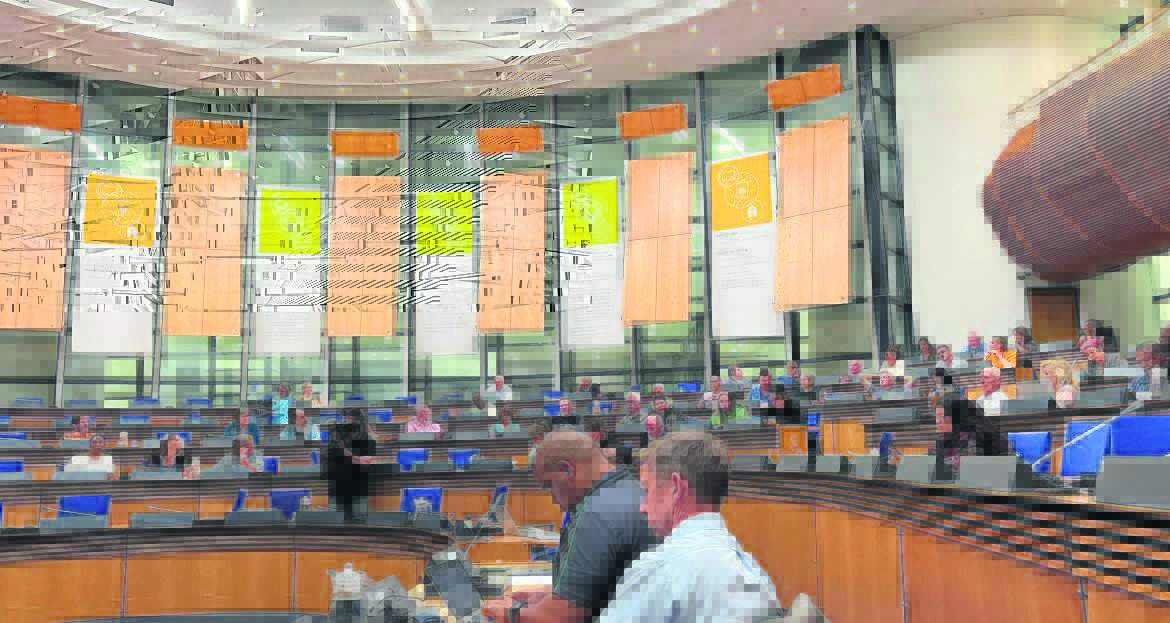

After months of heated debates around the polluted Milnerton Lagoon, the City of Cape Town finally engaged with residents and environmental organisations at its second quarterly report-back meeting on Wednesday 30 November.
At the meeting the City provided updates on current pollution mitigation measures, including litter trap installations. The residents were also introduced to a team of expert consultants appointed to formulate an action plan of short-term solutions to water quality in the lagoon.
Consultants shared several possible short-term measures to improve the lagoon quality, which will be explored in detail in coming months.
These measures include aerating the lagoon to introduce healthier oxygen levels, as well as potential bio-remediation solutions. Other short-term measures include improving the functioning at Potsdam Waste Water Treatment Works (WWTW), and exploring extra package plant capacity technologies at this facility.
Consultants will also thoroughly explore the process required to dredge the lagoon within three to five years to remove decades long pollution build-up.
Public feedback
The City previously invited residents to comment on the Milnerton Lagoon and 31 written submissions were received by the closing date.
The submissions from the public were summarised as below:
- Changing the Milky Way Detention Pond into a Retention Pond;
- building community ablution blocks in informal areas;
- diverting stormwater channels away from the river;
- installing renewable energy solutions at pump stations around the Milnerton Lagoon, preventing the impact of loadshedding;
- community partnerships and innovative ways of removing solid waste from the lagoon;
- widening the mouth of the lagoon;
- turning waste discharged into energy and
- bio-remediation.
The public can still submit comments to the following email address: Enviro@capetown.gov.za.
RethinkTheStink went ahead with water testing done on 4 November by an accredited independent testing company.
The results showed treated effluent containing 750 000 E Coli cfu/100ml (licence requirement is <1000 cfu/100ml) was being discharged into the Diep River at an estimated rate of over 36 million litres per day (equivalent to 18 Olympic-size swimming pools).
Some solutions
The City further mentioned that they are installing litter traps on identified stormwater outfalls that will capture solid waste before it enters the natural system.
The litter traps will catch solid waste that enters the stormwater channels from Milnerton, Royal Ascott, Joe Slovo, and Phoenix.
“The team of external scientists and experts appointed by the City to devise the remediation plan were at the meeting to present an update on their work. This was an opportunity for the community and stakeholders to engage directly with this expert team.
“The Milnerton Lagoon’s ecological condition is poor due to multiple pollution sources and requires the intervention of various stakeholders, from government, to the public and industries within the Diep River Catchment area. The City aims to steadily close off pollution sources to the lagoon, so that we can dredge and remove the sediment at the bottom, along with decades of pollution build-up. We are committed to addressing these challenges in partnership with all who care about restoring the health of the lagoon environment, which is non-negotiable for the City,” said the City’s Mayco member for spatial planning and environment, Eddie Andrews.
Potsdam WWTW
Potsdam WWTW is an ageing facility, requiring a capacity and technology upgrade valued at R5 billion and ongoing maintenance and remedial work.
The City says they are steadily working towards upgrading Potsdam, which is also on the Mayoral Priority Programme.
“We are committed to cleaning up the Lagoon by stopping pollution at its sources, which includes better equipping Potsdam WWTW so that the treated effluent is of better quality,” said Siseko Mbandezi, the City’s acting Mayco member for water and sanitation.
Lagoon odour
Mbandezi said the sulphur smell originates from the excessive accumulation of particulate organic matter in sediment that has caused bacteria to proliferate to such a degree that they are using oxygen at a rate faster than it is resupplied.