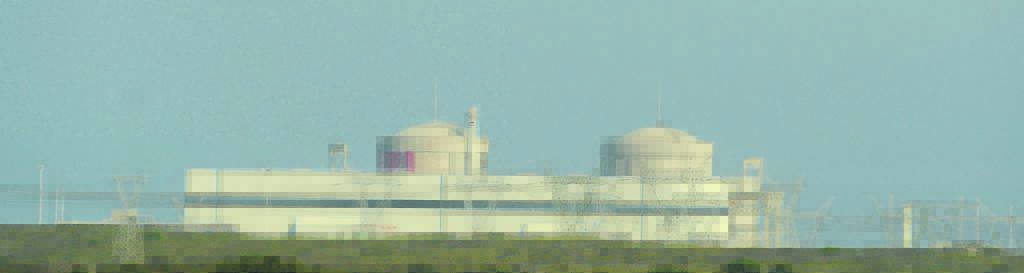

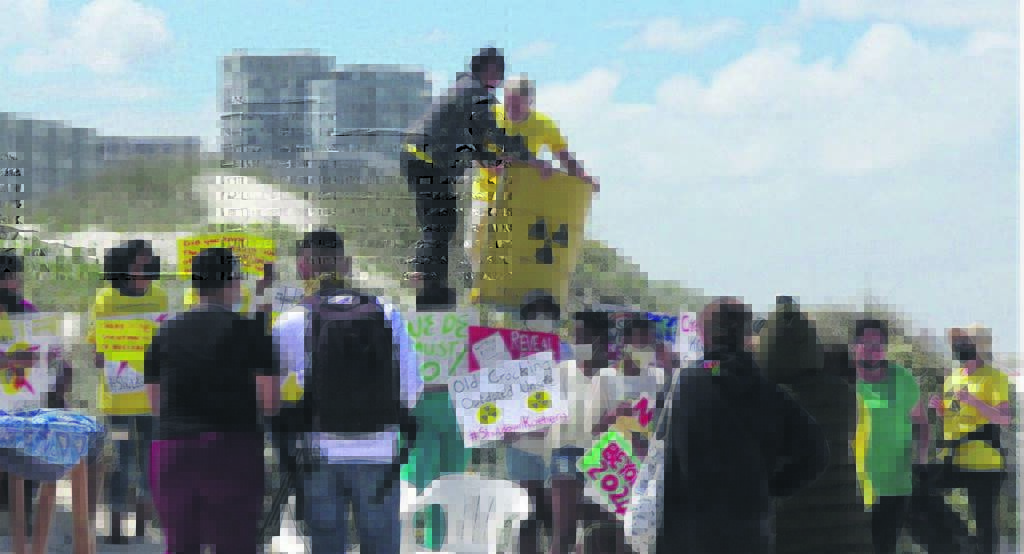
An anti-nuclear demonstration held on Bloubergstrand Beach in December last year highlighted concerns of Capetonians about the implications of Eskom extending Koeberg’s lifespan next year.
The nuclear plant reaches the end of its 40-year lifespan in 2024 but Eskom is trying to extend its operating life by another 20 years before any public consultation, protesters say.
The event was organised by Koeberg Alert Alliance (KAA) and the Southern African Faith Communities’ Environment Institute (Safcei).
Safcei’s Social Justice Leader at the Cape Town Unitarian Community, Cele Esau, says: “Quite a few residents who approached us did not know about the implications of Koeberg’s life extension. It was also a great opportunity for faith leaders to share their concerns about the ongoing secrecy surrounding Koeberg. Residents are not adequately informed about plans proposed for the plant and how it could affect them,” he said.
“Safcei joined in the protest to highlight ongoing issues at Koeberg nuclear power plant, including the lack of transparency or consultation with the public, too little information on safety issues, and the reported loss of key staff,” said Safcei Executive Director Francesca de Gasparis.
“A lot is happening in terms of decisions on energy provision by government at the moment including the seismic exploration and karpowerships which will not help us to reduce our dependence on fossil fuels. The plans for the Koeberg nuclear power plant are another example where due process does not seem to be followed. Eskom’s intention to extend the life of the plant for another 20 years has not been shared with the public and the desirability of a nuclear power plant at this site needs to be questioned,” she said.
According to KAA spokesperson Peter Becker everyone agrees that we need electricity, and so the question is, what is the best way to spend money to achieve that?
“We are asking Eskom to keep the plant running in 2022, and to shut it down as planned in 2024. By that time other plants would have been repaired, and new renewable energy installations will have come on line,” said Becker.
Eskom has announced that the first reactor will be offline from 3 January to 17 June in order to do the work needed to replace two steam generators, which is a necessary step towards extending the life of Koeberg.
Eskom spokesperson Deidre Herbst recently announced that in order to comply with emission standards, Eskom will need to take 16 000 MW offline, and threatened the country with continuous stage 8 load shedding.
If both Koeberg reactors are running they provide enough power to reduce load shedding by about two stages, since it is 1 000 MW per stage.
“It does not make sense to shut down reactors during 2022 when we need every kW of electricity we can get, just so that the plant can run after 2024, by which time Eskom will have had time to improve the reserve margin,” said Becker.
On the same day as the protest (16 December 2021), the French company EDF found cracks caused by corrosion in the pipes of reactors at the Civaux plant, leading to the pre-emptive shut down of that plant, as well as the Chooz plant which uses a similar design. These plants use 1 400 MW pressurised water reactors (PWRs), which are similar to the 900 MW PWRs used at Koeberg. Overnight, France lost nearly 6 000 MW of generating capacity.
“The French story should lay to rest the myth that nuclear power is safe and reliable,” says Becker. “And it also raises some serious questions about safety, such as does Koeberg suffer from the same problems?” protesters asked.
Earthquakes and climate change concern citizens
“With the two recent earthquakes approximately a year ago, a disaster could be in the making here. Along with expected sea level rises and increasingly unstable weather due to climate change, our view is we should not be investing in the extension of this nuclear power plant’s life,” said Safcei Executive Director, Francesca de Gasparis.
Safcei’s Energy and Climate Justice Coordinator Khulekani Magwaza added: “One of the reasons why we came out of our homes for a gathering and demonstration, despite the Covid-19 situation, is because, once again, we want to be visible. We want our government to see that we exist, and we have a voice. They must listen to us. Koeberg plant is becoming more dangerous as it gets older and we need Eskom officials to appeal to their conscience and make a proper decision by not extending the life of Koeberg. We know that there are good people in Eskom and in our government, we urge them to not betray their conscience, and they must not betray their communities. We urge them to stop the life extension plans for the Koeberg plant.”
For more information, visit www.awethu.amandla.mobi/p/koeberg.