

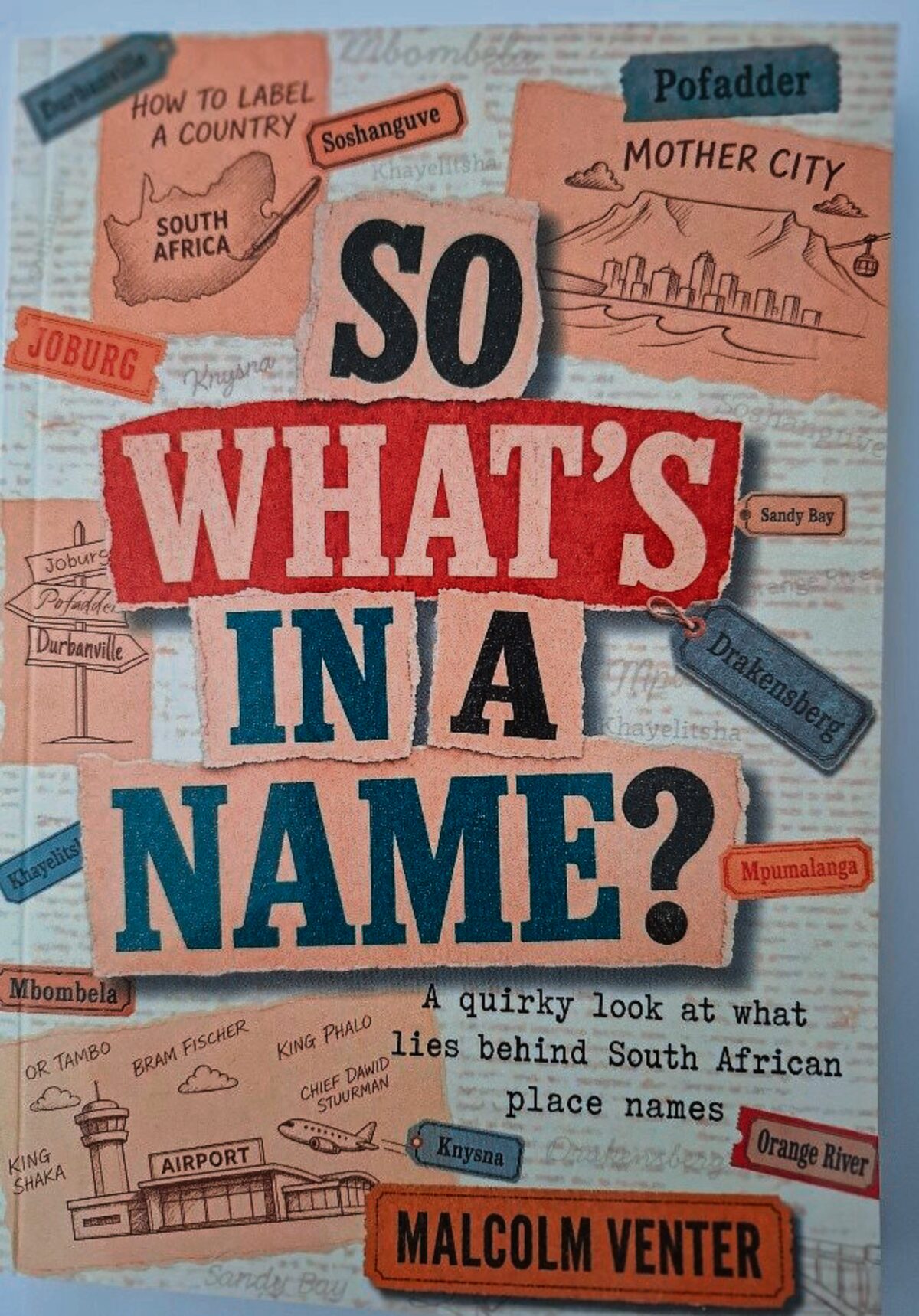
A new book that explores South African place names, their origins and what some of them mean has just hit the bookshelves.
So What’s in a Name, by Dr Malcolm Venter of Kenridge, Cape Town takes the reader on a journey through South Africa’s rich cultural landscape through its names. It relates how places have acquired their names, and in some cases there is an ongoing drive to rename many of them.
Venter, the founding headmaster of Edgemead High School from 1986 to 2007, said he had an almost lifelong fascination with history and the English language, starting at school and throughout his years at Rhodes University in then-named Grahamstown (now Makhanda), where he obtained a degree in history and eventually a PhD in English Linguistics. “Of course the two disciplines are part of place names,” he said.
Gathering information, research and writing process
Venter said the idea of writing this book occurred to him 10 years ago, when he had completed another book on South African English. “But the real work began about two years ago when I finally retired from education. My research has involved lots of reading as well as information gathered on travels around the country.”

Place names of SA
While one cannot pin Venter down precisely on the source of his fascination with South African place names, except for an ongoing preoccupation with history, particularly of a complex country he is proud to call his own and its being an interesting take on a more than 350-year heritage he identifies with.
“Also, one has to narrow one’s focus when one writes a book such as this, particularly in deciding which names to include. I chose to focus instead on certain parts of our country, which provinces, towns and cities, rivers, mountains, capes and bays.
“Even then there were many thousands to choose from. In the end the process became quite organic. I picked names that caught my interest or showed patterns in how we name places. From there the writing took on a life of its own; connections appeared and related names found their way in almost by instinct.”
His book, which is available on order, is self-published.
Little-known facts
Venter, who received the Shuttleworth Foundation’s School Principals’ Incentives for Excellence Award in recognition of his contribution to education, couldn’t quite tell TygerBurger how long it took him to write the book. Names were also chosen for their quirky stories, which made for informative reading for those who were none the wiser before.
“I wonder if most people know that there was once another ‘Durban’ in South Africa. Well, sort of. It was actually called D’Urban (pronounced without the apostrophe). Situated in what are now the Northern Suburbs of Cape Town, it began as a place with a natural spring and shady trees where early travellers stopped over for the night at the end of their first day’s journey by ox wagon from Cape Town to the interior. This little traveller’s post was called Pampoenkraal because, it is said, there was a pumpkin patch which grew alongside a dam located behind the current town hall. Understandably, then, locals were mortified and petitioned to change the name. Enter Sir Benjamin D’Urban, the British governor, who fifty years later kindly lent his name, D’Urban. But that caused mail to get horribly mixed up with the mail for the other D’Urban, so in 1886 it morphed into D’Urbanville, both later minus the apostrophe. Problem solved.
“And then there’s Goodwood,” said Venter. “The name comes from a famous racecourse in England because, a fun fact, this place was supposed to be Cape Town’s next big horse-racing hub. They even held one race before the plans were abandoned.”
Name changes
The author also shared his opinion on the current name-change process, such as the changes to place names in the Eastern Cape.
“I think it is perfectly understandable that there are people who are keen to change the names of places in South Africa. Most place names are not neutral in their connotation. So, they may be associated with people who don’t, in current opinion, have great track history.”
He explained further by way of examples.
“Take Grahamstown, for example. Back in 1819 Colonel Graham adopted a policy of using what he called ‘a proper degree of terror’ to push the Xhosa people out of the Eastern Frontier. It’s no wonder, then, that in recent years it was renamed Makhanda, after one of his prominent victims. And then there’s the general feeling of having one’s culture supplanted as place names are imposed on another culture.
“Of course, from another point of view, the locals whose ancestors lived here long before colonial times have always felt they were living in a foreign country. Many of the old names have been rejected because they came straight out of the “19th-century British Great Big Book of Imperial Officials” or even before that, from the Dutch settlers, while others have been dumped for simply being ‘too foreign’.
“In the case of East London, for example, it was said, ‘There is no London in South Africa. We are not a replica of Europe.’ So, after much wrangling, it became KuGompo (which, according to the original proposer, carries cultural significance because locals used to call East London Gompo to reflect the sound of the ocean hitting the rocks 7 km from the East London city centre).
“Of course, there have been counter-arguments,” he said “some from conservatives who want things to stay the way they are. Others point to the cost of changing names when there is so much poverty that needs to be dealt with instead, or they complain about the economic impact of a well-known name being wiped out.
“Furthermore, there is the question of whose culture was supplanted by whom? And, therefore, which names should be restored?” Venter said.
So What’s in a Name? is available at R220. To order e-mail the author at drv@worldonline.co.za
ALSO READ: Read to Rise launches new wordless book at Mitchells Plain educare centres


You must be logged in to post a comment.