
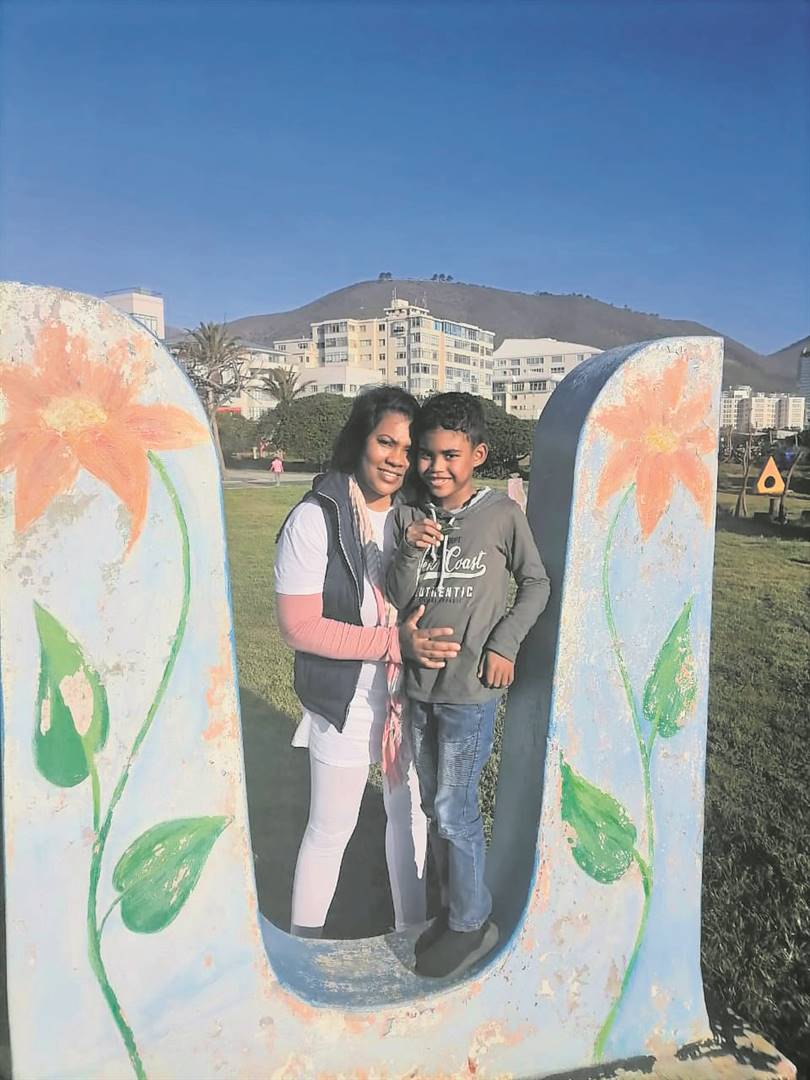
In an ode to her autistic son Charlene Pietersen, a Brackenfell police officer, poured her heart into a touching poem she wrote to depict her journey as a mother.
She wrote: “I longed for you and prayed for you, little did I know what our journey holds . . . You could climb into people’s hearts one smile at a time and even heal them . . . You are truly one of a kind . . . You came and turned our lives upside down, we had to adapt to what you had in mind . . . It isn’t easy you know, but keeping you in routine is all that matters . . . I sometimes felt like I’m failing you and then you would come out of the blue and just say, Mommy I love you . . . God really knew what he was doing when He chose you to be mine. I would be your number one till the end of time.”
April marks Autism Month around the world and by sharing her story Charlene hopes to create more awareness about the condition.
Dorchin Pietersen (8) was diagnosed with autism when he was four years old.
“On the day he was diagnosed, it was the first time I heard the word autism. The shock was so immense that I cried for that entire first year; I could hardly say his name. I had no idea what this autism was and only thought of it as the most terrible illness,” says Charlene who is very emotional when she recalls this memory.
Autism as defined by Autism SA is a neurodevelopmental disability that causes the autistic person to think, learn, socialise, communicate and play differently than the neurotypical person. Its prevalence in South Africa is estimated to be between 1 and 2% according to Autism SA.
“At the age of four Dorchin didn’t speak other than uttering a few words such as ‘mamma’ and ‘pappa’. He pointed to objects to express his wishes. He also didn’t socialise with other children and was easily triggered by noise,” says Charlene.
At first she was wrecked with guilt.
“As a mother I was devastated and I asked myself every day what I did wrong during my pregnancy to cause my child to have autism. I did not want my little boy to go through all of this. I felt alone and scared and as if nobody understood.”
As Dorchin grew older, the autism became more pronounced.
“He showed no emotions, made no eye contact and would become very anxious. If I was a few minutes late from work he would become fearful. He suffered outbursts during which he would hit his head against the wall and overturn tables.
“He only likes certain colours like dark blue and dark green and the labels on all his clothing has to be cut off.
“Also his food tastes are very selective and limited to only a few foodstuffs and he only drinks orange coloured juices. He smells everything before he eats it and if he doesn’t recognise the food, he will simply not eat it,” she says.
Medication prescribed to Dorchin helped ease the anxiety and occupational and speech therapy had to be employed. Charlene and her husband were faced with immense new challenges.
“We realised that we had to raise him to fit into society. We have to teach him social skills in order for him to be able to do things on his own.
“Little milestones that others take for granted is a big deal to us. For him to do anything on his own is a breakthrough to us and as we learned about the condition and came to understand it better we could help him in various ways in a daily routine to cope better with everyday life.”
Charlene says much more awareness and empowerment is needed about autism.
Family support is of utmost importance, but oftentimes lacking.
“Family members and other people do not always understand autistic children. They would often think that the child is only naughty without a deeper understanding of the child’s behaviour. A lot more time and patience is needed for children with autism.”
Dorchin is currently in a private school who was prepared to take him, but is on a long waiting list for entry into Cheré Botha School for children with special needs.
“There is a big need for schools for children with autism. Private schools are very expensive and normal mainstream schools cannot provide in the special needs of an autistic child. Learning is a problem as he battles to focus, apart from mathematics which is the only subject he loves. He can sit and do it for hours. He is still very selective when it comes to who he talks to or plays with, but now talks about the concept of ‘friends’,” she says.
When she thinks about her son and how far he has come, Charlene is filled with joy and praise for Dorchin.
“He creeps into everybody’s heart and without saying a word he can make your whole day. If he had a good day he is very endearing and full of jokes. He is gentle and softhearted,” she says.
As the world speaks about autism in April, Charlene’s message to other parents of children with autism is this:
“Talk to each other and support each other. You are not alone. Don’t blame yourself and love your child unconditionally. He or she might be different but they are special.”