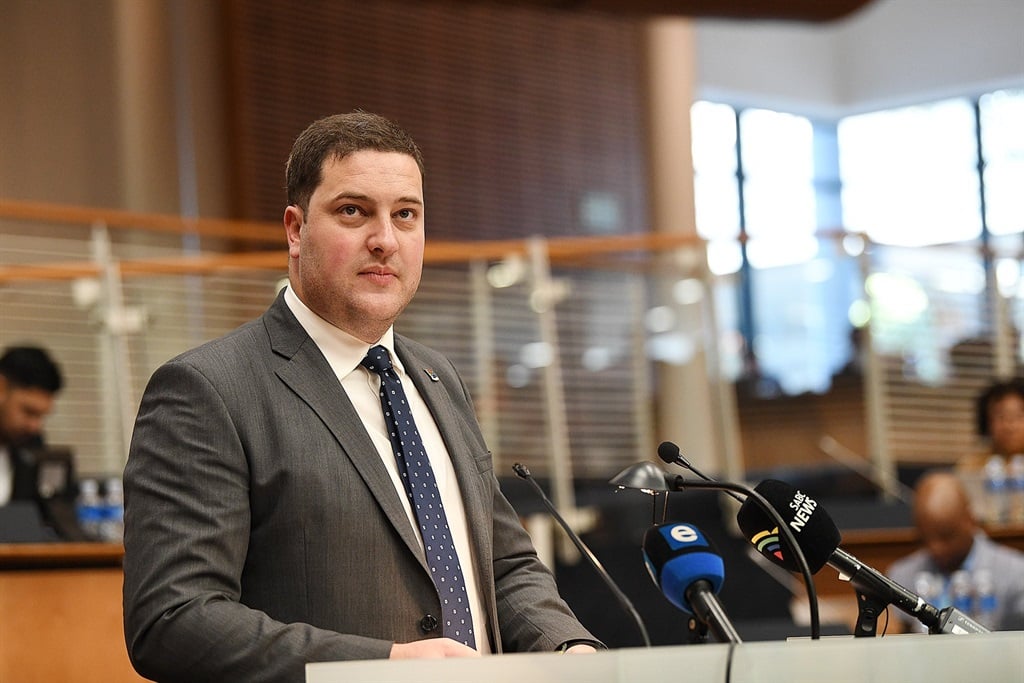


Eighteen months into his term, Cape Town Mayor Geordin Hill-Lewis last week updated the local business community on progresses made by his administration.
Touching on issues such us load shedding, economic growth, safety and security and homelessness, he addressed members of the Tygerberg Business Chamber at their annual dinner held at Goedgeleven outside Durbanville on Thursday.
“When I last addressed this forum, our administration was still relatively new. There were many future plans to talk about, but not so much in terms of achieved goals. This time round, however, it’s different. We’ve recently tabled our second City budget, and we’re roughly a third of the way into our five-year Integrated Development Plan,” said Hill-Lewis.
Speaking from both an economical and geo-political viewpoint, Hill-Lewis said people have every right to be worried about South Africa’s trajectory, and that he has no intention of painting a rosy picture of Cape Town that ignores this grim broader reality.
“Our local economic growth cannot be separated from the constraints on the national GDP and the policies and factors responsible for those constraints. We suffer the same crippling effects of load shedding, and businesses and residents here in Cape Town have to go to the same lengths as citizens elsewhere in order to shield themselves from this crisis as far as possible. We have to deal with an unacceptably high crime rate – particularly in Cape Town’s poorest communities – largely because of a struggling and poorly capacitated South African Police service.
“Furthermore, Capetonians suffer badly as a result of the collapse of Metrorail – again, thanks to the woes of the nationally-run Prasa. And while we can, to a degree, distance ourselves from national government’s stance on Russia, the global fallout affects us here too,” he said.
But even against this backdrop, Hill-Lewis believes that hope prevails, the most obvious evidence of this the jobs data for the first quarter of 2023, recently released by Stats SA.
According to this report the Western Cape and Cape Town in particular have seen an incredible bucking in the unemployment trend.
Cape Town’s unemployment rate, based on the expanded unemployment definition, which includes people who have given up looking for work, now stands at 26%, a full four percentage points lower than the first quarter of 2022.
The mayor noted that in the first three months of 2023, 40 000 more Capetonians went to work, taking the city’s labour force to 1,7 million people.
the fight to curb load shedding
Hill-Lewis summarised the City’s progress on the pledge to end load shedding, saying the administration is well on track to initially shield Capetonians from the first four stages of load shedding within three years, but ultimately to make the metro entirely load shedding-free.
A multi-phase procurement programme has been undertaken that includes a tender for 500 MW of dispatchable energy that was issued last month, as well as a tender for 200MW of renewable energy.
“We’ve also just received funding from the C40 Cities Finance Facility for a feasibility study for a R1,2 billion Solar PV installation at Paardevlei outside Somerset West. This plant will be capable of generating up to 60MW of power – enough to protect against a full stage of load shedding,” he said.
Over and above that, the City Power Heroes programme will see Capetonians incentivised for the voluntary switching off of energy-intensive appliances, such as geysers at peak times, while its cash-for-power programme will pay businesses and individuals for their excess rooftop solar power. In this regard Hill-Lewis reported that a record number of solar installation applications are being received currently.
In addition the City just budgeted another R1,2 billion over the next nine years for the maintenance and expansion of the Steenbras pumped storage power plant.
safety and security
Citing safety and security he outlined the successes of the Law Enforcement Advancement Plan (LEAP) officers deployed in partnership with the province.
“To date we have deployed over 1 200 LEAP officers to 11 crime hotspots, as well as the CBD. Between February 2020 and July 2022 altogether 1 200 officers made 8 500 arrests and removed almost 400 fire arms from the streets.”
Also, the City’s newly-launched highway patrol unit has paid dividends, with more than 400 arrests in the first four months, including 15 arrests for possession of a stolen or hi-jacked vehicle.
The mayor remarked on the city’s CCTV surveillance network saying with 2 528 cameras and counting, Cape Town has the largest CCTV network in Africa.
To address the shortage of metro police officers he said the City will spend R166 million over three years to expand its metro police training college, while at the same time continue to push for the devolution of policing powers from national government.
Economic growth expected
Infrastructure development to the extent of R120 billion over the next decade, he said, will gear Cape Town for economic growth.
“We want Capetonians to feel pride and a sense of ownership of their city, regardless of where they live.”
Another objective Hill-Lewis has underscored since taking office in 2021 is to streamline government processes to make doing business with the City easier.
He mentioned a business scorecard that was launched last week to keep track of progress to improve business-facing services. Among others it includes indicators on building plan approvals and obtaining business licences.
Overall this programme has already reduced the turnaround times for property rates clearance certificates to just four days. Into the bargain, the online development applications management port has been upgraded to streamline building plan and land use approvals.
On the worrying issue of homelessness the mayor affirmed that it is a major challenge faced by the City.
“With a budget of R230 million over the next three years the administration will operate and expand various Safe Space transitional shelters where residents have access to a bed, ablution facilities, two meals a day, and from there, hopefully reintegration into society and re-connection with their families,” he stated. According to him these interventions have resulted in 1 453 people being helped off the streets, 942 people participating in development programmes, and 409 EPWP work placements.
“And that is the bigger story of our work here in Cape Town. Yes, we still have a mountain to climb, particularly given the major challenges of load-shedding, crime and unemployment, but we are tackling those issues, one project at a time, until the challenge is a manageable size,” Hill-Lewis concluded.