
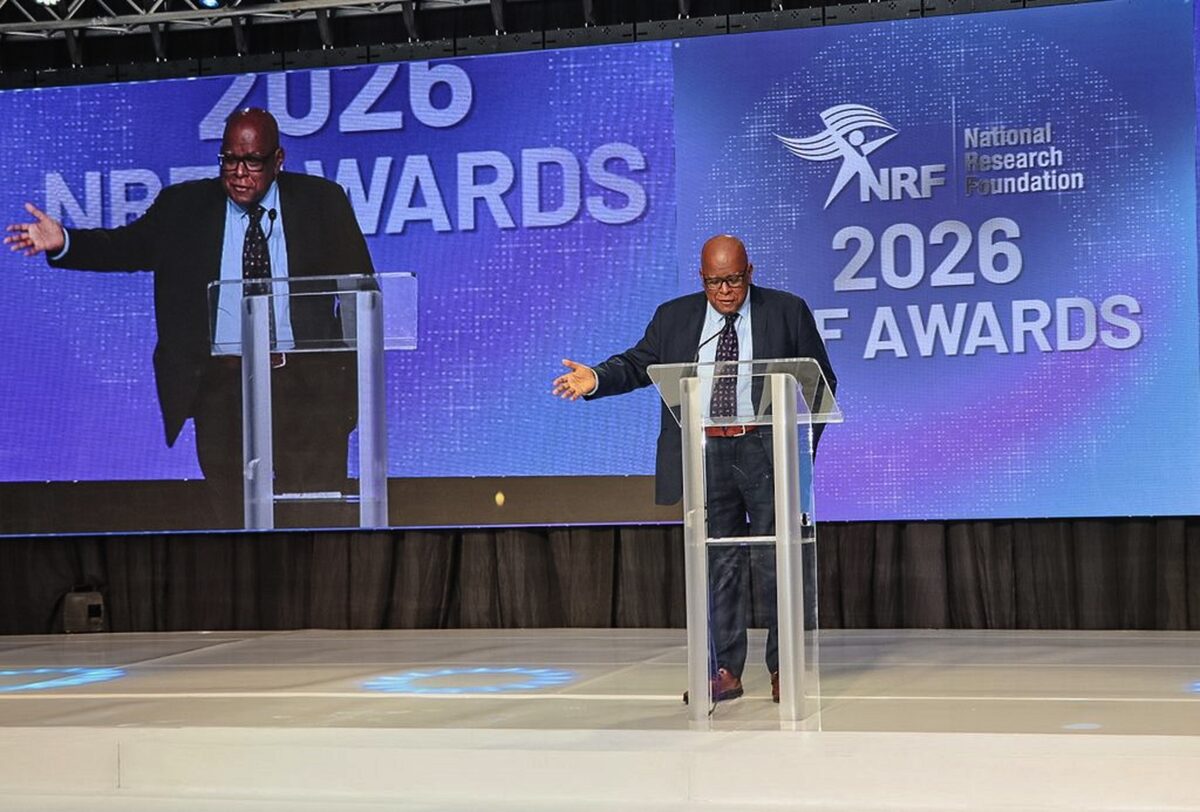
Professor Jonathan Jansen was among eminent scholars at Stellenbosch University (SU) who were honoured with National Research Foundation (NRF) Awards in recognition of their significant research impact and contributions to society.
Along with Tulio de Oliveira and Bert Klumperman the three received their awards at a ceremony in Gqeberha on Thursday.
Their work has shaped how South Africa thinks about education, how the world tracked a pandemic, and how new materials are being designed for medicine, three fields in which SU research has moved from the laboratory and the lecture hall into public benefit.
In addition, Prof Frank Tanser, was recognised as finalist in the Societal Impact Award through the work done by the South African Centre for Epidemiological Modelling and Analysis (SACEMA). SACEMA develops mathematical and statistical models to support evidence-based public health decision-making across HIV, tuberculosis, cervical cancer and emerging epidemics. Its HIV incidence estimation method was adopted globally by CDC, WHO and UNAIDS.
Leading SA scientists
The prestigious NRF Awards honour the country’s leading scientists and some of the best performing researchers for excellence and achievement in knowledge creation and dissemination.
“These awards tell us something about the kind of research university we are and the impact our researchers are having beyond the University walls,” said Prof Sibusiso Moyo, SU’s deputy vice-chancellor of research, innovation and internationalisation.
“Our researchers are recognised nationally and internationally precisely because they take on questions that matter to this country and this continent.”
Prof Tulio de Oliveira, director of the Centre for Epidemic Response and Innovation (CERI) and a Professor of Bioinformatics at the School for Data Science and Computational Thinking at the university, won a prestigious Societal Impact Award, which recognises researchers and research entities whose work has benefited society, either in terms of social impact, economic impact, innovation, or environmental impact.
De Oliveira was honoured for demonstrating how research excellence can lead to significant societal benefits through timely scientific discoveries, efficient dissemination and widespread public value.
He played a leading role in the response to Covid-19 in South Africa through his application of genomics and bioinformatics. His research informed national, continental, and global Covid-19 responses, including the rapid identification and reporting of major SARS-CoV-2 variants, especially Beta and Omicron, and strengthened African genomic surveillance capacity.
ALSO READ: Royal Society Africa Prize celebrates SA professor’s contribution to science
De Oliveira has worked for over 20 years with viral outbreaks, including HIV, Hepatitis B and C, Chikungunya, Dengue, SARS-CoV-2, Zika, and Yellow Fever Virus. His scientific contributions have significantly advanced our understanding of these pathogens and their impact on public health.
Strengthening society
Reacting to his latest achievement, De Oliveira said, “It is a tremendous honour to receive the prestigious NRF Societal Impact Award. From the beginning, we have believed that excellent science should not only advance knowledge but also make a meaningful difference in people’s lives. We are deeply grateful for this recognition, which belongs to the incredible teams and partners who make our work possible.
“It motivates us to work even harder to translate science into action that save lives, strengthen our society, and create new economic opportunities for South Africa and across Africa. We are proud of what we have achieved together, but even more excited about what lies ahead.”
De Oliveira has published widely and received numerous other awards, including the Order of Merit Medal from the President of Portugal for his groundbreaking work in genomics and bioinformatics, particularly during the Covid-19 pandemic, and the Order of Mapungubwe (Gold) from President Cyril Ramaphosa for his contribution to genomic surveillance and public health.
Prof Jonathan Jansen, a distinguished professor and renowned education expert in the Department of Education Policy Studies, received a coveted Lifetime Achievement Award for his dedication to education and change.
This award celebrates extraordinary contributions to the development of science in and for South Africa, and for the extent to which someone’s work has positively touched and shaped the lives and views of many South Africans.
Education research
A public intellectual and one of the world’s leading curriculum theorists, Jansen has used his expertise in curriculum change, institutional analysis, political science and the politics of knowledge to help improve education in South Africa.
A theorist and practitioner in equal measure, there is an urgency to his work in both schools and universities, where he has brought about meaningful change. His scholarship has informed how South African schools and universities think about curriculum and institutional culture.
Jansen is a prolific writer with journal publications in all the major education research outlets in the world. Jansen achieved the rare feat of having a lifetime of scholarship recognised on both sides of the Atlantic by elected peers in two of the most prestigious learned societies in the world, the American Academy of Arts and Sciences and the British Academy for the Social Sciences and Humanities.
Commenting on another milestone in his illustrious career, Jansen said, “The NRF Award represents a wonderful recognition from among your peers from the premier research foundation in South Africa. It is something to treasure and hopefully this inspires students and colleagues to produce scholarly or scientific work that counts over a lifetime in the academy. Of course, it feels very good to be recognised for your work among international academies but there is something special about getting awards at home.”
Prof Bert Klumperman of the Department of Chemistry and Polymer Science received his fourth A-rating from the NRF. A-rated researchers are unequivocally recognised by their peers as leading international scholars in their field for the high quality and impact of their research outputs.
Klumperman was recognised for his work in the field of radical copolymerisation, a process in which two different types of small molecules or monomers are joined together to form a larger material or copolymer, using free radicals.
The work of his research group is applied in two main areas, namely the isolation and stabilisation of membrane proteins for drug discovery research, and on-demand reversible hydrogels – a soft jelly-like material that absorbs water and swells to form a 3D net-like network with pores – that can, among others, be used as reversible male contraceptive.
Reflecting on his fourth A-rating, Klumperman said, “In 2007, my first A-rating felt like a huge honour and now, almost twenty years later to receive the fourth consecutive one still feels like that. I am exceptionally grateful to all my talented students over the years who have contributed to my research.”
SACEMA develops mathematical and statistical models to support evidence-based public health decision-making across HIV, tuberculosis, cervical cancer and emerging epidemics. Its HIV incidence estimation method