
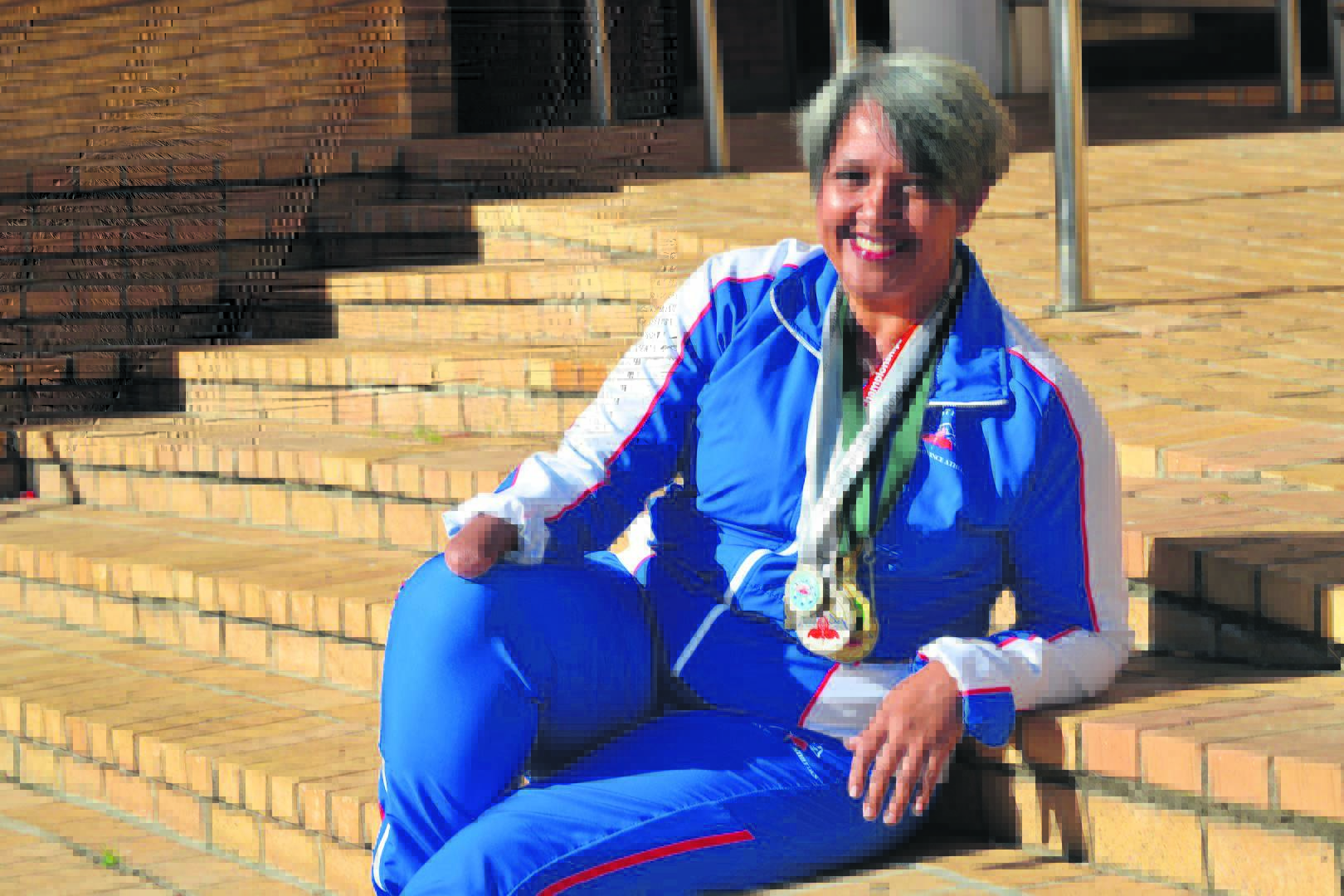
- 52-year-old para-athlete, Donna Africa, who hails from Cape Town, fiercely advocates for inclusivity in sport.
- Africa was born without a right hand and is classified as an “F-46” para-athlete.
- Africa specialises in shot put and discus and trained hard to work on her balance.
Para-athlete and staunch advocate for inclusivity in sport, Donna Africa, 52, has one motto in life: “To live every day of my life beyond disability.”
Training in shot put and discus at the Eastern Athletics Club in Kraaifontein, where she is also a part-time coach, she encourages disabled children to take up sport.
“No disabled child should ever feel excluded in sport. I am passionate about this because I was excluded from participating in sport when I was growing up. In school I did not have the opportunity to take part in much sport. The teacher would just look at my stump and say, ‘No, you can’t’,” says Donna, who was born without a right hand.
True to her belief that it is never too late to set new goals, she last year started training at the Bellville Athletics Club, among other disabled athletes.
Competing in nationals
“I took up the challenge after being encouraged by an administration member of Western Province athletics. My first masters tournament was held in Oudtshoorn in October last year.”
From there, she went on to compete in the Para Nationals held at Green Point Stadium from 19 to 21 March, hosted by the South African Sport Association for Physically Disabled (SASAPD).
For this tournament, she had to be assessed and classified and registered as a para-athlete.
“I am classified as F-46; based on the length of my arm and the lack of a hand, this classification enables me to compete against other athletes with similar abilities,” she says.
At the Para Nationals she met a 14-year-old Namibian athlete, Lize Meyer, with the exact same disability as hers, also competing in shot put.
“It was a goosebumps moment for me. We were amazed at the similarities of our arms and even compared our stumps. It was like watching a mini version of myself,” she says.
She says:
She also became the national champ for shot put in her classification.
Donna says not enough parents of disabled children have them classified as para-athletes.
“Disabled athletes have different disabilities and abilities. Where I have only one hand, other athletes could be visually impaired for instance. As a para-athlete you can compete with able-bodied athletes in certain sporting codes. For instance with one hand I am good at shot put, because you only need one hand and with practise, I managed to find my balance. The important thing is that I am included.”
More opportunities on the cards
Being formally classified and registered according to your disability opens up more opportunities for the para-athlete.
“It will make it possible to compete at school level and later on at WP [trials] to compete nationally and internationally.
“If you dream big, you can even train to compete in the Paralympics.”
She is currently training to compete in the Masters Tournament again this year and plans to complete a training course in coaching.
She continues:
Mandy Skinner, head coach at Eastern, says she is proud of the progress Donna is making in her training and very excited about the inclusivity of the disabled at the athletics club.
“It is going to mean so much for the club and the community. I ask parents with disabled children to give them the opportunity to do sport.
“They will be an inspiration for able-bodied people, to see what can be achieved in sport, even if you are disabled,” she says.