
The City of Cape Town says the work on Small Bay beach in Bloubergstrand will be done in phases to limit the impact on residents and users.
The project is going ahead despite the disapproval of some of its residents.
TygerBurger reported about residents claiming the wall will destroy the view of the beach and coastline.
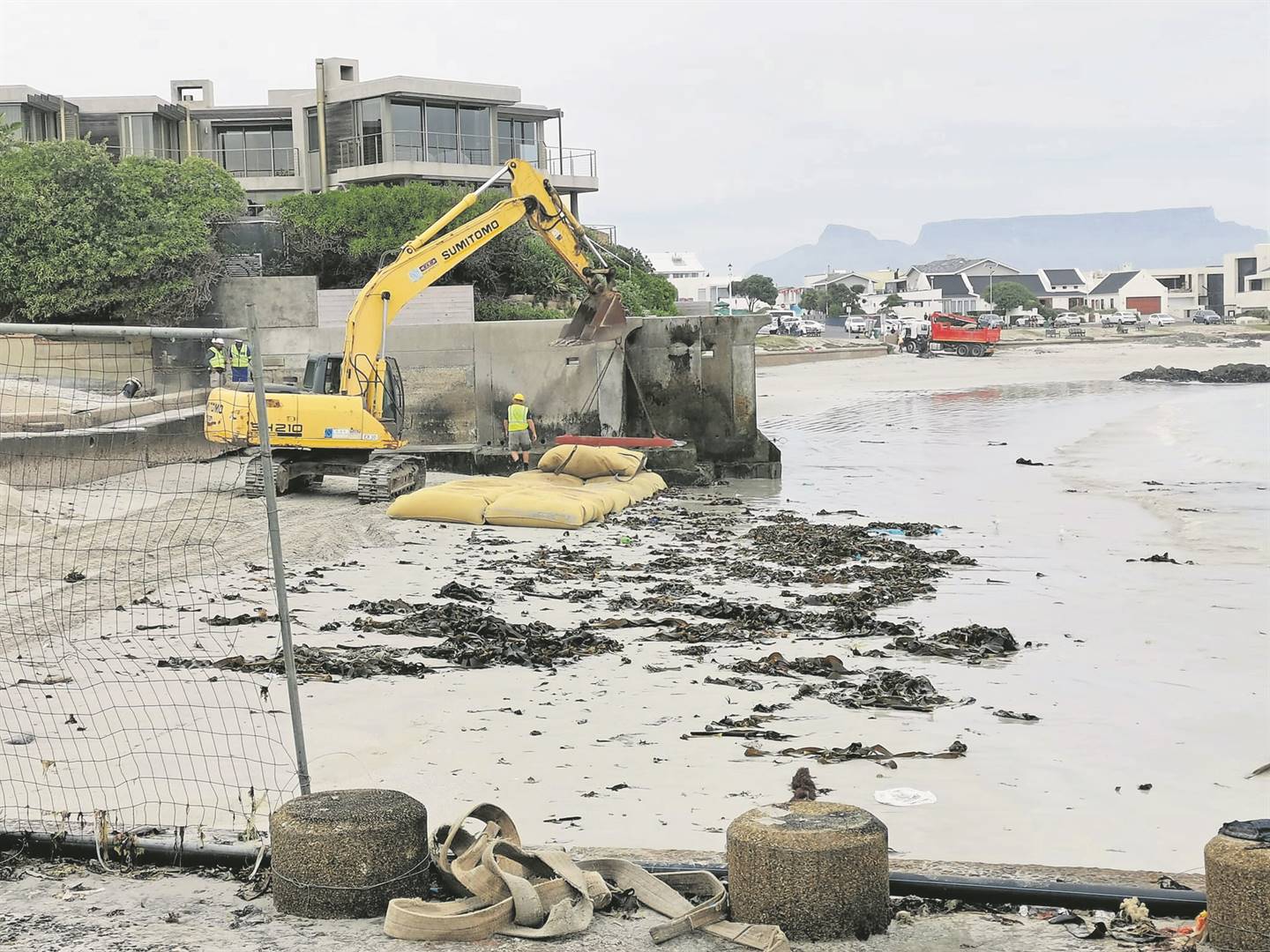
The upgrade of the sea wall at Small Bay, and the work to relocate the sewer main along this stretch of the coastline, started in February. If all goes as planned, the work should be complete by September 2024.
Currently work is underway to build a sewer pipeline from the De Mist ablution building to a new manhole at the Ferguson Street intersection.
The work started in April.
After TygerBurger was inundated with complaints of the noise pollution and completion of the project, the City was contacted for clarity.
Eddie Andrews, the City’s Deputy Mayor and Mayco member for spatial planning and environment told TygerBurger that the upgrade of coastal infrastructure and reconstruction of the sea wall at Small Bay is to protect coastal properties and important services infrastructure from wave overtopping and flooding.
“The existing sea wall will be reconstructed from the Small Bay Park, along Pelegrini and Popham Streets to Ferguson Street – all-in-all, a section of about 190 m. As explained above, the existing sewer line will be rerouted landward, away from the sea wall, from the park to the De Mist ablution building and a portion of Pelegrini and Popham Streets along the seawall will be reconstructed,” Andrews says.
Motivation
Andrews pointed out that Small Bay beach is an important recreational and tourism destination.
The existing concrete seawall and walkways which extend from the play park in Small Bay to the Popham and Ferguson Streets intersection, have been undermined for a number of years, are collapsing and have resulted in damage to the adjacent road infrastruture.
This was due to the age of the infrastructure, as well the historical development footprint which resulted in hard infrastructure and services located in the tidal- and wave breaking zone.
Project constraints
Andrews says the project has significant project constraints which had to be considered to ensure the most feasible solution in terms of coastal protection, recreational use and constructability in such a dynamic environment.
- Constructing a robust seawall defence structure on a very small existing footprint. Due to the emergency nature of the project and to mitigate any potential negative impact on the natural environment and coastline, it was essential to ensure the re-constructed seawall footprint shall not encroach seawards. In order to work within the allowable footprint, the existing beach access and configuration were maintained (like for like). A great and important addition is to ensure that the new ramp access has a flatter gradient – thus, once reconstructed, it will allow for better wheelchair access to the beach. The pedestrian walkway makes allowance for universal access along its length.
- Allowance for pedestrian movement and seating. The old seawall configuration comprised of a “stepped landscape area” along a portion of Popham Street. “Unfortunately, this stepped landscape will be lost when the new seawall is constructed. The key issue that the City is now facing is that by allowing historic development to encroach so far seawards, we now have reached a pinch point where we have so little space left that our choices for coastal protection have become severely limited. The lesson from Small Bay is development and services must be set back,” Andrews says.
After completion of the project, the formal beach access will remain at the beach adjacent to the park, where the ramp will remain in place to provide access to the beach.
“Given the urgency of the work, the severe consequences of a sewer line failure that will have wider impacts beyond Small Bay, and the presence of other beaches accessible to the public in close proximity, the City is of the view that access to the beach adjacent to the Park via the ramp is sufficient and appropriate.”
Height of new seawall
“To protect key infrastructure from inundation, allow for some overtopping while minimising visual impacts in order to mitigate wave overtopping and protect the sewer line, a 900 mm high cope (concrete unit on top of the seawall which is curved to deflect waves) is required along the wall. This will result in the top level of the hard structure being 900 mm higher than present. However, it will not affect public access to the beach via the access ramp provided. Thus, formal access to the beach is in no way inhibited,” says Andrews.
Flooding during storms
“It is noted that the new seawall will not provide full protection to the infrastructure or properties behind the seawall. There will still be significant wave overtopping and flooding behind the seawall during storm and high-water conditions even with the cope units. Periodic flooding will take place behind the seawall due to the relatively low road and property levels behind the seawall and the flooding will increase in time due to the effects of sea level rise,” he says.
“The public will not be able to access the beach from the Small Bay Park. Access to the parking area adjacent to the park will be restricted.
“Only residents will have access to Pelegrini Street. Signage will inform the public as such. The contractor will use the Small Bay Park as a temporary site camp and the City will try its best to limit the impact on residents and visitors as much as possible. Given the unpredictable environment, the construction will be subject to storm events and other natural processes beyond the City’s control.”