
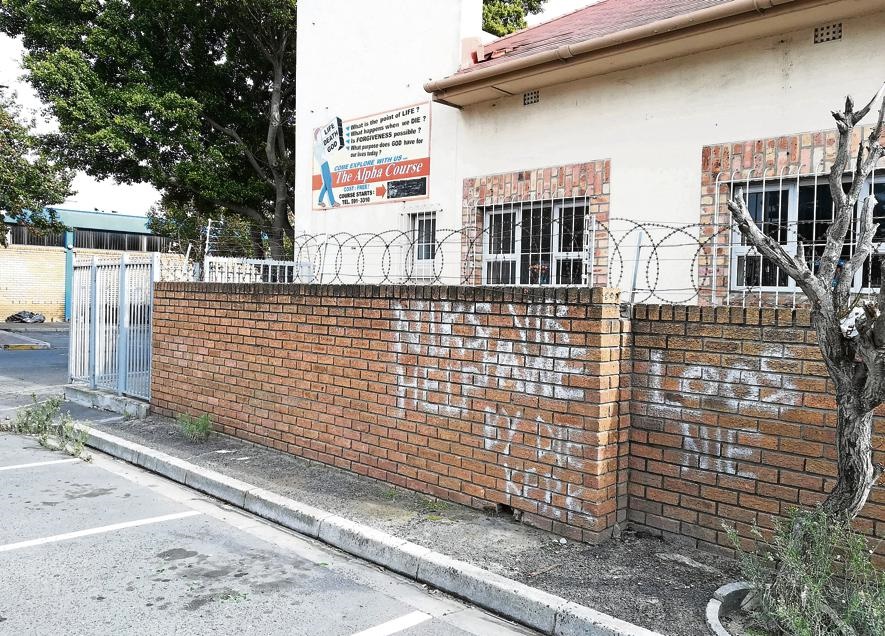
A graffiti message stating “there’s no help for the homeless at this church” (Niks help vir haweloos by die kerk nie –sic), recently made its appearance on the border wall of the Goodwood Presbyterian Church.
The main entrance of the church is opposite the stretch of the sidewalk next to Goodwood Library in McDonald Street that has become a regular hangout and sleeping place for the homeless. “The person who wrote this message on the wall of the Goodwood Presbyterian Church needs help for they know nothing of the history of this church regarding the homeless, destitute people on our streets of Goodwood and surrounding areas,” says Loretta Napier.
Whether it was a resident or one of the homeless who wrote the message is unsure, but Napier, a young at heart 80-year-old who has been involved with the church since 1976, feels it is important to set things straight.
She says a soup kitchen was opened for the street people at the church in 1995. From this, a vision developed in having a shelter built for these desperate people. Prayers were answered, she says, and on 2 September 1997, the Elim Night Shelter in Third Avenue Elsies River opened its gates for the homeless.
“We have offered to take them off the streets and even have sponsorship for those who cannot afford the shelter, but unfortunately and very sadly and heartbreaking many refuse to be helped. We do not encourage handouts but rather hand-ups for these people need to be helped to come off the streets.
“This is what the church has done for the homeless street people and it is still active in doing so,’’ she says.
Napier says when the shelter was opened all the churches in Goodwood were approached and those 12 churches are all still serving at Elim Night Shelter.
‘‘They serve food parcels, they serve soup, all kind of things – and they all know that it’s not about handouts but hand- ups.”
From years of experience in dealing with the homeless she says, what has changed is that the homeless, they are dealing with today are more aggressive and this is probably drug and alcohol-related. “The problem is there are those that want to be helped and those who do not want to be helped. You can’t force anybody into a shelter.”
There is also a church service at Elim every Sunday night, which is led in turn by the various churches in the community. Napier says anybody is welcome at the shelter – ‘‘whether they are Muslim or Jewish, no matter who – we will allow them in, but they must abide by Christian principles. If they don’t want to come in, that is their choice, but once you’re in you abide by the rules.’’
People are taught various skills at Elim, from woodwork, needlework to computer skills, which they can take with them when they leave.
“It’s not just a shelter it’s more than a shelter.” For Napier it is about glorifying God by helping others.
“Many street people get raped or murdered on the street, which is why we really try and encourage them to get off the street. The more handouts we give the longer we encourage them to stay on the street.”
She says for a while some come to the church services, but then they stop.
‘‘You can only help that much. If they think we are just going to give them food, no. We do everything we feel necessary to do.”
If there might be a perception among some that churches simply give blindly, Napier says, “we are not giving to them to get rid of them, we are giving to build them up.’’ This, she says is why they are not going to hand out parcels.