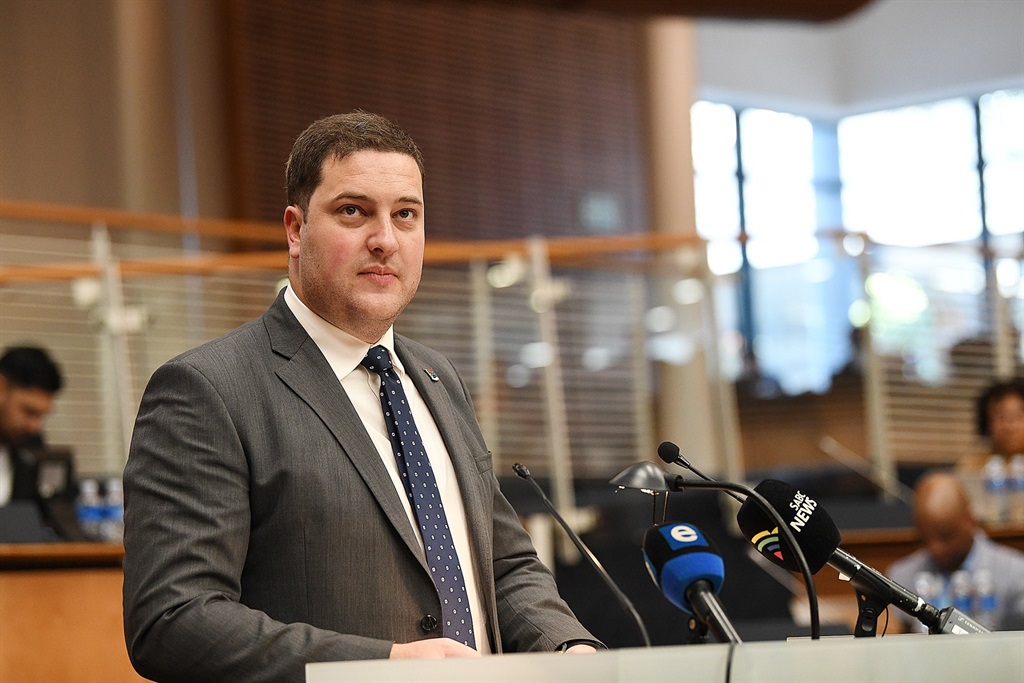


In a bid to increase the dismal criminal conviction rate in Cape Town, Mayor Geordin Hill-Lewis has formally requested police minister Bheki Cele to devolve full crime-fighting powers to the City’s police officers that will enable them to investigate crime.
Hill-Lewis made the announcement at a full sitting of the council on Thursday.
Hill-Lewis invoked Section 99 of the Constitution that stipulates that a cabinet member may assign any power of function to a municipal council.
“Accordingly, I have written to the minister to request that he uses his constitutionally-enshrined power to give us the policing powers we need. Minister Beki Cele has previously said that he cannot devolve power in the absence of a constitutional amendment . . . but that is nonsense,” said Hill-Lewis.
He referred to a recent study that found that 48% of South African Police Service detectives in the Western Cape have a caseload of over 200 dockets per officer.
“This is 333% above the norm. This problem is compounded by the current shortage of more than 500 police detectives in the province. It is common cause that the police have a woeful conviction rate. Lost dockets, lack of evidence and corrupt officials are staple features of police investigations, which is why so many criminals still roam our streets, terrorising communities. These failures give the many hard-working police officers a bad name, and erode public trust in the police,” he said.
He noted that devolution is an overarching government policy.
“It is not good enough for us to increase our policing power; we need to expand the powers of our city officers as well. We are a capable government, and we are capable of achieving much more if the national government devolves more power to us. Our metro police and law enforcement officers do an incredible job, but they do not yet have all the powers envisaged in the Constitution to win the war against crime.”
“Specifically, our officers are limited to crime prevention in the main, with limited scope for criminal investigations. While we already use that existing scope to the full, and we are fully confident in our power to do so, we also want to do so much more. We could be doing so much more to help the police build prosecution-ready case dockets. Instead, our officers have to rely on an overwhelmed and under-resourced police force that, frankly, does not have the capacity to investigate crime properly.
“We want our own fully-fledged City police force with all the powers it needs to drastically reduce crime in Cape Town. And, if the minister is not prepared to give us the powers we seek, we will fight tooth and nail to get them. We owe it to the millions of people in this City who live in fear of crime.”
The Tygerberg cluster Community Police Forum (CPF) fully supports the move of bringing more authority to the local metro police service.
Chair of the Tygerberg CPF Sean McCleland says “it will only assist our communities in giving the police more power to concentrate on proactive policing strategies as apposed to reactive policing, whereby violent crime can be prevented instead of the police just picking up dead bodies”.
He furthermore said this move, if successful, will greatly assist the police in that metro police and law enforcement will have more arresting powers for various offences ranging from control over taxis to drug offences and property crimes.
“It will give the police greater force multipliers in reducing violent crime in our communities,” said McCleland.