

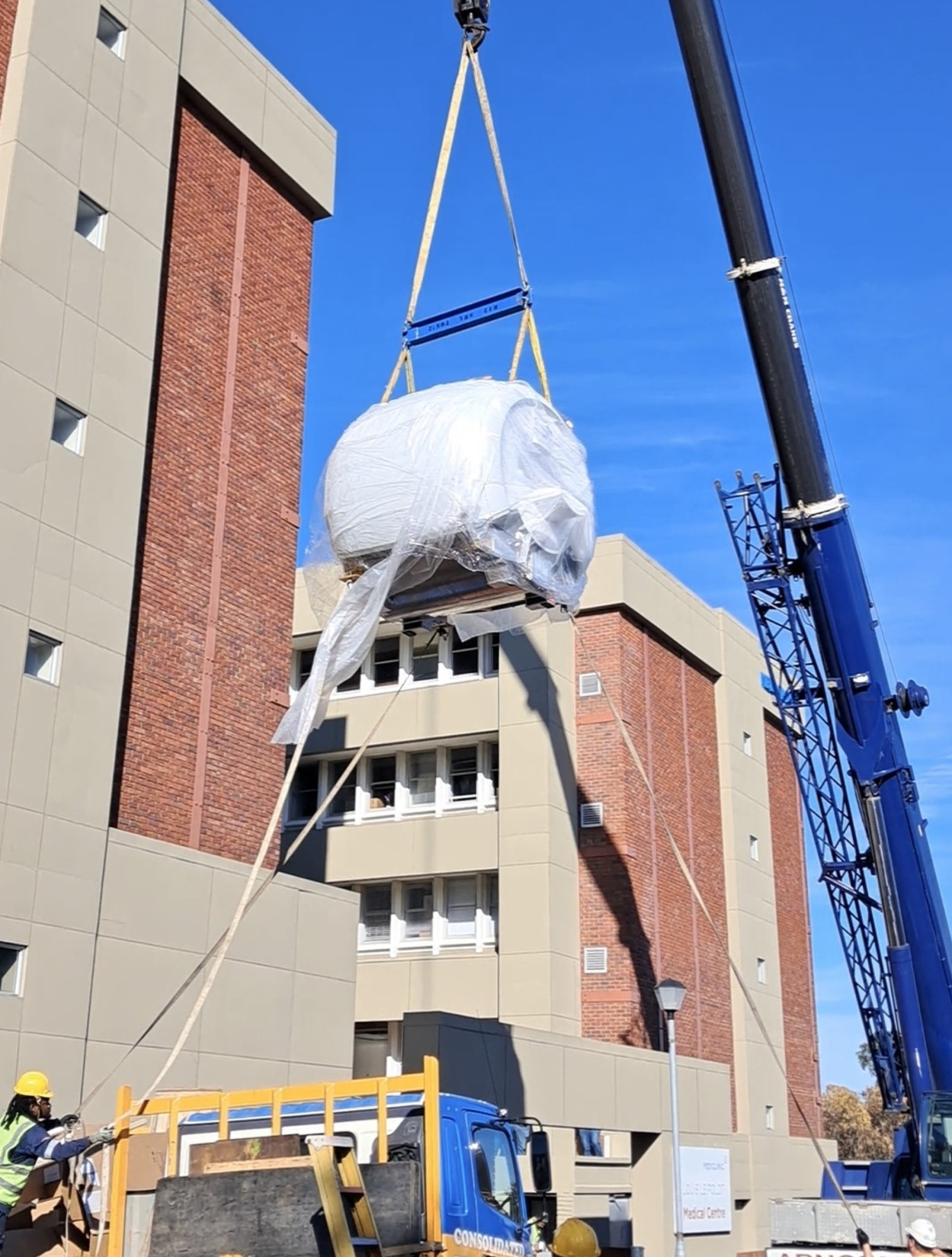
Mediclinic Louis Leipoldt in Bellville has become the first of three Western Cape facilities to receive a new low-helium MRI machine as part of a rolling upgrade programme by SCP Radiology. The Bellville installation, which ran from 16 April to 3 June, is complete — and attention now turns to Vredenburg and Worcester, where the same process is yet to unfold.
Two more to go
With Bellville done, SCP Radiology Vredenburg at Life West Coast Private Hospital in Vredenburg is next, scheduled to run from 27 June to 3 August. SCP Radiology Worcester at Mediclinic Worcester will follow, with timelines still to be confirmed.
“It is far more complex than moving almost any other piece of hospital or healthcare equipment. And our practice is doing it across multiple sites over the coming months,” says Tinus van Rooyen, Business Project Manager at SCP Radiology. The Louis Leipoldt installation has set the benchmark for what lies ahead at each site.
A crane, a closed road and a wall that had to come down
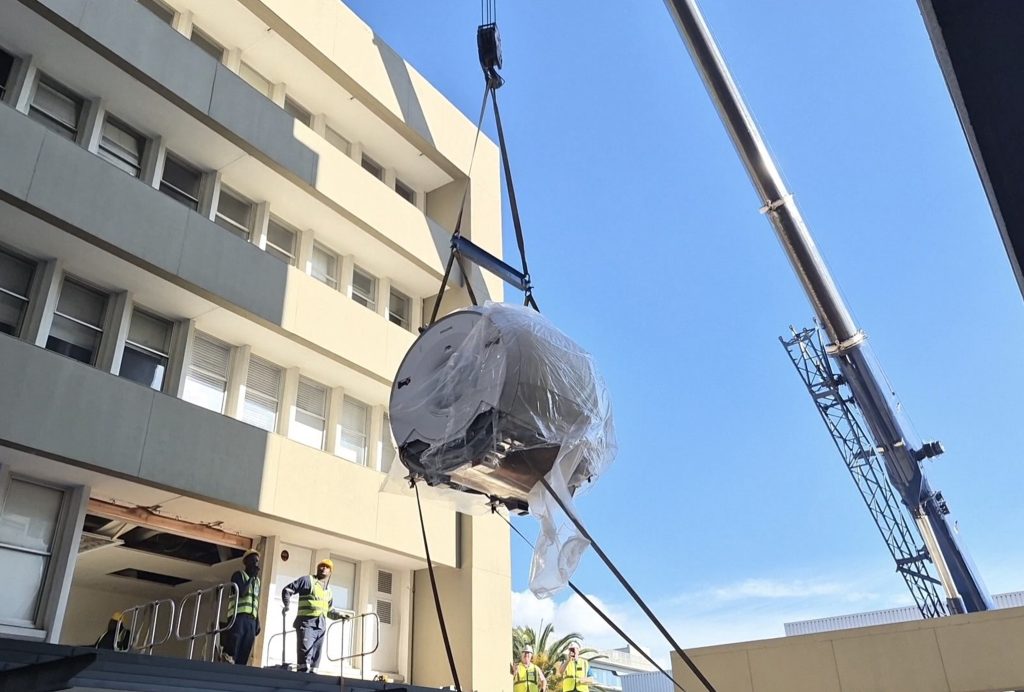
Residents who drove past Mediclinic Louis Leipoldt between April and June may have noticed something unusual: a section of road cordoned off, a crane towering above the building, and a large opening where an external wall once stood. The MRI machine was making its way to the first floor — and that single logistical fact shaped the entire operation.
A specialised platform was constructed outside the building, part of the external wall was removed to create access, and the road was temporarily closed to allow for safe offloading and lifting. A crew of 10 riggers, who have partnered with SCP Radiology for over a decade, managed the delivery. In addition to the 3.3-tonne machine itself, 90 boxes of additional electronic equipment and supplies were offloaded.
ALSO READ: Springbok star Handré Pollard welcomes baby girl at Bellville hospital
“Getting the MRI into the building is a display in itself. Powerful cranes hoist the machine through a specially constructed opening. Every step demands precision to avoid damaging the magnet or the building,” says Heinie Matthysen, SCP’s Facilities Manager. “Everything is planned in minute detail — however, we also have to factor in the Cape Town weather, which has a mind of its own,” adds van Rooyen.
Why the machines are being replaced
MRI machines have a lifespan of approximately 10 to 15 years. As they age, they reach End of Support — the point at which manufacturers no longer maintain the unit and spare parts become unavailable. “It becomes unreliable to keep running. Patient care is paramount, as is minimising potential downtime and ensuring continuity of service,” explains van Rooyen. The upgrades also give each facility access to the latest imaging technology, improved image quality and an enhanced patient experience.
What makes the new machines a step forward
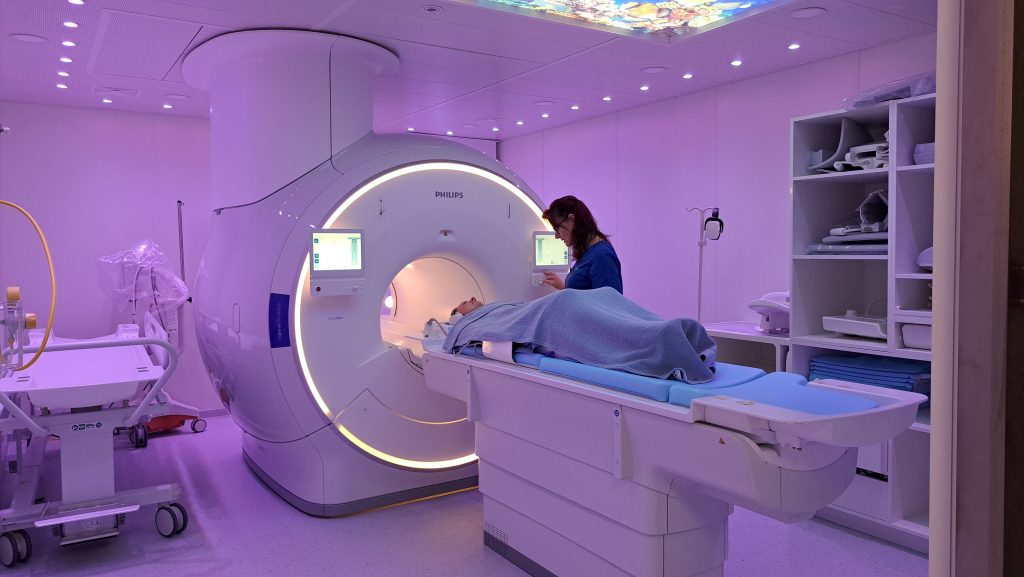
The machines being installed across the three sites are low-helium MRIs — and the difference in resource consumption is significant. A conventional MRI requires around 1 500 litres of helium to operate, with regular top-ups required. The new machines use just 7 litres across their entire lifespan and require no refilling at all — less than 1% of what a conventional unit consumes. This matters because helium is a non-renewable and relatively scarce resource, with approximately 32% of current global consumption going to MRI machines.
There is also the risk of a quench — the rapid, unplanned discharge of the superconducting magnet that releases all stored helium within minutes. This is extremely expensive and, in a third of cases, results in more than three days of downtime. The new machines eliminate this risk entirely. “The improvements in technology also ensure improved image quality,” says van Rooyen.
The room has to be built around the scanner
An MRI cannot simply be placed in any available room. At Louis Leipoldt, the space was purpose-engineered around the new scanner. A Faraday cage — constructed from copper to exact specification by a specialist supplier in the Netherlands and shipped to South Africa — surrounds the machine. It keeps external radiofrequency signals out so they do not interfere with the MRI, and keeps the machine’s own signals in so they do not affect nearby equipment. Additional contractors handled the copper cladding, drywalling, reinforced flooring, painting and joinery — work that will be replicated at each subsequent site. “Without shielding and safety systems, the images would be unreliable and the risks much higher,” says van Rooyen.
A process measured in weeks, not days
Each replacement takes up to eight weeks from start to finish. The old machine is ramped down — a controlled reduction of its magnetic field to zero — before being disconnected and removed. The new unit is installed, cooled to a superconducting state, and ramped up gradually until it reaches its specified field strength, before being calibrated and cleared for patient use. Continuity of service was maintained at Louis Leipoldt throughout, with alternative arrangements



You must be logged in to post a comment.