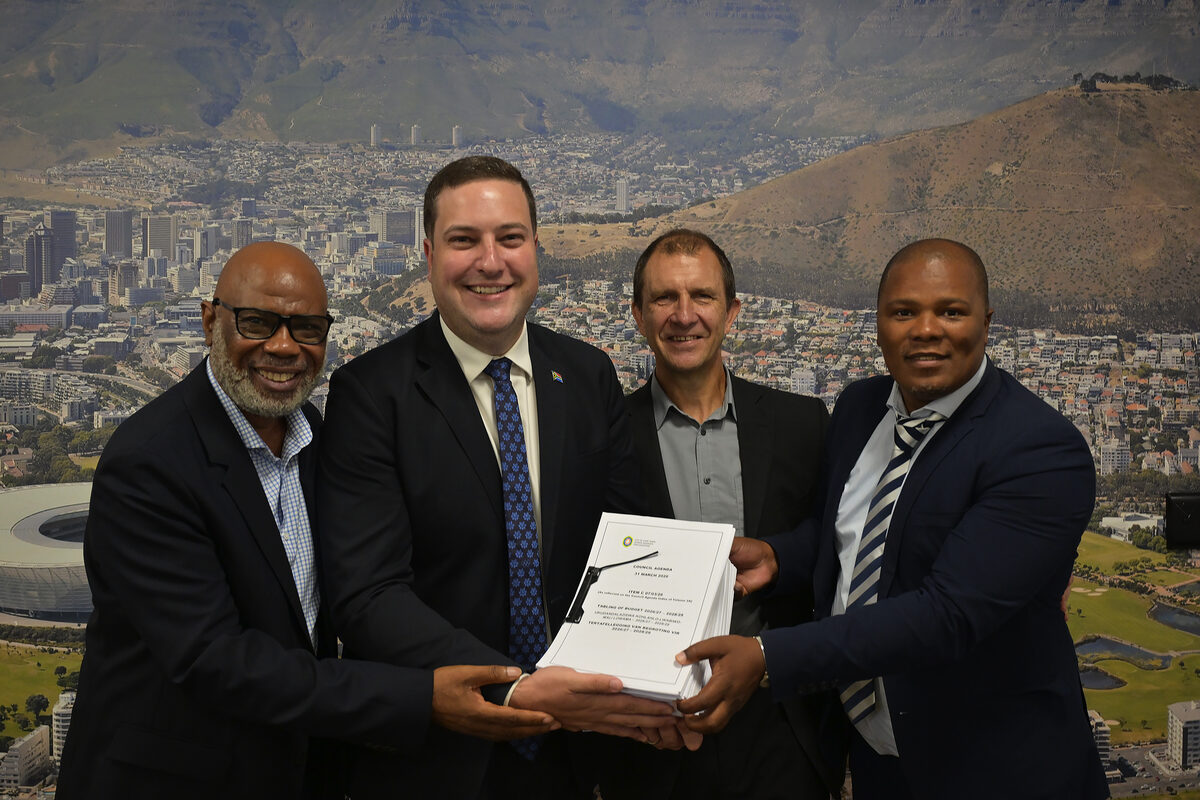


With an increased budget of R61,5 billion for the 2022-’23 financial year, Cape Town Mayor Geordin Hill-Lewis made bold promises to “do more” for Cape Town residents.
The draft budget was tabled by the mayor at a City council meeting on Thursday.
Hill-Lewis said the proposed budget provides for extensive capital expenditure of R7,8 billion, but that it is crucial that the City actually spends the money, as opposed to the underspending last year.
He said this was unacceptable, and that the City’s senior management team will from now be held accountable for the capital budget.
A total of R53,6 billion was allocated for the operational budget, the biggest slice going to employee costs of R17,4 billion, followed by bulk electricity purchases at R12,3 billion and contracted services at R8,5 billion.
In the safety and security directorate a budget of R770 million over the medium term will provide for 230 new safety and security officers, the 24-hour operationalisation for traffic, metro and law enforcement services and procuring crime-fighting tech such as body and dashboard cameras, drone and aerial surveillance technology, gunshot-location pinning, and more CCTV.
Hill-Lewis says the City must do more to end the killing and senseless violence in Cape Town.
“It angers me that the South African Police Service and the national government continues to under-service the most violent areas of Cape Town and surrender our residents to criminals. This budget is an attempt to fill the gap left by the police.”
The City will spend at least R8 billion on water and sanitation infrastructure in the next three years, with R1,6 billion this financial year alone.
He admitted that the City had not sufficiently invested in maintenance and refurbishment of the sewerage infrastructure resulting in extensive problems that require major infrastructure investment.
“The poor state of our infrastructure network threatens the health of citizens and we are taking immediate action to fix these problems. On top of the R25 million we budgeted in January, we add another R24 million for jet vac vehicles to provide immediate relief to the number of blocked sewers and the length of time it takes to get them unblocked. Residents can expect more preventative jetting and clearing of the sewer system and faster responsiveness on sewer spills,” he said.
This amount includes R406 million for the replacement of the Cape Flats main sewer, R755 million for the replacement and upgrading of pipes on the sewer network, and R300 million for the replacement and upgrading of pipes on the water network.
“We will double our pipe replacement to 50 kilometres this year, and in 2023 we will double it again to 100 kilometres,” he said.
Some R784 million was allocated for waste management in informal settlements and R650 million will go to replacing the waste collection fleet of vehicles to improve on overall waste collections.
“Our R7,8 billion capital budget will meaningfully enable economic growth with new infrastructure to support economic activity. We are also doing more to upgrade existing infrastructure. Also, R50 million more is budgeted for maintenance in this financial year alone, which will see buildings being painted, community halls being repaired, playground equipment kept in working order, gardens and parks being tended, and carpets in libraries being cleaned.”
A total of R3,8 billion is set aside for capital expenditure in the energy sector over the medium term and the City will be spending R48 million in its initial push to end load shedding. Over the next three years the City plans to spend R45 million to enable and incentivise residents to self-generate and sell their excess energy to the City.
Hill-Lewis said R1,2 billion will be spent on the refurbishment and upgrade of the Steenbras Pumped Storage Scheme, currently our primary means of mitigating load shedding.
“This project will increase the efficiency and power output of the plant, and extend its operating life. A further R10 million this year is allocated to ensure our first bid round of IPP procurement is finalised as soon as possible.”
To address the shortage of housing the City has set aside R2,8 billion for capital expenditure over the next three years to upgrade informal settlements, social housing and support for backyard dwellers.
In addition, the City will be releasing state-owned land for the development of social housing close to transport nodes and economic opportunities.
In the transport sector R6,4 billion was allocated over the next three years, with R696 million this year to expand the MyCiti bus system, which will link Mitchells Plain, Khayelitsha and Philippi with Claremont and Wynberg.
The budget is set to directly support job creation and entrepreneurship. For this R424 million is set aside for investment promotion, and R181 million for direct economic incentives to attract jobs and investors to Cape Town. Another R53 million is budgeted for upgrades to informal trading infrastructure and R55 million is allocated to the City’s Jobs Connect and Cape Employment Accelerator programmes that focus on placement and skills, for especially young people.
To support the poor the City’s social package amounts to R3,75 billion, which includes R1,4 billion in rates rebates and R2,3 billion for indigent relief.
“This will ensure that Cape Town continues to have the broadest free basic services reach of all the metros, with 40% of households receiving free basic water and sanitation, and 27% benefitting from free electricity on the lifeline tariff. This is compared to around 15% of households in Gauteng on these indicators,” he says.
To fight the ever-growing homelessness crisis the City’s programme to help people off the streets has been increased to R77 million in this budget. A further R10 million will go directly to increasing beds at shelters this winter, and R142 million is set aside to operate and expand City-run shelters in the next three years.
“Like other cities around the world, we are faced with complex social problems, such as the worsening crisis of homelessness in our city.”
He concluded by saying that the draft budget is being met by modest tax and service tariffs, knowing that it is still a substantial burden commitment for residents.
“Ours is a vision of a Cape Town where people are prosperous, free, safe, and living in dignified conditions,” he said.