
If you’re a frequent visitor to Majik Forest, you are in for some proverbial (and ecological) magic.
The Wildflower Stepping Stones Project (previously called the Tygerberg Renosterveld Community) will be expanded in the park, with a large piece of land earmarked for a locally indiginous Renosterveld garden.
It is located at the left of the park, on top of a hill, if you enter the park from the bottom gate.
“In summer this area is quite hot and dry, and many visitors skip this uphill route as a result,” Dalena Theron, a representative of the project, says.
“It’s about to become Majik Forest’s most noteworthy attraction. This piece of land has been earmarked for a locally indigenous Renosterveld garden, designed by the talented, well-known landscaper and botanist, Leon Kluge.”
In short, because there is so little of it left, says Theron. According to the South African National Biodiversity Institute (SANBI), there is only about 5% of Swartland Shale Renosterveld left – until recently still in abundance in the Tygerberg area. There are different types of renosterveld, with different types of charactaristics, which are all part of the fynbos biome.
“This type of renosterveld consists mostly of bulbs such as Watsonias, Gladiolus lilies, Beetle lilies, Cape Tulips and Cape Buttercups, and the Asteraceae family – daisies – as well as shrubs and grasses.”
Theron says Renosterveld is known as the richest bulb habitat on earth.
“Renosterveld harbours unique plants like the Skilpadbessie (Muraltia spinosa), which features strikingly bright, tiny violet flowers and is best propagated by passing through the intestines of a tortoise.”
Swartland Shale Renosterveld grows on fertile soil, which means it is highly threated by farming and urbanisation, the cause of the sharp decline over the years.
“It stands to reason then that good urban planning is the best way to preserve and restore what we used to have – enter the Majik Renosterveld Garden.”
The plan
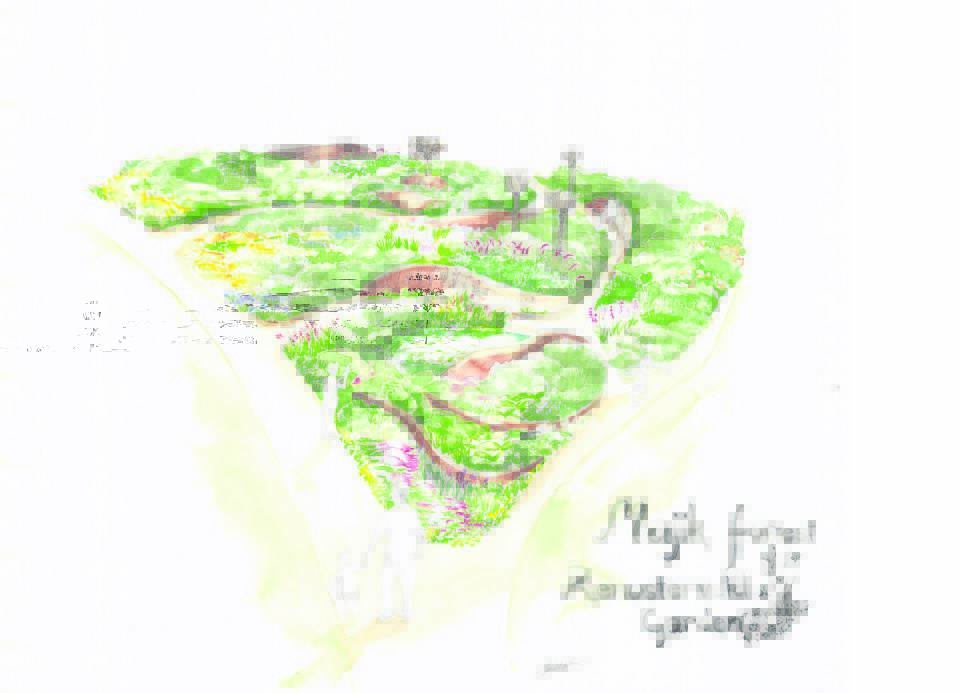
Theron says Kluge’s design (done by artist Tristan Woudberg) “sits at the forefront of international design trends – it puts the environment, and locally indigenous gardening, at the heart of it.”
The eventual garden will showcase the benefits and beauty of the local plants.
“(There will also be) sections for a seasonal pond, annuals and bulbs, as well as floral sculptures made from found materials in the area.”
As per the project’s name, the ultimate plan is to create a “stepping stone” for pollinators and birds, which will make it easier for them to travel betweek parks and to and from the Tygerberg Nature Reserve to the Durbanville Fynbos Reserve.
This could also be a safe haven for other wildlife such as chameleons and tortoises, Theron says. “(They) rely heavily on the critically endangered locally indigenous vegetation for survival.”
Anel Botha, another representative, says they get their plants from Lynda Muller from Bristle Nursery who is a restororation ecologist with permission from CapeNature to grow them as long as there is a specified place to plant them.
Get involved
The project needs help from everyone in the community.
“The Wildflower Stepping Stones Project need help for this garden.
“This garden, like in fact the whole project, relies heavily on community involvement, and a garden of this size and magnitude needs resources.
Every bag of cement, every cubic metre of sand and gravel mix, laterite is appreciated,” Theron says.
They are grateful for any donations and are looking for the following:
- A digger loader for two days.
- 6 cubes building sand
- 40 bags cement
- 3 cubes gravel for concrete mix
- 30 cubes laterite (can be old, dug-up laterite recycled from somewhere else) for paths
- Cash donations to buy the above
Send an email to wildflowersteppingstones@gmail.com for more information or if you’re able to contribute any of the above items.
- Alternatively, you can make a cash donation to the fund that looks after Vink se Tuin (the trees at the bottom entrance of Majik Forest), and of which this garden is an extension.