

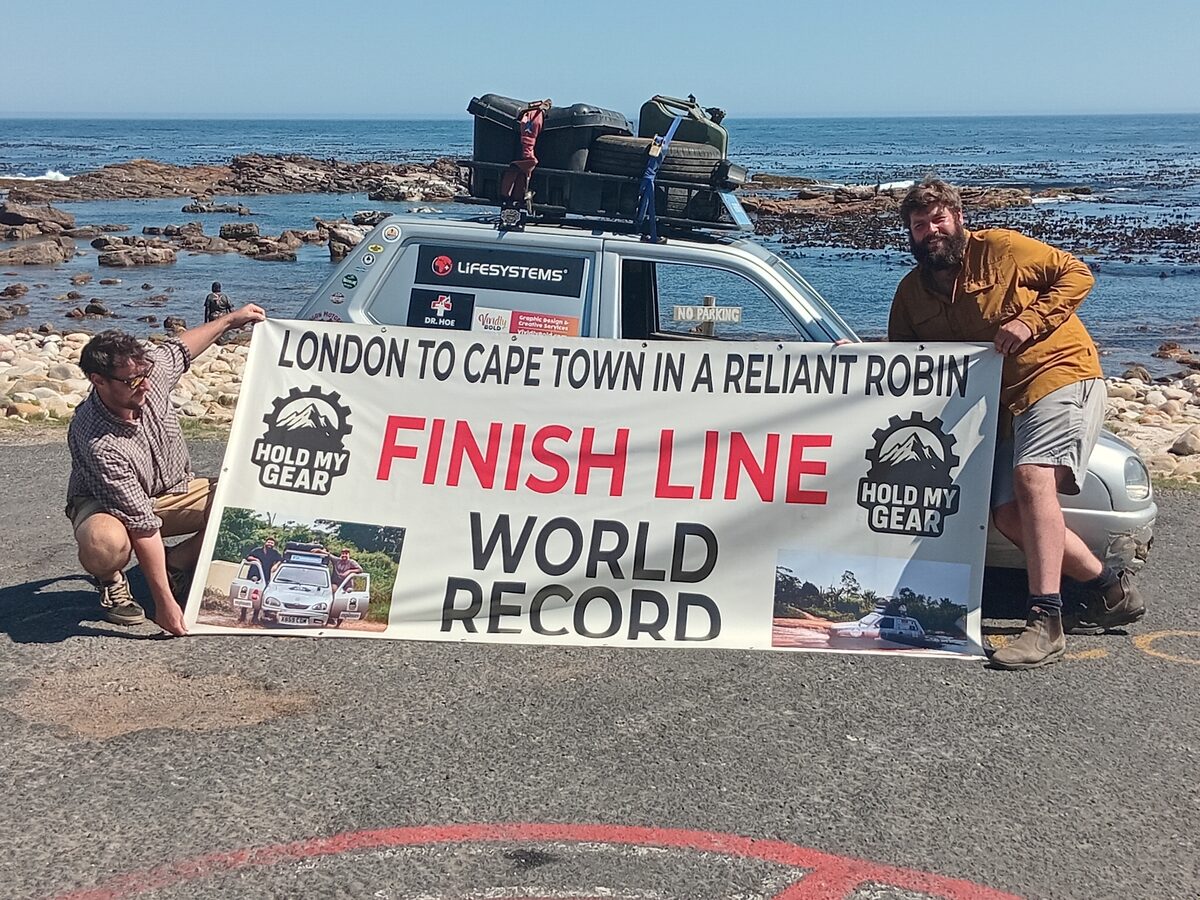
“This is the worst thing I’ve ever done but the greatest,” said Seth Scott, a Vancouver native who became one of the first men to drive across Africa in a three-wheeled car.
“It was f*cking terrible,” said Ollie Jenks cheerfully, after the pair finally made it to Cape Point, the most south-westerly point of the African continent on 11 March.
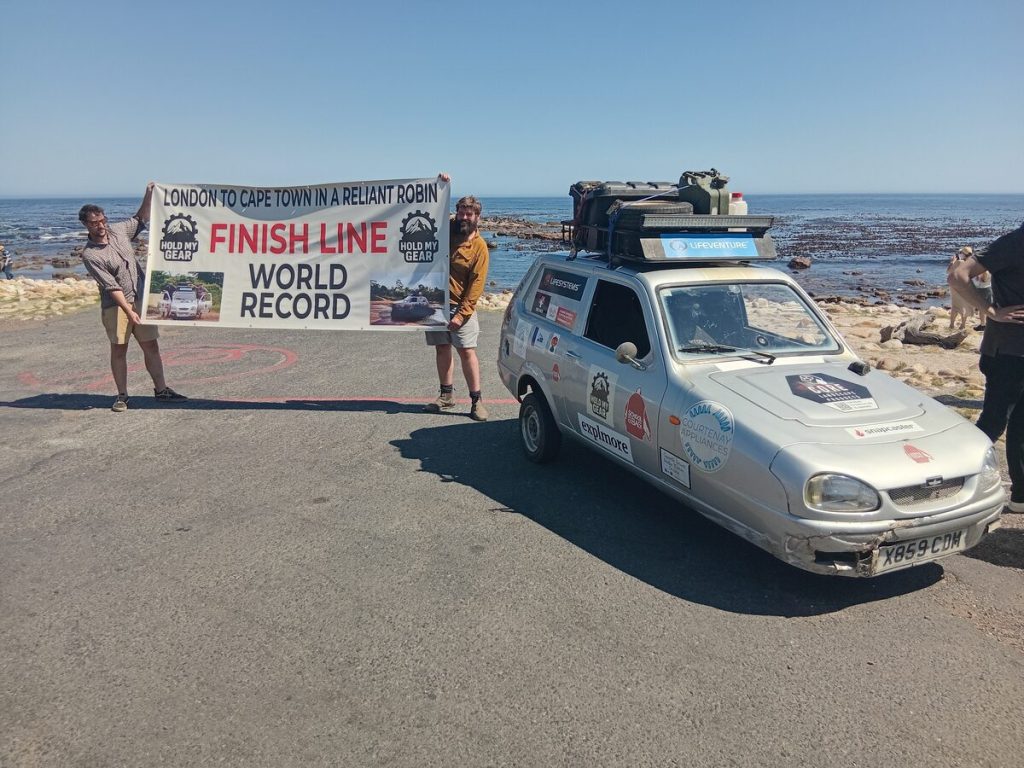
The duo made the journey in a Reliant Robin, a cheap fibreclass car that has motorcycling ambitions. The car is considered iconic in Britain where it was produced between 1973 and 2002 and where it can be driven with a motorcycle license. According to Scott and Jenks’ Instragram channel, @hold.mygear, the car they drove to achieve the world record, nicknamed Sheila, was the last of its kind.
They met, they planned, they drove
The unlikely partnership began during the 2018 Mongol Rally when Scott and Jenks first met at the Iran-Armenia border, both driving “crap cars” from England to Mongolia.
“The idea has been in my head for about seven years, growing,” Scott said as he chatted with fans who graduated from being social media followers to literal followers on the day.
Scott said it took about another eight months of extensive planning before they chose the notoriously unstable Reliant Robin for their African adventure.
“I saw someone driving a Reliant Robin on the Mongol Rally, and I thought, ‘what could be something even crazier to do in a Reliant Robin?’” Scott said.

Potholes and perils
The 24 000km journey was plagued with problems including engine failures, multiple brake breakdowns, and countless border delays, all of which they chronicled on social media. Their biggest setback came in Cameroon when their engine suffered complete failure.
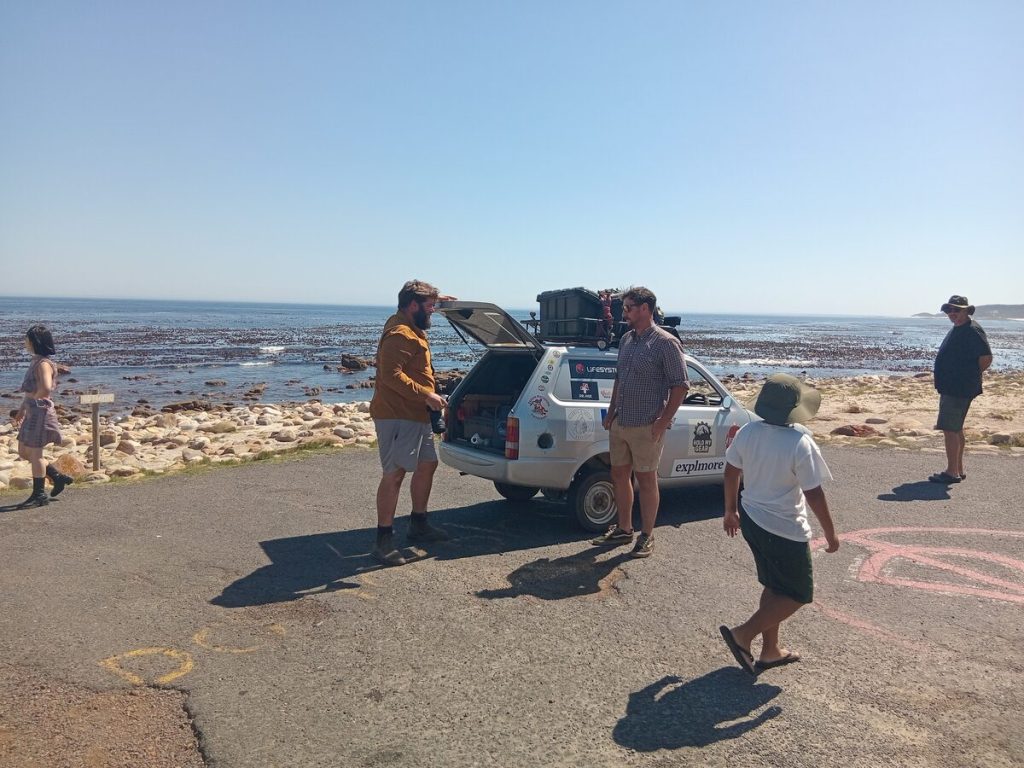
Scott enthralled local car enthusiasts with the stories of destruction when they met at Cape Point. He said they had to have a replacement engine shipped to the Congo region, where they rebuilt it themselves.
But engine failure was just the beginning of their mechanical woes. They replaced five wheel cylinders and four sets of brake shoes during the trip, with brakes failing every 5 000 kilometers due to the weight distribution on the Robin’s drum brake system.
“It was a lot of stress and anxiety, being push mechanics,” Scott said.
An axle failure in Congo presented another challenge, as they needed to find a vehicle with approximately 50 horsepower on the rear end — nearly impossible in a region dominated by heavy-duty trucks.
Border battles and route reality
Administrative challenges proved almost as difficult as mechanical ones. What should have been 30-minute border crossings often stretched to two to three hours, with Morocco’s border control taking six hours due to strict documentation requirements for their unusual vehicle and carnet de passage — essentially a passport for the car.
“Visa planning, logistics, also judging conflicts, looking into conflicts, coups. There were coups while we were on the way here,” Scott said.
Road conditions varied dramatically across the continent. While Namibia and Angola offered “quite good roads”, most other countries were “pretty dodgy”, according to Jenks.

Stranger things
Scott and Jenks also encountered many Samaritans and sponsors along the way, including in Cape Town, where a stranger promptly handed a bottle of champagne and glasses to them on their arrival.
Several other “crank heads” were also eagerly awaiting their arrival, including members of the Crankhandle Club, based in Wynberg, who arrived in an impressive collection of vintage cars and met the adventurers at their pitstop in Constantia.
The entourage followed the cranky Sheila as she trundled, almost Flintstone’s style — at an average speed that appeared to be about 40km an hour, to the pitstops along the Cape Town leg. These were Engen N1 Winelands South, Constantia Village, Lakeside Fire Station, Cape Point, Chapman’s Peak Large Lookout and The Bay, False Bay RC.
ALSO READ: South Africa’s largest printed QR code unveiled at Eric Miles Cheshire Home
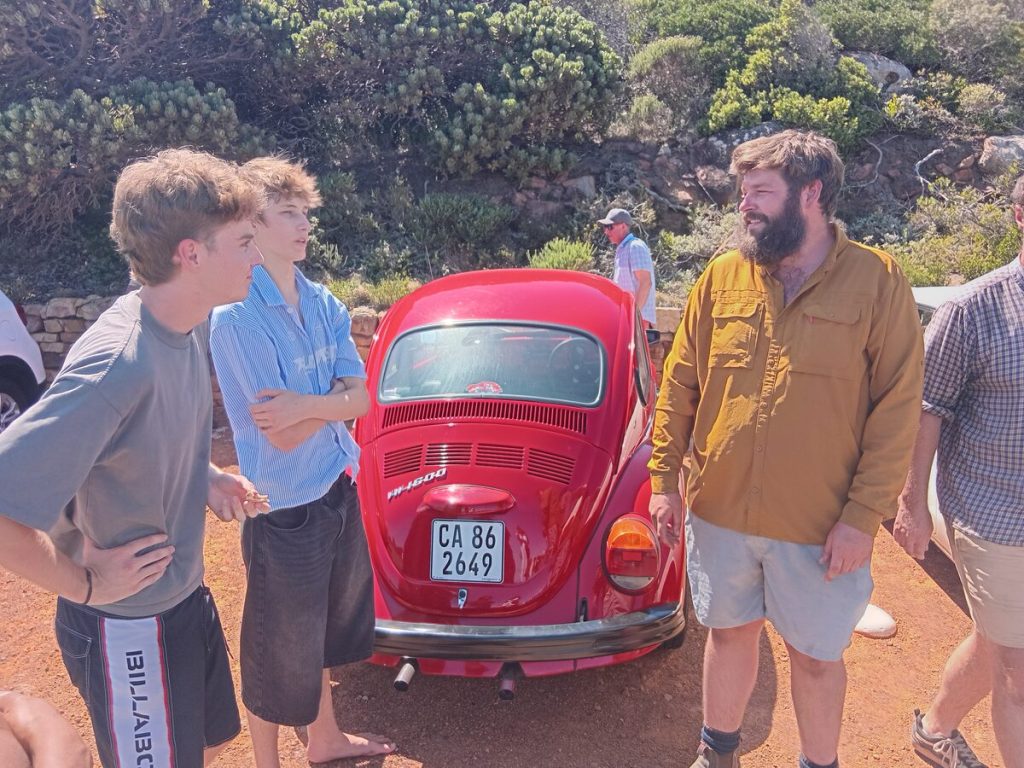
By the time they reached Cape Point, hours later than planned, their following had grown to include several more fans, including Presley Ofsowitz (18) and Luke Hare (19) of Fish Hoek. The teens are huge fans of the @hold.mygear channel and encountered the pair by sheer good luck. Ofsowitz said they were contemplating a beach outing and had deferred leaving several times, due to the heat wave, until eventually they decided to go, and just as they were getting out of the car at the beach, Sheila came by.
“As soon as we stopped, we were getting out of the car and saw the Chev and thought, ‘ooh that’s nice’,” Presley said referring to one of the Crankhandle Club’s cars. “Then we turned around and saw them and we realised straight away.”
They immediately joined the entourage in their bright red Volkswagen Beetle.
On-road support
The pair’s biggest follower however is Jenks’ girlfriend Rachel Garrison. Garrison flew to Cape Town on the duo’s expected due date, only to find they were severely delayed.
After spending some time in the city, surfing and meeting friends, Garrison travelled to Namibia to meet the pair at the country’s northernmost point with a support vehicle.
“They’d made it until there without a support vehicle,” Garrison said, adding that this was likely why it had taken them so long.
“But they would have made it one way or another,” she said. “They were determined.”
What’s next?
The record-breaking Reliant Robin finally made it to Cape Town after 130 days — a month later than planned.
She will now likely find a temporary home at a museum, with the Franschhoek Motor Museum being considered as a display venue. The car club members have offered to help facilitate the arrangement.
The duo hasn’t ruled out future adventures, though, mentioning potential plans for “another one coming home maybe like that, um, but you know, the east coast”, Scott said, amid champagne celebrations at the Cape of Good Hope.



You must be logged in to post a comment.