

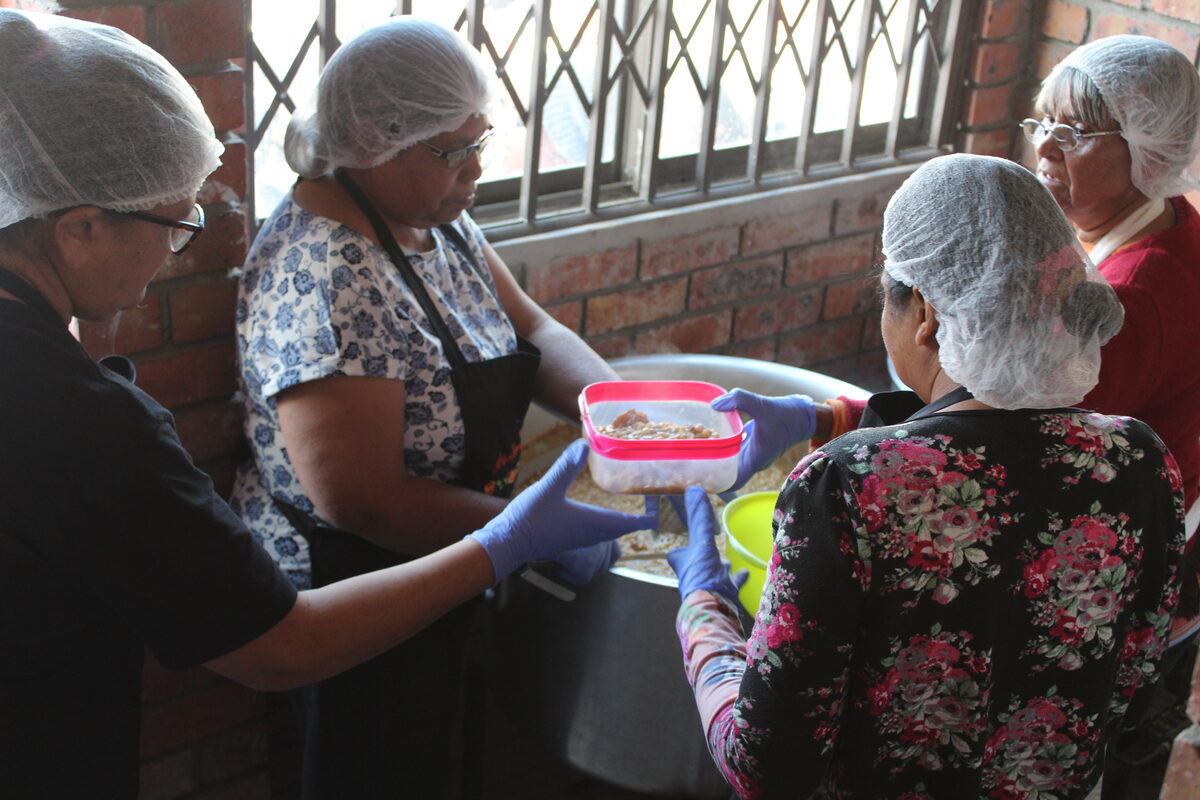
A small fracas breaks out in the queue for the soup kitchen in Morgen’s Village. Among the long line of people standing in the heat, a small argument breaks out about the size and number of containers that some people have brought.
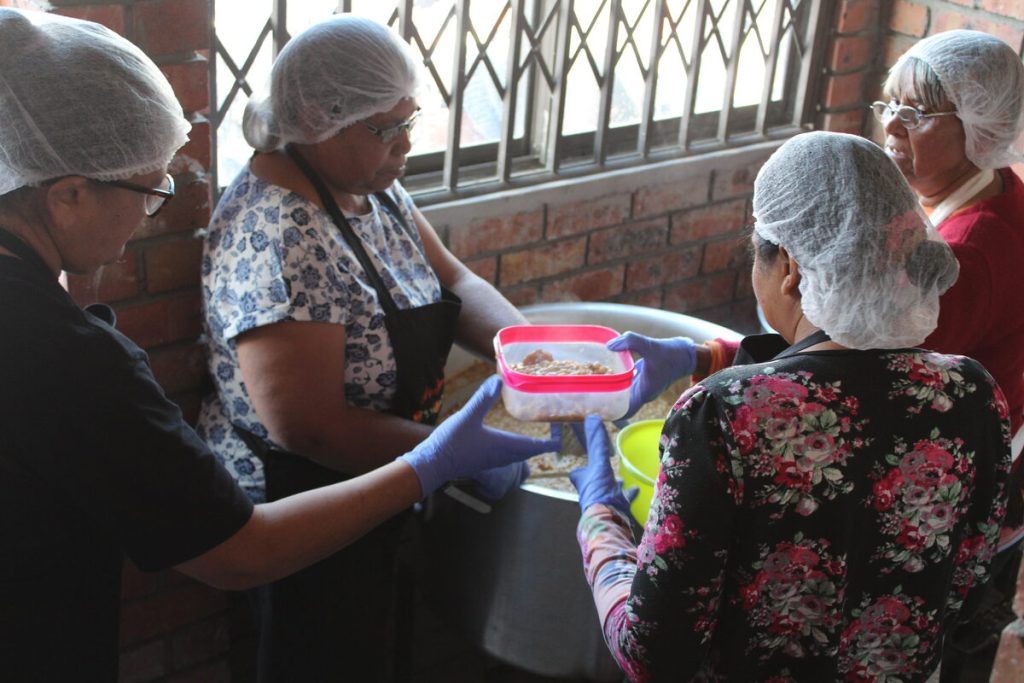
The group of women dishing the food keep an eye on the argument but don’t intervene at first. They have just filled the bowls of learners who come to the feeding scheme straight from school.
Their lunchboxes have not even made a dent in the 160-litre pot but the adults waiting in the queue can’t see this and a mild panic is spreading that those at the back won’t get their share if the people in the middle, who have brought empty five-litre ice cream containers, get to the front first.
A woman in a hair net stirs the samp and beans while her neighbour reassures the queue that there is in fact more than enough. Then they continue dishing as the queue slowly dwindles.
Inside the small dining room, on a couch tucked under the stairs, an elderly woman waits with empty containers which are all repurposed plasticware from store-bought items.
As Beverley Baron-Chongo passes, she takes the containers and tells TygerBurger: “This Ma is 86 years old but she comes every week to peel onions because she wants to contribute.”
Baron-Chongo runs Arise Shine Africa from her home in Morgen’s Village. The soup kitchen is just one of the non-profit’s projects.
Affectionately known as Aunty Bev by everyone, even women who are older than her, she started the soup kitchen in 2009.
At first the feeding scheme was just to feed the children who attended the NPO’s homework and afterschool programmes but as the years passed, the need in the community changed and now the project feeds anyone in need several times a week – depending on donations.
Increase since Covid
The biggest increase in demand came in 2020, during Covid, but it has not dwindled.
While Arise Shine Africa’s feeding scheme is almost two decades old, other feeding schemes in Mitchell’s Plain are much newer.
Many were born during Covid but the department of social development said they have seen a steady increase in NPOs with feeding schemes since 2020.
One such feeding scheme is the St Vincent De Paul soup kitchen at St Philip’s Catholic Church, Strandfontein.
The scheme was opened during lockdown but continued even after restrictions were lifted because the numbers of people coming to the scheme did not decrease.
Beverly Abrahams, who assists at the scheme, said that during Covid there were less than a hundred people that came every week and most of them were from the surrounding informal settlements. This number has steadily increased to more than 200 people a week but now also includes more people from within Strandfontein suburbia.
Social development support quadruples
Abrahams’ observations are in line with the provincial department of social development’s stats.
Department spokesperson, Esther Lewis, said they have seen an increase in demand for “nutritional support”.
“The department currently funds 102 community nutrition and development centres (CNDCs),” Lewis said.
Part of the increase was due to the 20 centres that were transferred from the national department in 2020.
“In addition to the CNDCs, the department also works with NPOs to support 54 community kitchens, who provide 2 106 000 cooked meals to beneficiaries per year,” she said.
The number of people getting support from department-funded feeding sites daily has almost quadrupled since 2020.
In 2018-’19 altogether 5 329 received support. In 2019-’20, 6 092. The following year the department saw a massive increase to 14 685 with a slight dip in 2021-’22 to 13 102. Over the next two years the increase had two big jumps from 15 922 in 2022-’23 to 22 128 in 2023-’24.
Furthermore, these stats don’t include the numbers of people being fed at schemes that are unregistered and are kept afloat by residents or businesses.
Households ‘feel the pinch’
“The number of South Africans living below the poverty line has increased since covid,” said Cape Chamber of Commerce president, Jacques Moolman.
He said the increase is one of the indicators suggesting that the average South African household is under “severe strain”.
“The latest national Household Affordability Index, compiled by the Pietermaritzburg Economic Justice and Dignity Group, shows that households are feeling the pinch,” he said.
Moolman said that year-on-year, the cost of the average household food basket increased by R153,48 (2,9%) from R5 227,14 in August 2024 to R5 380,62 in August this year.
Furthermore, the rising electricity and transport costs are also weighing heavily on households’ “disposable income”.
Moolman said that while the Western Cape appears to be better off than the rest of the country, at least 55% of people living in the province are experiencing “moderate to severe food insecurity” according to the 2023 National Food and Nutrition Security Survey.
“The Cape Chamber is partnering with key stakeholders in both the public and private sector to accelerate reforms aimed at bolstering the economy,” Moolman said.


You must be logged in to post a comment.