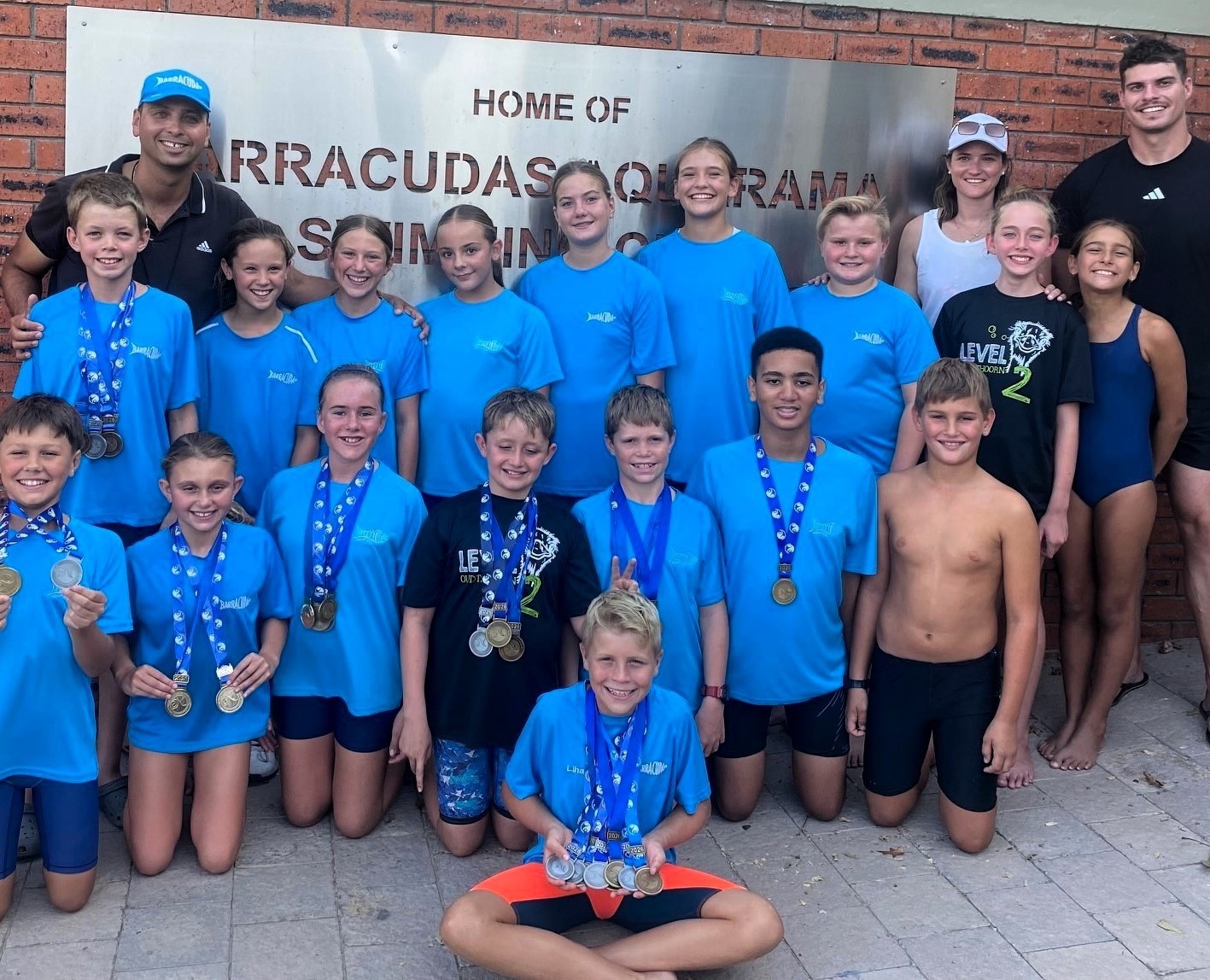


A local swimmer recently returned home with an incredible medal haul after he took part in the World Transplant Games in Germany.
Jeandré Geldenhuys (39) from Durbanville, a member of the Barracudas Aquarama, represented South Africa at the World Transplant Games in Dresden in Germany. He won three gold medals and two silver medals.
Jeandré, the South African record holder in 400m freestyle, also broke the 400m freestyle record at the World Transplant Games.
“Jeandré’s achievements highlight not only his talent and dedication in the pool, but also the resilience and determination that define transplant athletes worldwide. He is an inspiration to fellow swimmers and the community at large,” says his coach, Coenie van Graan.
“The Barracudas Aquarama, based at Durbanville Preparatory School, congratulates Jeandré on this remarkable success and is honoured to celebrate his journey,” he says.
Kidney failure
Jeandré was first diagnosed with kidney failure (glomerulonephritis) in 2013, and received a transplant three years later in 2016.
“To this day, we still don’t know what caused my kidneys to fail, because the doctors were hesitant to do a biopsy. They weren’t sure which kidney was the stronger one and feared that testing could damage it,” he explains.
“I consider myself very fortunate that I never had to go onto the transplant waiting list. From the start my wife wanted to be my donor. That said, the process was far from simple. There are many hurdles to overcome, especially when your living donor isn’t a blood relative.
“Recovery is different for everyone. In my case, I faced an early setback when my white blood cells started dying, and I had to return to hospital. After extensive testing, the doctors discovered that the antibiotics I was on were too strong. Once that was sorted out, my recovery became much smoother – and I’ve been moving forward ever since,” he says.
Potential
He first got into swimming back in 1994 when his primary school offered swimming lessons. “My swimming teacher noticed something in me right away. After only my second lesson, she told my parents that I had potential and suggested I join the local swim club. That was the start of my journey, and now, 31 years later, I’ve been swimming competitively for 24 of those years,” he says.
When he was diagnosed with kidney failure, he stepped away from the pool for six years.
“During that time, my doctors told me about the Transplant Games and encouraged me to consider competing once I received my transplant. Given my background, swimming was the natural choice for me to return to,” he says.
Jeandré and Coenie first met years ago as young competitive swimmers. “We swam against each other at different clubs – Jeandré at Worcester Health & Racquet Club, and I was with Bellville Aquarama. Over the years, we became close swimming friends. At every gala where we crossed paths, we would chat, share experiences, and keep track of each other’s goals,” Van Graan says.
“In September 2022 Jeandré reached out. He was looking for a club and asked if I would be interested in coaching him as a transplant athlete. That was the real beginning of our journey together,” he says.
Hard work
“Breaking both the South African and World Transplant records wasn’t just about me – it was proof that the hard work, the tough days and the doubts were worth it. And it wasn’t done alone. Even though swimming is called an individual sport, it takes a team to get you there. For me, it also means honouring my donor, because without that gift of life, none of this would even be possible.
“It honestly hasn’t fully sunk in yet, but I’m proud of what I achieved. Still, the Games are about far more than medals and records. They’re about showing the world – and especially South Africa – that life after a transplant is full of possibilities,” he says.
“The Transplant Games may not be on the same level of visibility as the Olympics, but this is where transplant athletes prove that we shouldn’t be put in glass boxes.
“We’ve been given a second chance at life, and we can use it to inspire and make a massive impact.
“What matters most to me is using this platform to raise awareness for organ donation and to highlight the stories of other South African transplant athletes. Each of us carry the message that transplantation works – that it gives real people real second chances,” he says.