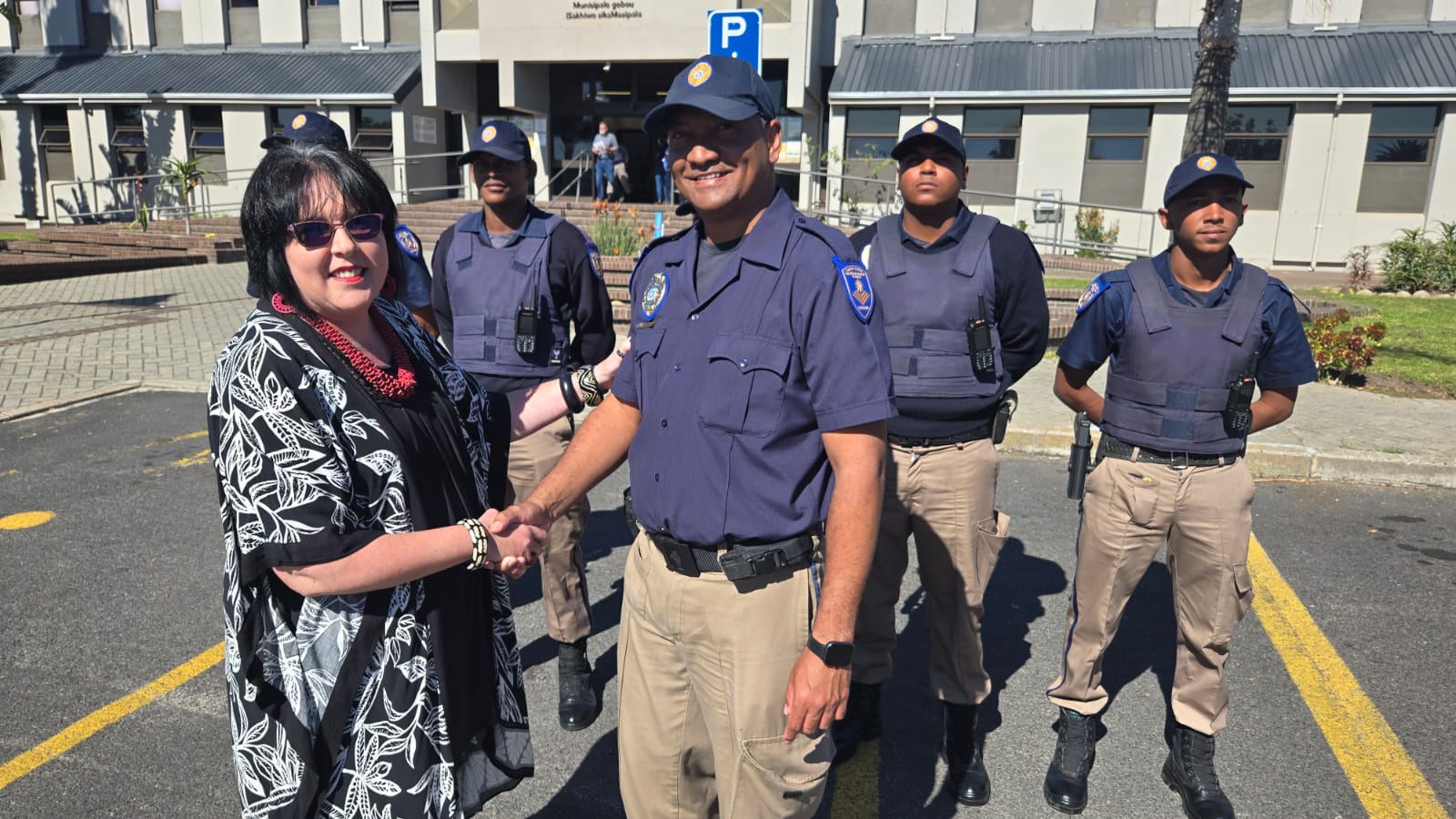

Durbanville will be awarded a total of 25 metro police officers by the end of the first week in September.
This is part of a citywide project in which each of 93 of the 116 municipal wards in the City of Cape Town will be awarded five metro police officers.
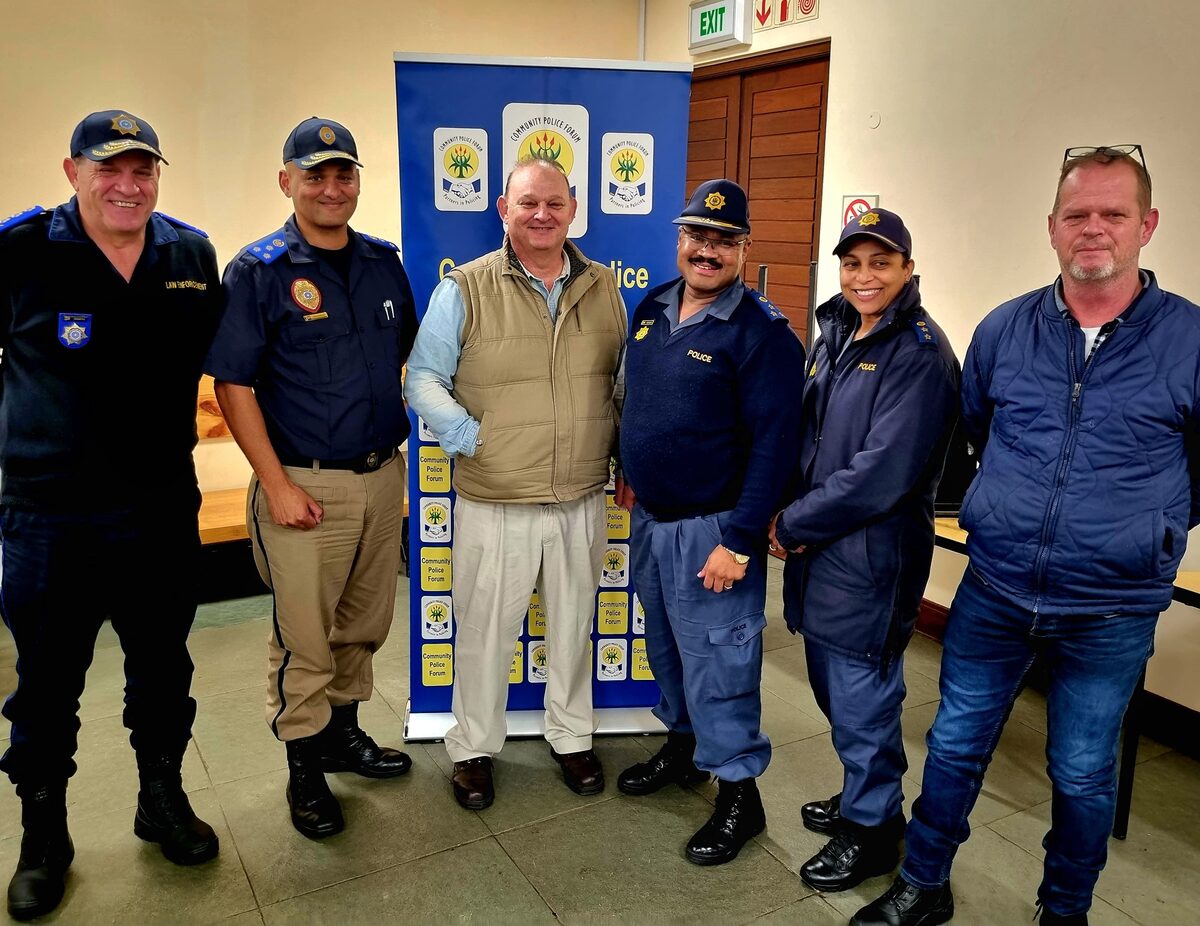
This was shared by Petrus Robberts, director for policing and enforcement of the City, at the recent monthly meeting of Durbanville Community Police Forum (DCPF).
“By 4 September Durbanville are getting five metro police officers per ward, which are 25 officers that will be allocated to Durbanville where they are going to be responsible to be visible, to mingle with the community and to get information from the community,” Robberts said..
The other 23 wards in the City will get Law Enforcement Advancement Plan (LEAP) officers, or already have LEAP officers, he said.
Final stages of training
The new metro police officers are currently in their final stages of training at the City’s Observatory college, according to a media release issued by the City yesterday.
“The 700 new officers are a key investment in a safer Cape Town as part of the City’s new Invested in Hope Budget,” Cape Town mayor Geordin Hill-Lewis said in the media release.
“These officers will get to know the neighbourhood challenges, the goings-on, the problem buildings, and the residents themselves. This kind of personal policing, where relationships and trust are built, can only lead to more positive outcomes,” Hill-Lewis said.
The candidates are busy completing an 18-month-long programme which included a 12-month traffic officer course; metro police officer training, which included firearm competency training; specialised training, which included neighbourhood safety officer training; evidence- based policing, as well as additional tactical training, training in emergency police incident control (EPIC) and civic academy training.
“Officers were also put through their paces using the City’s cutting-edge fire arm simulator training. They will be assigned EPIC hand-held devices for digital policing coordination and reporting of offences. They will also benefit from the bodycam rollout under way across the City’s policing services,” Hill-Lewis said.
Extortion is worst problem
Robberts said at the meeting extortion is currently the worst problem within the Western Cape province and its metropoles.
“It does not matter if it is business, informal businesses like your restaurants and your pubs that are getting extorted by private security companies, or if it is your informal businesses, your spaza shops, or if it is your transport or your scholar patrol that are extorted by taxi’s, or it is your building construction sites.
“There is a new airport coming to Durbanville, an international airport, and we are already looking at extortion with regarding to the tenders that are going out.
“That is how far or how difficult it really is. They are far ahead of us in this – the gangs are infiltrated on senior chief executive office level on these construction sites and with these tenders in the budget.
“From cityside we are investing in this. We are having an escort unit that need to escort contractors in the area to clean up bins because they are getting extorted. They need to pay R15 000 before they can start working and to stop them from being extorted. I need to take my traffic officials, my metro police officers from the road in order to escort the trucks in Gugulethu, Nyanga and Khayelitsha in order to provide an essential service to the particular community,” he said.
Crime stats
A huge achievement was when the police very recently started to make crime statistics available to the City’s law enforcement department on a day-to-day basis, Robberts said.
” I want to know what happened to my community last week. What was the crime there last week. The problem was always that the police cannot make the statistics available, because it is only done once a quarter. Or once a year. I hate to be reactive. You need to plan proactively and know what is happening in your area,” he said.
“So now, with 7 000 members, I can plan. We can plan together. We can deploy where I previously did not know how many murders were committed, how many robberies there were. I think it is a step in the right direction,” he said.
“If I am looking at various other departments, like correctional services, I want to know who and where are the people on parole in this area. So with regard to our operational approach. we are really working well with the police. On the ground level we fight crime together. We need to sort out the differences between us, because we cannot work apart from each other,” he said.
Recycling criminals
“We are recycling criminals on a daily basis, because there is no space in prisons. The court roles are too full at the moment. The best option is just to postpone the case to another day. Do you think I am not getting sick and tired of recycling the same person every day – arresting him every second week with a firearm, going to court and try to oppose bail – then just to find out we cannot detain him,” he said.
“There is room for improvement to get people convicted to not sit with repeated offenders that you recycle on a day-to-day basis,” he said.
“I am here tonight to communicate to you. I am really standing here as a proud member of safety and security. I am coordinating our VIP unit, our SWAT unit and also our operational coordination. Then we have disaster management in the safety side, the fire emergency services, one of seven call taking events, and then also our support office.
“So we are actually a big component and nearly 7 000 members within the City and just within safety and security. We are serving every single community within the metropole,” he said.
“We are sitting around the table with the police regarding intelligence and information and I can tell you, we are the front runners in terms of technology within the country.
“We have over 6 000 cameras within the City that are monitored on a 24-hour basis – should it be in our residential areas, on highways and byways or at the taxi ramps.
“We are covering 25 PTIs with cameras and all our connections with the LPR user groups in the various residential areas. My operational members regarding to the three services are operating with a cellphone. That is how we are operating within the city of Cape Town.
“I’m getting a call through the 107 centre from you as a resident in Durbanville and it gets dispatched directly on my cellphone. I can track every single member within the services and monitor my police members on a 24-hour. I can show you our electronic map where I’m monitoring 800 to 900 vehicles per day regarding our movement. How long does it take you to attend to an incident?
“Technology wise we are supporting the City with drones. We are operating our own drones. You cannot police anymore in the same way as 10 or 20 years ago,” he said.
Six pillars
“We are working in terms of a six pillar approach. Pillar one is our information gathering or crime intelligence. I need the community’s information. I need their eyes and your ears. I cannot plan if you don’t report a crime – if you just give over and hand over and say nothing is going to happen to my case. You are going to be pulling at the short end and suffer the most if you don’t report that particular crime,” he said.
“I need to know where do I need to deploy my 7 000 members on a daily basis.
“Where do I deploy them tonight? Is Durbanville a hotspot area, yes or no? Is it in Durbanville, is it Goedemoed, is it Aurora, is it the CBD – which of the areas do really need police attention? If you do not have this information, you cannot actually activate Pillar two, the operational approach where we sit together with the police and doing joint operations within this area.
“That is the police, metro police, traffic, law enforcement, all our units, including the departments of education, home affairs, correctional services, any provincial department – should it be parks or social development,” he said.
“The City is there for you; safety and security is there for you. Yes, we have problems, I do not hve thousands of people but I’m trying my utmost best to serve every single community in this area. From our side I want to assure you we are there to support you as a community and we are there to do our utmost best to keep you safe and secure.
“And it is not just for you, because your children in five or ten years, they are going to sit here. I want to urge you to take hands with the police and with safety and security and let us work together.”