

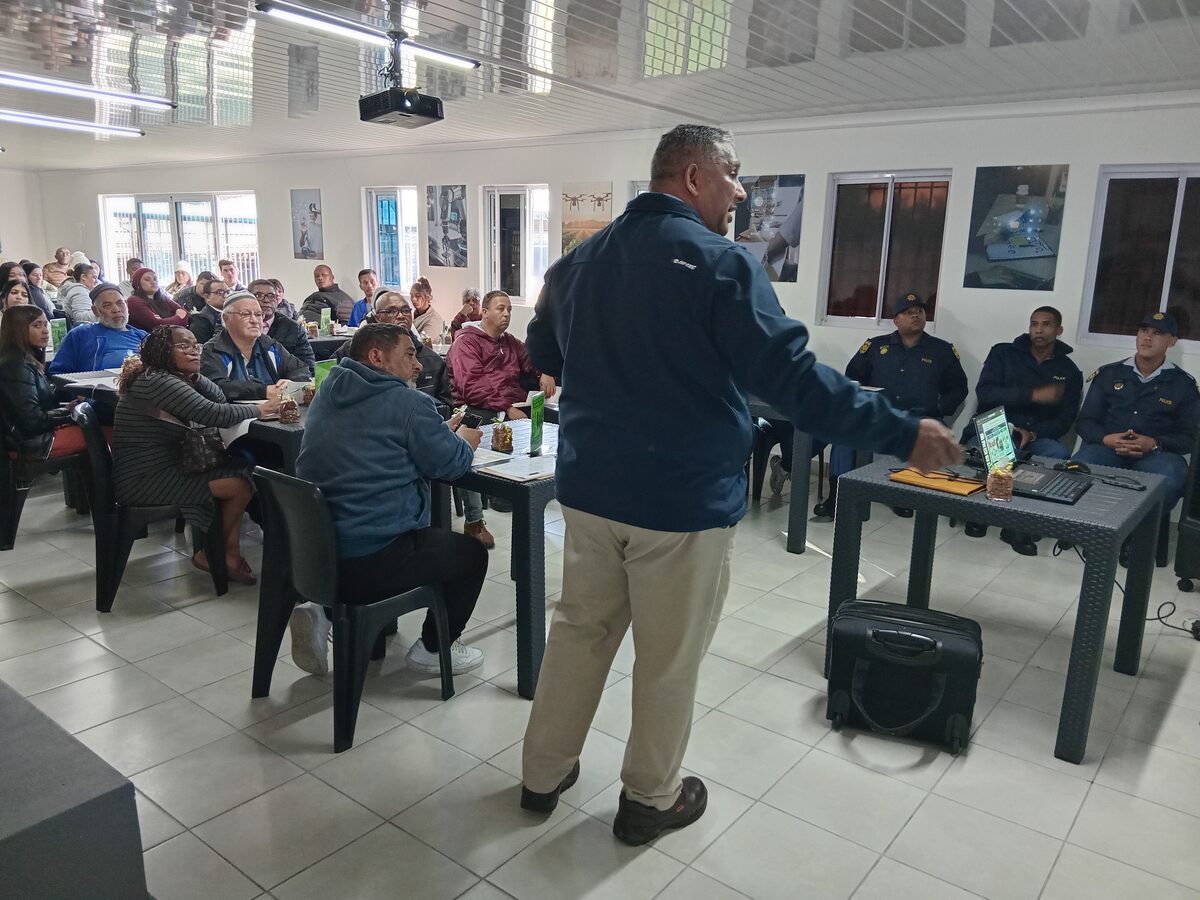
West End Primary School in Lentegeur opened its doors on Wednesday 17 June to share the strategies that helped it reach the global stage — and how those same strategies are keeping gangs at bay.
The school was shortlisted in the top ten of the World’s Best School Prize in the “overcoming adversity” category in 2022. It hosts regular community workshops as part of its winning approach. This latest workshop drew principals, school governing body (SGB) members, parents, safety officers, support staff, and representative council of learners (RCL) members from schools across Mitchells Plain and Philippi. Representatives from the Western Cape Education Department (WCED) Safe Schools, the police, and City of Cape Town Law Enforcement also attended.
The three weapons gangs use
Clive Arries, former principal of West End Primary and current acting principal of Lentegeur High School, delivered the presentation, titled “Navigating Gangsterism and School Improvement” in the school’s e-learning centre.
He said gangs rely on three main tools to take control of schools and communities: fear, belonging, and protection.
“We all might be aware of how gangsters are operating,” he told attendees. “They make sure you have a notion of fear — the teachers, the parents, the community. That is how gangs operate, not only here in Mitchells Plain but across the world.”
Arries described how, in his first week at Lentegeur High School, he was visited by three members of a local gang. He used the experience to illustrate how important it is for school leaders to stand firm and not be intimidated.
The school as a superior alternative
He said the solution lies in schools offering learners something better than what gangs offer.
“To belong to a gang is a demotion for any learner,” he said. Schools, he argued, must become a superior version of belonging, protection, and identity, thereby giving learners a reason to stay.
Arries urged schools and communities to break what he called the “culture of silence” and to stop passing the problem along.
“The teachers say it’s not my problem, it’s the parents’ problem. The school says it’s not my problem, it’s the police’s problem,” he said.
The Sanctuary Model: six steps to change
The centrepiece of Arries’s presentation, which he also delivered at the WCED School Safety Summit, was what he calls the Sanctuary Model, formally known as the Community-Centred Enhancement (CCE) diagramme. It lays out six strategic steps for transforming a school into a safe haven for learners.
- The first step is asset-based community mapping: identifying trusted local figures such as shopkeepers, retired nurses, faith leaders, and reformed community influencers who can act as “lighthouses”. Schools are also encouraged to audit their physical environment for safety risks and to identify “gatekeepers” who can help protect learners.
- The second step is establishing the school as a sanctuary. This means defining the school’s mission as a psychological safe zone, ensuring all staff share the same values, and taking immediate visible action, such as removing graffiti and painting murals, to signal that the school is neutral territory.
- The third step is creating a full-service support hub. Arries envisions schools partnering with non-governmental organisations (NGOs) to bring social workers and therapists on-site, and providing for learners’ basic needs, including uniforms and food.
- The fourth step is radical parental involvement. Rather than treating parents as onlookers, Arries wants them to become active stakeholders. Practical ideas include organising a “walking bus” along high-risk routes to school and giving parents access to school resources such as wi-fi and computers.
- The fifth step is student agency through a junior commissioner system. This involves creating diverse leadership tiers among learners — not just a single head — fostering a strong school identity, and training learners to resolve conflict among themselves through restorative practices.
- The sixth and final step is sustained inter-departmental collaboration — building a formal working relationship between the school, the police, social development services, and NGOs. Arries said schools should use community intelligence to anticipate trouble before it starts and adjust their schedules accordingly to keep learners safe.
Mapping what your community already has
A key part of his presentation focused on asset-based mapping, which identifies people, institutions, businesses, and spaces that already exist in a community and can be used to support school safety.
He encouraged schools to see retired teachers, local businesses such as the nearby shops, sports fields, libraries, and even street vendors as potential partners and assets, rather than overlooking them.
“I can see the auntie selling sweets in front of the school as a solution,” he said. “Possibilities will open up where we realise that the community can become a solution.”
Collective vision, not isolation
Arries also called on schools to develop a shared, collective vision built with input from teachers, parents, learners, and the broader community, rather than having the principal decide alone what direction the school should take and celebrate all the school’s successes, no matter how small.
He pointed to West End Primary’s own journey as proof that the approach works. When Premier Alan Winde visited the school in June 2022 and announced that it had been shortlisted among the top ten schools in the world for the World’s Best School Prize, Arries said it transformed everything at the school, the culture, the pride, and the community’s sense of ownership.
“Everything changed,” he said. “You can’t take it away.”
ALSO READ: Safe zone activities get underway across Mitchells Plain as R9m plan rolls out