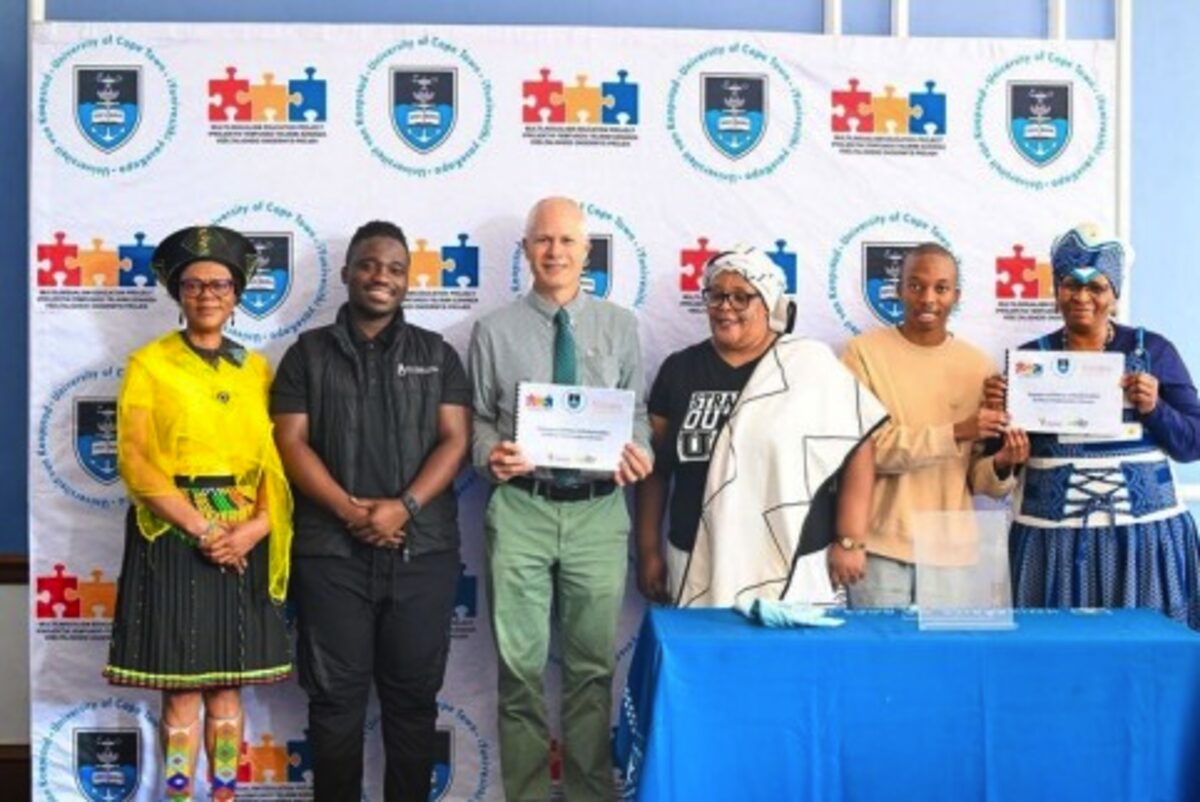
UCT has launched a Xhosa glossary for first-year mathematics students. This is part of its efforts to strengthen multilingualism and help students learn academic terms in their mother tongue.
The glossary is the product of a year-long collaboration between the Department of Mathematics and Applied Mathematics, the Academic Development Programme and the Multilingualism Education Project (MEP). The MEP sits in UCT’s Centre for Higher Education Development (CHED).
The launch took place on 23 September 2026, coinciding with International Day of Sign Languages.
How the glossary was built
Nolubabalo Tyam, a lecturer at the MEP, said the process begins in the academic department, which must “harvest” at least 250 terms from its discipline.
Once the terms are identified, MEP brings together subject specialists and language experts to workshop each term. The aim is to coin new Xhosa terms, transliterating only where a new word would lose the original meaning. Consequently, the list then goes to the Pan South African Language Board (PanSALB) for verification and authentication before returning to UCT for its launch.
“We cannot do it alone,” Tyam said.
In addition, Oliver Maasdorp, chief language practitioner for Afrikaans at PanSALB, explained that the board is a constitutional body. It verifies terminology through the committees of its national language bodies. Importantly, their members must declare any conflict of interest.
Policy in practice
Brandon Collier-Reed, UCT’s Deputy Vice-Chancellor for Teaching and Learning, unveiled the glossary. In fact, he had been through the same process in the Department of Mechanical Engineering. He has also used the resulting glossaries in his own classes.
He linked the initiative to UCT’s language policy and implementation framework, approved in December 2024. In practice, the framework commits the university to using Xhosa and Afrikaans alongside English across all areas of university life. In addition, it ensures that language is not a barrier to participation.
The glossary, he said, represents what becomes possible through policy, expertise, collaboration and institutional commitment. It is a step towards “a more multilingual, inclusive and accessible university”.
Digital tools and AI
Meanwhile, Mishka Reddy and Corné Oosthuizen from the Centre for Innovation in Learning and Teaching (CILT) described a workstream exploring how digital tools and artificial intelligence could support multilingual teaching.
The team is evaluating a chatbot for multilingual teaching with a diverse group of students. They are also running workshops with tutors who already code-switch and translanguage in their classrooms.
Furthermore, lecture recordings are increasingly being transcribed. About 7% were transcribed in 2024, about 24% in 2025 and 30% so far in 2026, with a target of 96–98%. The team is also researching how those transcripts might be translated using large language models.
A personal connection
Rorisang Matlaila, a tutor in the Department of Mathematics and Applied Mathematics, said he learned mathematics in his home language for his first four years of primary school. The experience taught him that “the language that one speaks on a daily basis need not be a barrier”.
Contributing to the glossary “meant a lot to me also on a personal level”, he said.
Additionally, he read a message from two colleagues who led the project but could not attend: Kate le Roux of the Academic Development Programme and Álvaro de la Cruz-Dombriz. Drawing on the Martinican writer Édouard Glissant, they described the colonial language as a single, “totalising” and “hierarchical” root, and set against it a web of languages that need and extend one another.
From awareness to belonging
Because the launch fell on International Day of Sign Languages, MEP Director and PanSALB Chair Lolie Makhubu-Badenhorst started the event by leading the audience through the South African Sign Language (SASL) alphabet. Moreover, MEP’s Zukiswa Zono spoke on fostering DEAF inclusion at UCT.
SASL is now an official language, Zono noted, and much effort goes into raising awareness.
“How does awareness then become inclusion?” she asked. Her answer moved in steps: translation and interpreting give access; access makes participation possible; participation brings belonging.
Makhubu-Badenhorst said UCT already provides SASL interpreters and real-time transcription through its Disability Service. There, trained student volunteers transcribe lectures live. Graduation ceremonies are interpreted, and information for prospective students on UCT’s website is now available in SASL.
But interpreters should not be reserved for major events, she said. DEAF people should have a say in decisions that affect them, and their inclusion should become ordinary.
“Our task is not simply to build bridges,” she said. “It is to ensure that everyone has a place on the bridge.”
ALSO READ: UCT faces student protests over accommodation shortages, fee blocks, and financial exclusion