

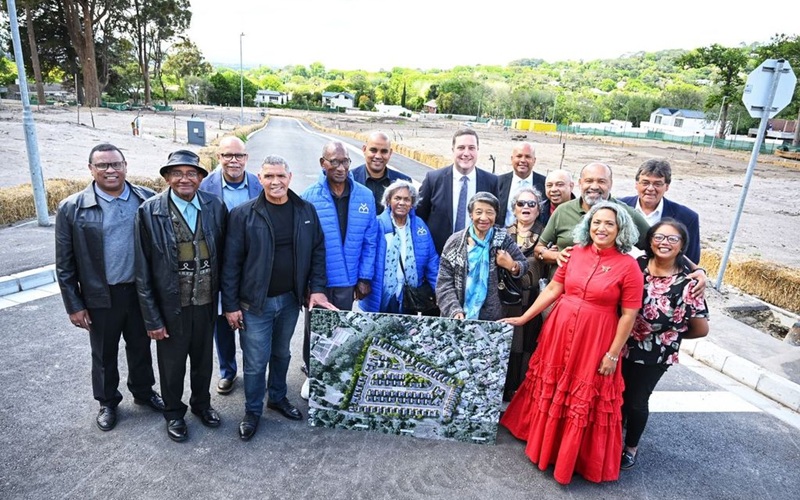
The apartheid government forcibly removed 86 families from Bishopscourt between 1959 and 1970. Now, those families are one step closer to returning home.
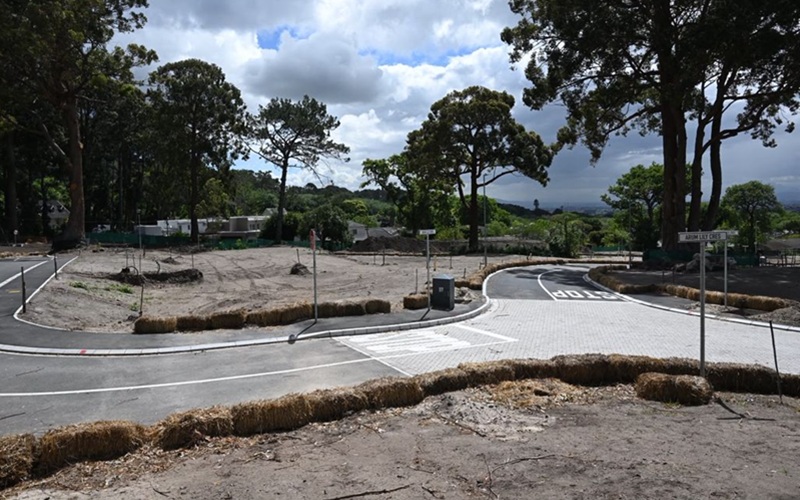
This follows the City of Cape Town’s completion of R83 million in bulk infrastructure. The City has also released municipal land valued at R320 million for the restitution project.
Cape Town Mayor Geordin Hill-Lewis joined Protea Village families on Monday 19 October to mark the milestone at the site. The City has completed bulk and link infrastructure, including civils and electrical works.
“It was special to join Protea Village families today to mark the start of construction of their 86 restitution homes in Bishopscourt. The City is proud to enable this project with the release of R320m in municipal land, alongside the completion of R83m in bulk infrastructure,” said Hill-Lewis.
Furthermore, he added: “I cannot wait to see the families return to their land, move into their beautiful new homes, and begin a new chapter in this place they have long called home.”
What is the Protea Village restitution project?
The Protea Village Restitution Project addresses the forced removal of families from Bishopscourt under the apartheid government’s Group Areas Act. These removals took place between 1959 and 1970.
The community lodged a successful land claim in 1995 under the Restitution of Land Rights Act, 1994. Consequently, the City and the national departments of Land Reform and Public Works and Infrastructure awarded Erven 212 and 242 in Bishopscourt to the Protea Village CPA in 2006.
A communal property association, or CPA, is a legal body established under South African law. It holds and manages land restored to a community through the restitution process.
Subsequently, the land reform department transferred the land to the CPA on 15 June 2021. This followed a protracted land-use rights process. The CPA drives the project, with Bethel Partners as the appointed development manager.
How will the homes be funded?
The project uses a cross-subsidisation model. The CPA describes it as the first of its kind in urban land restitution in South Africa.
Specifically, the CPA is selling 50 open-market residential stands on Erf 212. These sales fund the construction of 86 free-standing homes for returning families on Erf 242. Each stand in Protea Village is approximately 300 square metres.
In addition, the sales generate annuity income for the CPA. This income enables the community to sustainably maintain their homes and build generational wealth. Former CPA chairperson Cedric van Dieman, who died in July 2021, described this as creating “our first generation of wealth for those who come after us”. This according to the Protea Village official website.
The City’s contribution includes R83 million for civil and electrical bulk infrastructure. It also includes assistance with planning approval processes and post-development support. The total municipal land value released is approximately R320 million.
What happens next?
Protea Village CPA chairperson Andre Maxwell said the progress means a great deal to families who have waited decades for restitution.
“At our sod-turning ceremony last year, we celebrated the start of construction. Today, we can see just how far we’ve come. For a community that has waited decades for restitution, this progress means an enormous amount. We are now another step closer to rebuilding Protea Village and finally returning home,” said Maxwell.
However, Maxwell cautioned that work remains.
“We have come a long way, but our work is not finished. Our focus now is on securing the remaining building approvals and getting construction underway so that the 86 families can finally return home,” he said.
The City’s official statement says the 86 homes are “expected to be completed in the latter part of 2027”. Nevertheless, building approvals are still outstanding. Therefore, the timeline depends on how quickly the City grants those approvals and construction can begin.
A model for future restitution
Hill-Lewis said the project could serve as a template for restitution across the country.
“This project is a unique example nationally of what meaningful land restitution looks like. Not only does it restore dignity and redress apartheid’s spatial legacy, but it also presents a scalable restitution model that could help shape future restitution programmes across South Africa,” he said.
Moreover, Councillor Carl Pophaim, the City’s Mayco member for human settlements, said the initiative “restores land, dignity, and economic opportunity”. He said it integrates “displaced families into this affluent suburb”.
Greenbelt preservation
As a further benefit, the project preserves four hectares of public greenbelt along the Liesbeek River. The City will manage this municipal land to enhance environmental and community benefits, according to Councillor Pophaim.
ALSO READ: After decades, Simon’s Town residents finally ‘at home at last

You must be logged in to post a comment.