

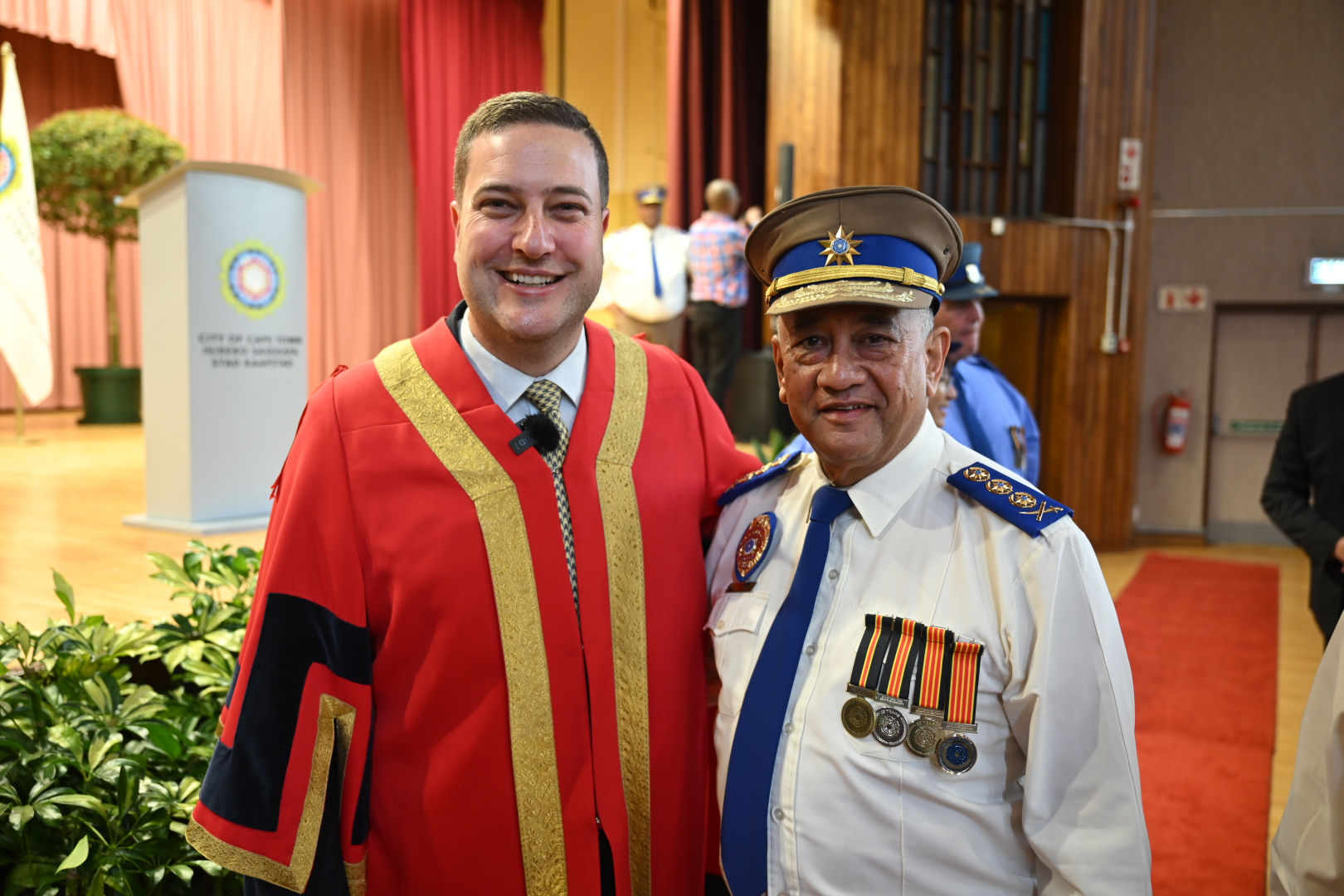
CAPE TOWN – For over four decades Metro Police Chief Wayne le Roux has worn the badge with one guiding principle: to serve people with integrity.
From directing traffic as a young officer to becoming South Africa’s longest-serving metro police chief, his career has been defined by a commitment to community policing, mentoring the next generation of officers and leaving a legacy in Cape Town.
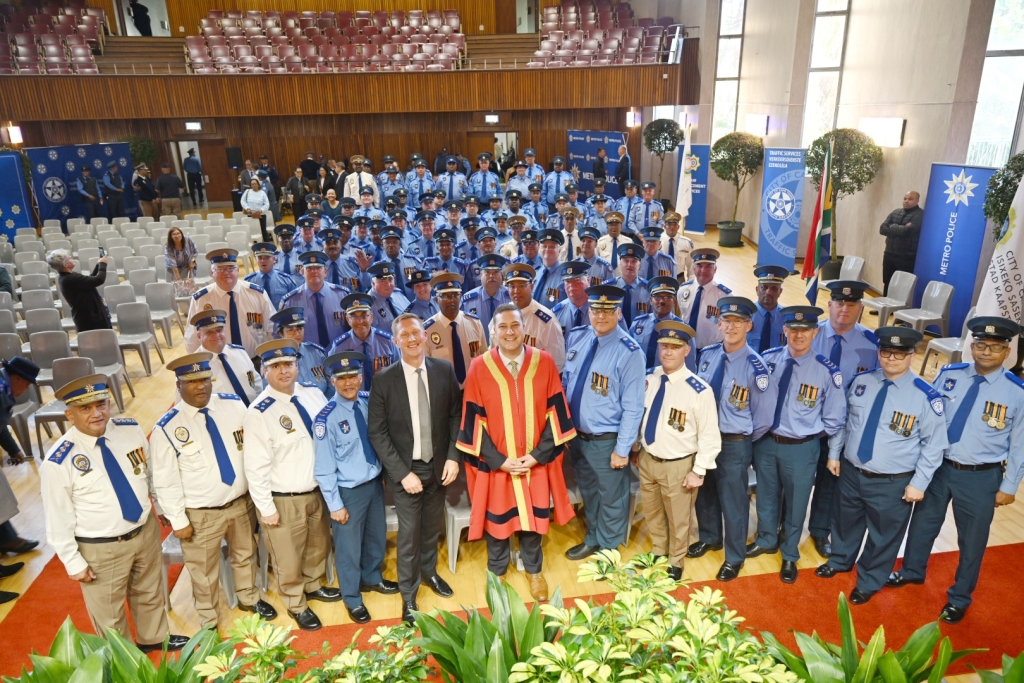
On Tuesday, 4 August, that legacy was recognised when Le Roux was honoured at the City’s inaugural long-service awards ceremony, where he received a medal in recognition of 44 years of service alongside several law-enforcement personnel who were similarly honoured.
The ceremony celebrated 112 law-enforcement officers who completed 30 years or more of service, with Mayor Geordin Hill-Lewis praising their dedication to protecting Cape Town’s residents.
Speaking at the ceremony, JP Smith, Mayco member for safety and security, said: “Pausing in recognition and remembrance is the least we can do for the thousands of staff who put their lives on the line in service of Cape Town.”
Leading Integrity
The journey of Le Roux, a Heathfield resident, began in 1982 when he joined the City’s Traffic Service.
Determined to grow within the organisation, he continued his studies while working and, at just 23 years old, became one of the youngest sergeant supervisors in the department.
His career took another significant step in 2001, when the City Police was established, later becoming the Metro Police.
Le Roux was among a select group appointed as divisional commanders.
“My first area I started in was Bonteheuwel. I was responsible for overseeing the precinct. It was a learning experience.
“I knew that were a new police force and people are going to compare us to members of the South African Police Service. That’s when I started the community policing concept to ensure we build trust with the community.”
Community Policing
Rather than relying solely on vehicle patrols, Le Roux believes officers needed to become familiar faces in the communities they serve.
“We did foot patrols, interacting with the community and showing them that we can make a difference and be a force multiplier to the police. Eventually, we started getting information from the community about irregular things that they saw or knew about.”
The success of the approach saw him transferred to Mitchells Plain two years later and then to several areas across Cape Town to implement the same policing model there.
Throughout his career, Le Roux continued to further his education, a commitment that paved the way for his appointment as Deputy Chief of Metro Police in 2009.
On 1 October 2011, he was appointed Metro Police Chief, a position he has now held for nearly 15 years.
“I always tell staff not to compromise their integrity. When you wear your uniform it’s a calling to make a difference in the community. Treat people with dignity and respect no matter where they live.”
For Le Roux, leadership is about remembering where you started.
“You have to support and work with your team. Never forget you were also learning and were also a constable at one stage.”
Global Experience
His career has also taken him beyond South Africa’s borders, with the City providing opportunities to attend international policing programmes and engage with police leaders around the world.
“I must thank the City for giving me the opportunity. I have been overseas many times to gain police training. I have been a member of the international police chiefs around the world.”
Among the countless incidents he has attended, one remains his proudest memory.
“I helped deliver a baby on the Grand Parade. It was the biggest joy in my life to see a child being born in those circumstances.”
Yet policing has also brought moments of sadness.
“Having to share with families the news when officers died in the line of duty” remains one of the hardest parts of his career, he said.
Future Plans
Le Roux is already looking beyond his planned retirement next year, when he hopes to conclude 45 years of service.
But even after retirement, he hopes to continue shaping the future of policing by returning to the Metro Police training college.
“If my health is there and God gives me the strength, I want to go back to the training college and share my experience with the young people and new recruits. That is what I would like to do.”
His advice to officers has remained unchanged throughout his career.
“I always tell staff, no matter the circumstances, they must make sure that when they wear that uniform their boots and uniform are clean and they interact with people. It gives a good impression of who we are and what we want to achieve.”
Leadership Lessons
Le Roux believes policing is ultimately about building relationships, not rank.
“We must interact with people. We shouldn’t just be driving around and expect people to see us; we must make a difference. I also tell young people they don’t have to turn to drugs. Role models are not people in high positions; they are your mother, father, grandmother or people who have made a difference in your life.”
Reflecting on more than four decades in uniform, Le Roux said he remained grateful for the opportunities he received and the people who stood behind him.
“I am thankful to God for the mercies He has given me. I am also grateful for my wife and two kids for their support. It has given me encouragement over the years.”
For Le Roux the stars on his shoulders have never been the measure of success. “Bars and stars on your shoulders don’t make a person. It’s how you interact, make a difference and pass on the legacy.”
ALSO READ: Cape Town pays homage to fallen heroes at Remembrance Day Service

You must be logged in to post a comment.