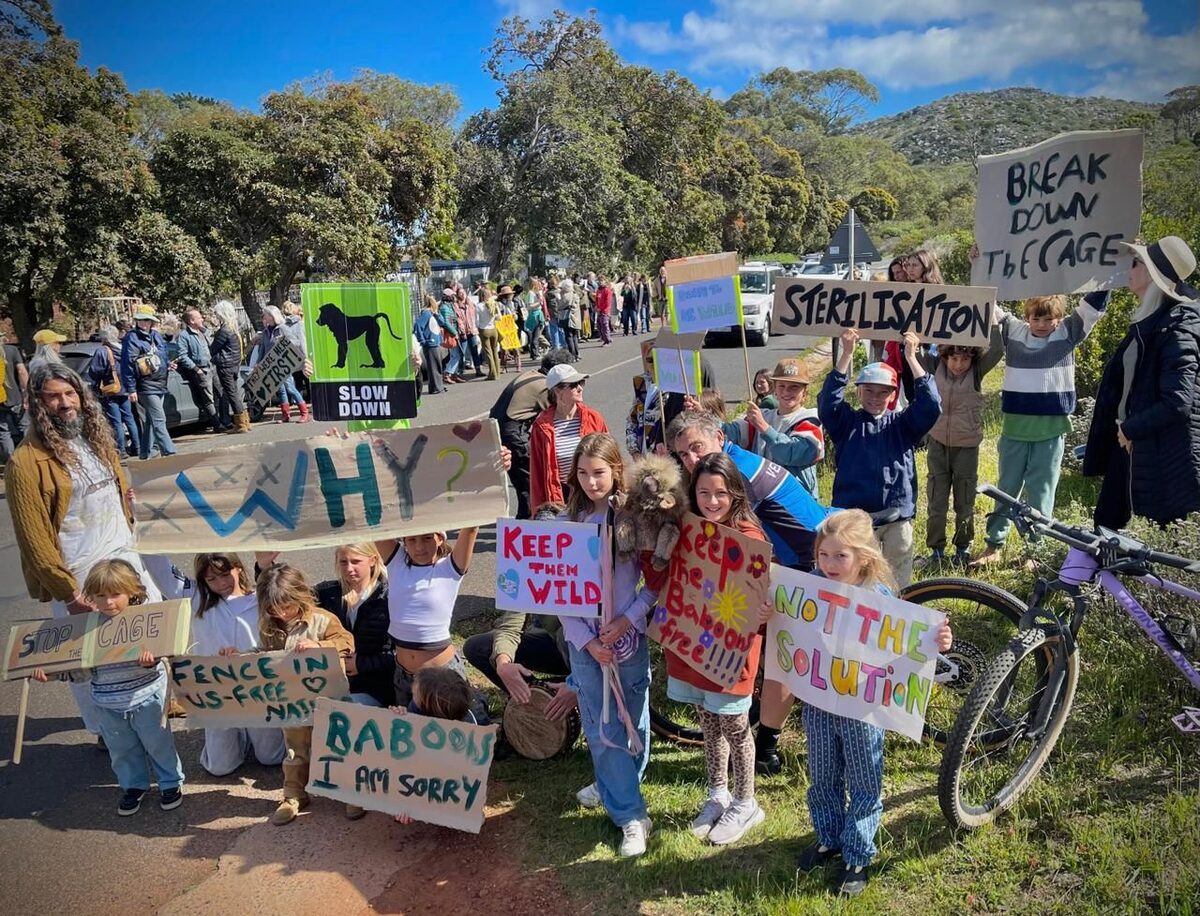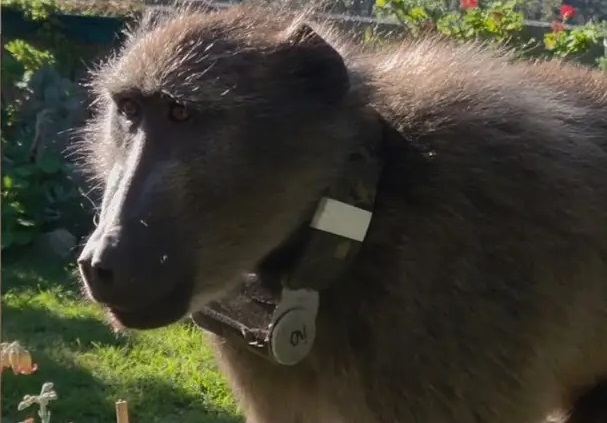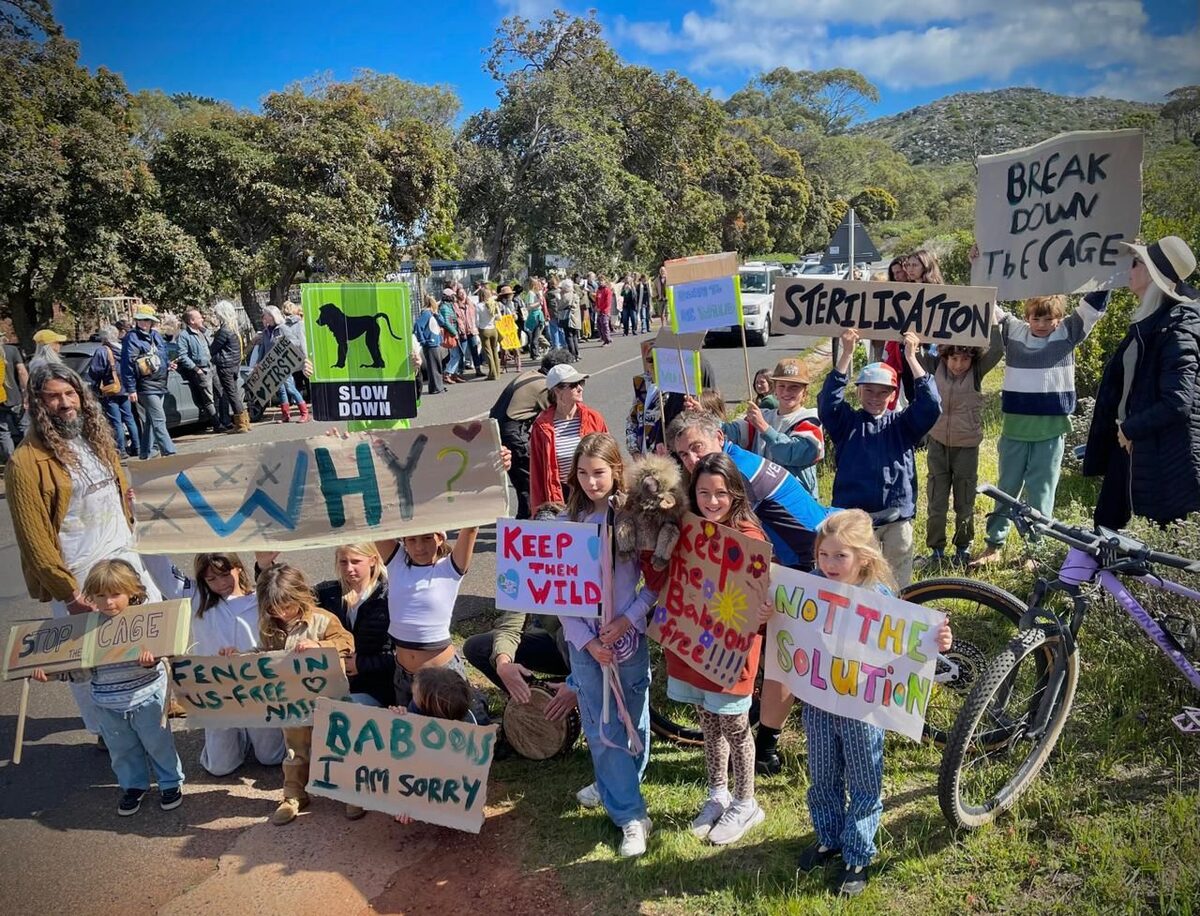
A hundred protesters gathered in Kogelfontein, Redhill Road, near Scarborough opposing the caging of two baboon troops on Sunday 30 August.
Earlier this year, People’s Post reported that the planning and development of the proposed sanctuary for two baboon troops in the Southern Peninsula was underway, the City of Cape Town confirmed.
Primate plan
Last year the Cape Peninsula Baboon Action Plan for relocating the primates was approved by the City, South African National Parks (SANParks), and CapeNature.
The Cape Peninsula Baboon Management Joint Task Team (CPBMJTT) is responsible for developing and implementing a baboon management programme in the Cape Peninsula and comprises three authorities: CapeNature, SANParks and the City.
In January this year, CPBMJTT confirmed that it has approved the intention to capture and relocate two baboon troops to a purpose-built sanctuary, said the City’s manager of coastal environmental management, Gregg Oelofse.
“Planning and site preparation for the trial enclosure at Kogelfontein are actively moving forward under environmental guidelines. Relocations are executed as whole-troop operations to preserve social cohesion, paired with perimeter fencing to keep troops safe from urban hazards.” CPBMJTT said. Previously baboon-troop relocations, including the Waterfall and Seaforth troops in Simon’s Town, were governed by the Cape Peninsula Baboon Management Action Plan (v.2), Final, June 2026).
Baboon fencing
People’s Post spoke to Dr David Gaynor, a conservation biologist and primatologist who holds a PhD in baboon foraging ecology for his thoughts on the issue of baboon fencing.
“I cannot speak to the authorities’ motives; I can speak only to the reasons they gave me. They argued that a complete fence around every urban, naval and other premises accessed by Waterfall and Seaforth would be 16-18 km long, cost R35-40 million, require gates and continued ranger management, and may displace the troops towards Harbour Bay, Glencairn, Scarborough or Misty Cliffs.”
However, this was not the proposal he put to them, he adds.
“I proposed a targeted, privately funded fence along the Simon’s Town residential edge. It would exclude only 52,9 ha from Waterfall’s 736,1 ha range — about 7,2% — while physically separating the baboons from the principal conflict area. The donor was prepared to carry the capital risk. What I find difficult to reconcile is that the Action Plan itself says authorities will use “hard boundaries” such as baboon-proof fences to keep baboons out of urban areas. For Slangkop it goes further: “Fencing is essential to prevent a need for the removal of this troop.” My question is therefore very simple: why not test a reversible, privately funded physical barrier before making the irreversible decision to put two wild troops into permanent captivity?”
CPBMJTT confirmed recently that fencing in this area was fully and objectively assessed before the removal of the two troops was included in the Action Plan.
“Importantly, should the Waterfall and Seaforth troops be excluded by a fence, they will not have access to suitable low-lying habitat and will be forced to forage at high altitude in what is predominantly sandstone fynbos. Research in the Cape of Good Hope section of Table Mountain National Park on free-ranging baboons (i.e., not managed) revealed that baboons seldom foraged in this habitat type, and commute through it to forage on strandveld vegetation on either coastline (*Lewis 2015),” said the CPBMJTT.
Response
The estimated cost of a fence that would exclude the two troops from Simons Town, the SA Navy areas and associated suburbs of Murdock Valley would exceed R30 million, the CPBMJTT added.
“Therefore, the best possible alternative that is in the best interest of the welfare of the Seaforth and Waterfall troops and to reduce the very high levels of human wildlife conflict in Simon’s Town is to move the troops to a purpose-built urban wildlife centre where they can live out their lives, without the risk of being injured or killed, and the risk of disease as a result of them having access to human-derived food that has a severe impact on their health. The only other alternative was culling which was not desirable.”
Gaynor said he did not object to “properly conceived baboon sanctuaries” as they can play an important part in conservation.”
It can care for animals that are injured, disabled or genuinely unable to survive in the wild. It can temporarily hold baboons while they recover, while a conflict situation is resolved. So my objection is not to sanctuaries; I strongly support a genuine baboon conservation sanctuary. I would like to see Kogelfontein developed into precisely that: a facility for injured and non-releasable animals, temporary rehabilitation and holding, research and trials of better conflict-management methods, conservation education, and, where feasible, preparation for release back into the wild.”
Conservation measure
He said he objected to calling the permanent capture, sterilisation and reproductive extinction of two viable wild troops “a conservation measure”.
Ward 61 Councillor Simon Liell-Cock said he does not feel qualified to comment on the issue as he is not a primatologist or wildlife expert.
“I always defer to the recommendations of experts who have dedicated their lives to the conservation of the environment. In this case SANParks and Cape Nature are the mandated authorities responsible for the constitutional requirement for the protection of the environment and, together with the City, manage the baboons via the Joint Task Team.”
After decades of conflict between residents and baboon rights activists everything possible has been done to ensure that the sanctuary will provide the two urban troops in Simon’s Town with a vastly improved quality of life, he added.
ALSO READ: Record number of entrants in this year’s Women’s Day swim