

The City’s draft Comprehensive Integrated Transport Plan annual update, tabled at subcouncil meetings last week, is now open for public comment.
The draft sets out the City’s plans for passenger rail, including a recovery period from 2027 to 2030 and a long-term rail network planned for 2040.
The documents are available on the City’s website, and at subcouncil offices and City libraries. The comment window closes on Wednesday 30 September.
How Capetonians travel
The update reveals how Capetonians commuted in the 2024-’25 period.
About 35% of all trips were made using public transport. Private vehicles accounted for 55,2% of trips, or 2 314 000 journeys, while 9,6% of trips were made by walking or cycling as a main mode of travel.
Within public transport, minibus-taxis carried the most passengers, at 22,5% of all trips or 945 000 journeys. Trains accounted for 3,2%, or 133 000 trips. Bus services such as Golden Arrow and MyCiTi accounted for 7,1%, while 2,4% used metered and e-hailing taxis.
Rail the backbone of public transport
The draft update addresses the need for a diagnosis of the central transport problem in the city, an updated plan to integrate public transport with walking and cycling, and measures to restructure urban areas to improve efficiency and accessibility.
It also includes the council-approved Walking and Cycling Strategy, an updated Freight Management Strategy, and an updated Travel Demand Management Strategy.
Rob Quintas, Mayco Member for Urban Mobility, said the City puts people at the centre of its transport planning.
ALSO READ: Boost public transport without gentrifying it out of reach
“We need to support people to make good travel choices which are environmentally sustainable and support the economy. This update does this through improved public transport; improved conditions for walking and cycling; improved public transport nodes and improved urban centres. Our aim always being to keep Cape Town moving safely and efficiently.”
He said rail must be the backbone of the public transport network, carrying the highest share of passengers, with road-based services such as buses maximised along major travel corridors through priority public transport lanes.
Rail recovery planned for 2027 to 2030
The document outlines a “recovery” period from 2027 to 2030, during which full train services are planned to resume.
This includes trains running every 5 to 15 minutes during peak hours and every 20 to 40 minutes off-peak, at normal operating speeds of about 90 km/h, with functional signalling systems and modernised stations.
According to the document, progress is already underway. The City and the Passenger Rail Agency of South Africa (Prasa) have signed a rail service level plan, and the Cape Town Rail Feasibility Study has been completed and endorsed by council.
Partial signalling has been restored on parts of the Central Line, and 78 new electric trains have been procured, pending the lines being ready for them.
The City plans to integrate the rail service with MyCiTi routes which are also in the process of being expanded.
Rail projects earmarked for 2040
The updated Integrated Public Transport Network Plan 2040 summarises the rail projects proposed to be in operation by 2040.
These include a new Blue Downs rail line connecting the Metro South-East and Bellville, with stations at Mfuleni, Blue Downs and Wimbledon.
Other proposed projects include a rail link between Cape Town’s central business district and Cape Town International Airport, and a rail connection to the proposed Cape Winelands Airport, using the existing Fisantekraal line.
Further proposals include doubling the single-track line to Strand between Eerste River and Firgrove stations, creating new stations at Philippi West, Bloekombos, N1 City and Nomzamo, and an extension from Chris Hani in Khayelitsha to Firgrove and Somerset West.
Planning for an uncertain future
The plan uses a new approach to planning in the face of uncertainty. Extensive scenario planning of supply and demand resulted in what the City calls a “low regrets” investment network, which identifies the travel routes needed under all possible scenarios.
The plan also includes an implementation strategy to ensure the network can be delivered.
Skytrain and Capetrain proposals not pursued
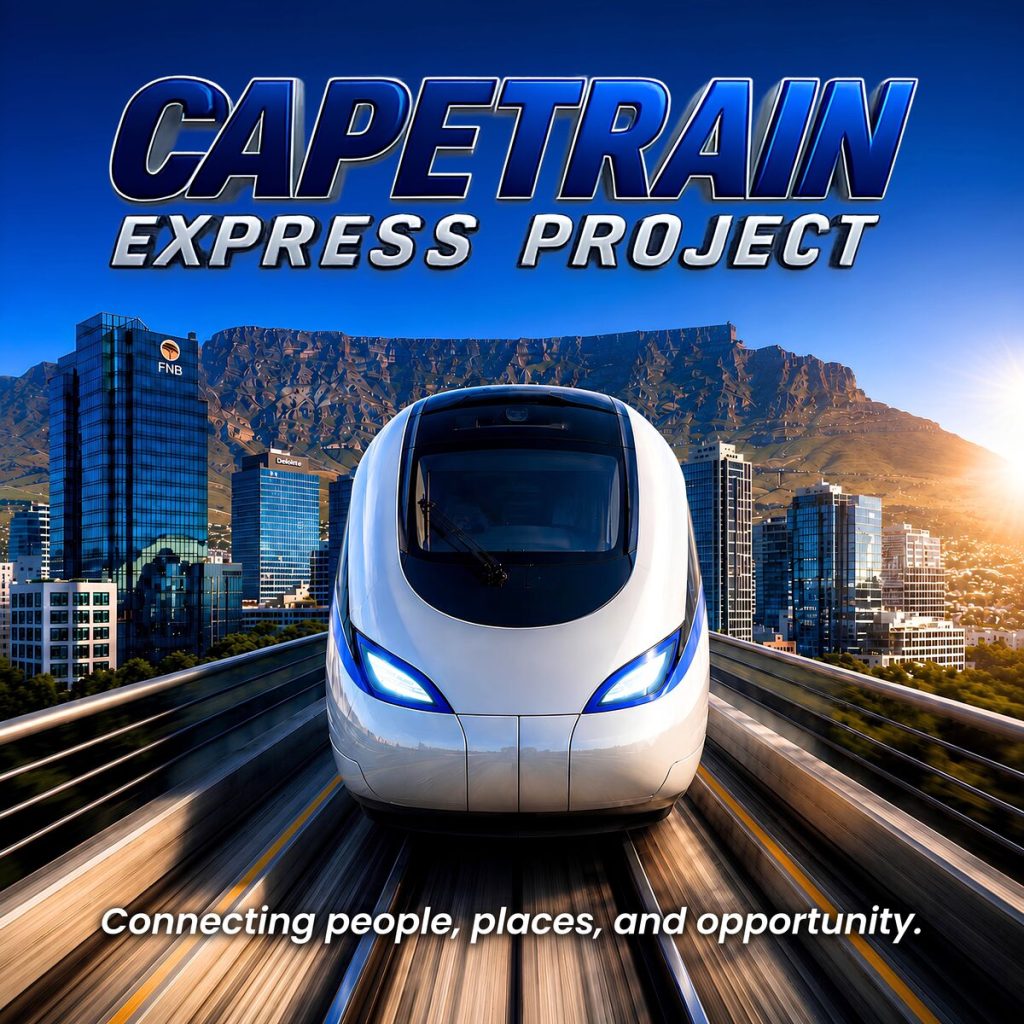
In an email to the TygerBurger the City confirmed that it is not pursuing the Skytrain or Capetrain Express proposals as part of its approved public transport planning programme.
The CapeTrain Express concept, which has been widely shared on social media, originated outside of the City’s planning processes, Rob Quintas, Mayco Member for Urban Mobility, said.
He said the concept was “not currently supported by the City’s transport modelling or planning priorities.
“The City does, however, recognise the pressing need for expanded passenger rail and is actively planning for this through the Integrated Public Transport Network Plan, aligned with the National Rail Master Plan. This includes priority rail projects and the investigation of strategic future rail links, including airport connections. Any new rail proposal must demonstrate sufficient demand, technical feasibility, and economic viability before it can be considered further,” Quintas said.
How to comment
Residents and interested parties can submit comments from 1 September to 30 September.
Comments can be submitted online at the City’s Have Your Say webpage, by email to Comprehensive.IntegratedTransportPlan@capetown.gov.za, or in writing at any library, subcouncil office, or the Public Transport Office on the second floor of the Cape Town Civic Centre in Hertzog Boulevard.
ALSO READ: City distances itself from viral AI express rail concept for Cape Town



You must be logged in to post a comment.