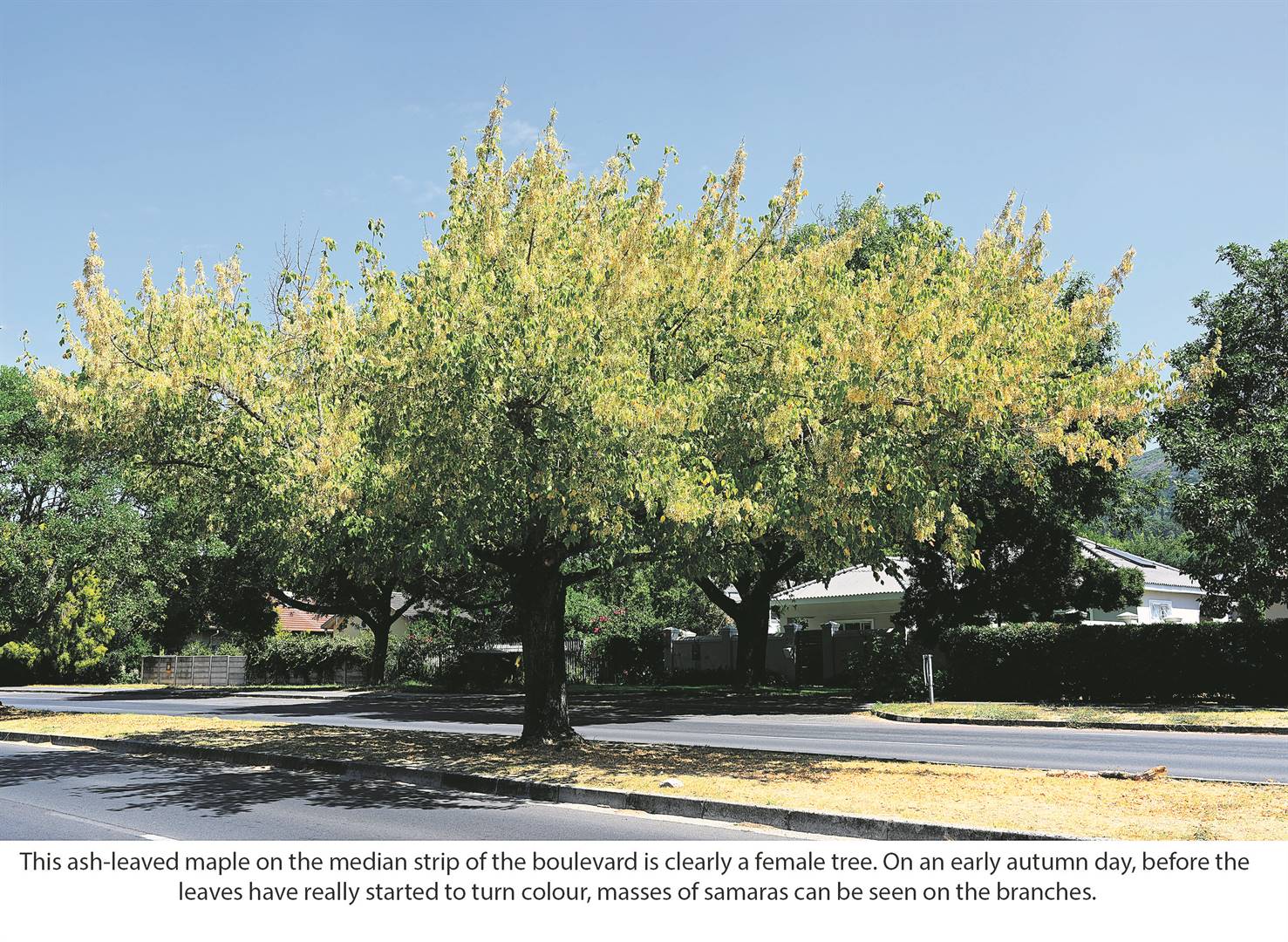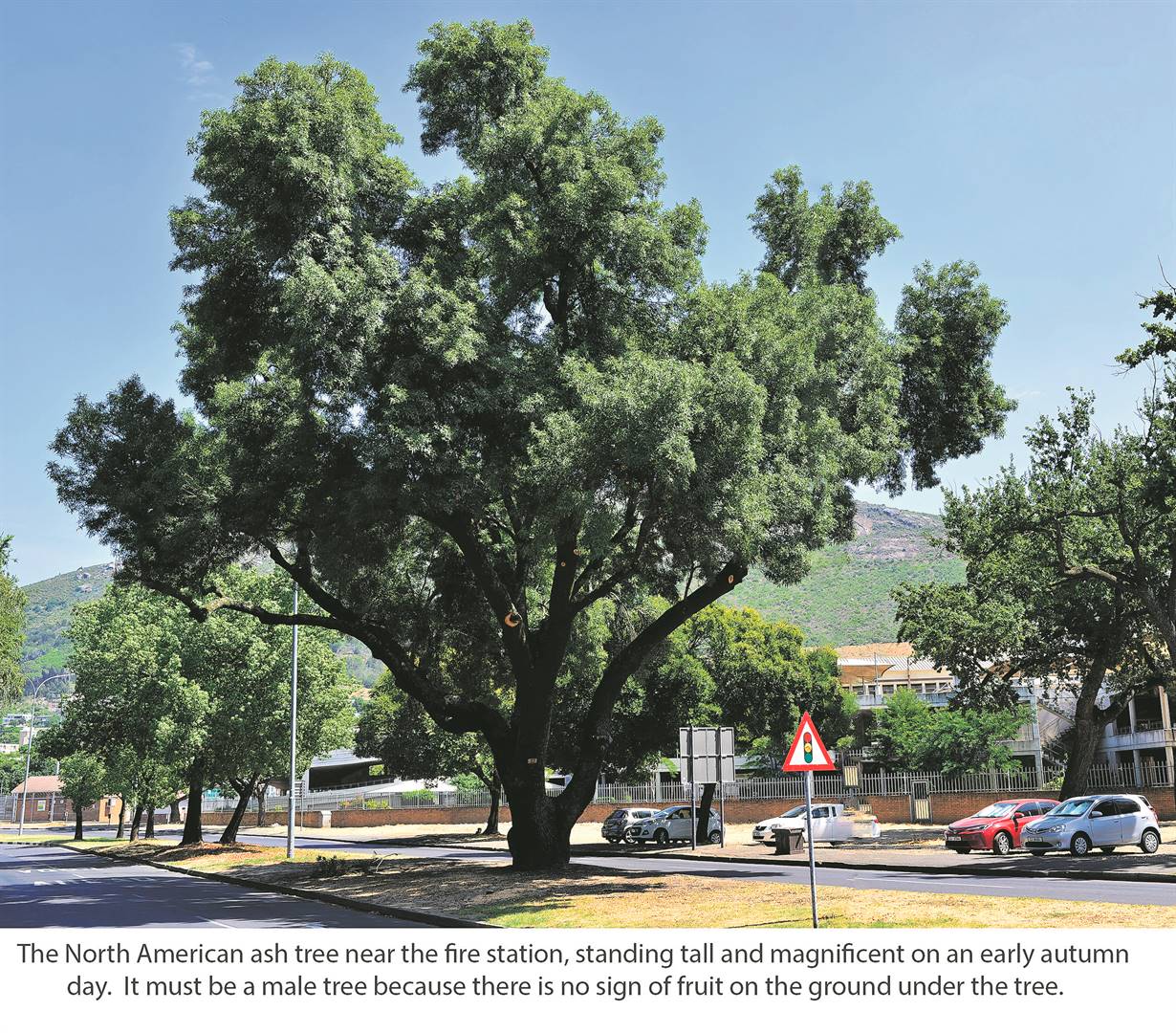
On the median strip of the Berg River Boulevard, near the fire station, stands a big deciduous tree whose identity is somewhat of an enigma. I recall that years ago a controversy erupted as to what species of tree this was. Widely-respected people made categorical identifications. Eventually a real botanist arrived on the scene, and presumably pronounced the tree to be Fraxinus americana, because that’s the species given in the list of big trees in Paarl.
The white ash, as Fraxinus americana is known in layman’s terms, hails from the eastern and central part of the USA, where it’s widely cultivated. It is the timber of choice for a variety of purposes. Its wood is white, dense, strong and straight-grained. It is a moderately fast-growing, long-lived, deciduous tree that can reach a height of 24 m at maturity. It has pinnately compound (feather-like) leaves with seven leaflets per leaf, and this figure is remarkably constant on the americana species, whereas in other ash species it is more variable – an important identifying feature. Interestingly, the term “white ash” is not derived from the colour of the wood, but rather from the fact that the underside of the leaves of this tree is much lighter (“whiter”) than the upper surface. This provides another valuable identifying feature.
A third clue as to the identity of the white ash is its consistently reliable autumn colours which are typically bright orange, tending to reddish hues, as opposed to other species of ash that produce a uniform yellow colour.
With such good pointers to use, why is it difficult to identify the white ash? Well, firstly the tree in the Boulevard is too high to reach the leaves if you stand on the ground, so you can only examine the leaves with binoculars, which is not ideal. Secondly, autumn colours can at best only provide plausibility. You have to allow for colour differences from tree to tree within the same species.
The main reason, however, why one would like to be sure of the identity of the ash in the Boulevard is that there is another ash species, also originally from the midwest and eastern part of North America, which is very similar to the white ash, and that is Fraxinus pennsylvanica, the green ash. The latter is one of the most widely planted ornamental trees throughout the USA and much of Canada. It has also found favour in Argentina, and in Europe, from Spain to Russia. Modernising cities in Russia and China began using green ash a century ago to plant along streets and in public parks. The advantages of green ash over white ash are a faster growth rate, better tolerance for urban environmental conditions, and easier propagation. It is known that the green ash was brought into South Africa on an experimental basis and that it has often been planted here along streets and in parks. In an older book, Suid-Afrikaanse Boomgids, the author, RJ Poynton, mentions that the green ash is often misidentified as a white ash. All this adds to the conundrum of the true identity of the venerable old guy in the Boulevard.
The fruit of both these trees is a samara (winged nut) comprising a single seed. In both species, male and female flowers are borne on separate trees. Both species have been hit severely by the emerald ash borer, a beetle accidentally introduced from Asia which caused massive casualties in ash populations, similar to what the shot hole borer is doing in our country at present.