Stealing fruit may well sound like mischief, but it has become a massive threat to an industry worth billions.
Fond are the memories of those late nights slipping out of the school res and making a beeline for oom Hendrik’s orchards – the best yellow clings in the world. But it never did hurt oom Hendrik or the other farmers then. At one school function he even referred to those disappearing peaches as the angels’ share. Those were the days, my friend, I thought they’d never end. They did.
“Fruit theft, I reckon, is as old as fruit farming” is how Nic Dicey, Hortgro chairperson and fruit farmer on La Plaisante, just outside Wolseley, starts his story. “But today, fruit theft is out of control. When you leave, drive the 5 km to town and count the number of people on the side of the road, virtually everyone with a backpack filled with peaches. Stolen from me and my neighbours in broad daylight.”
The losses and damages due to fruit theft are massive, but almost impossible to quantify. However, according to Louis Wessels, Manager: Legal Services and Administration at Agri Western Cape, individual producers’ estimated losses ranged from R40 000 to R600 000 last season. The problem is, to really know what the damage is one needs to know how many thieves there are. But how? They’re not exactly going to report to a census return. They are criminals, says Wessels.
What makes it even more difficult is fruit thieves come in categories. From the loners stealing a bagful each to the gangs coming in numbers with pick-ups, pillaging orchards, damaging trees, disappearing with a ton of your best fruit.
How do you stop the raiding?
An obvious method is enclosing your orchards with state-of-the-art electrical fences and using drones to keep watch during daylight hours. Now we are talking serious money; money that adds to the bottom line of your fruit, making it more expensive and in the process making the thief’s offer more attractive.
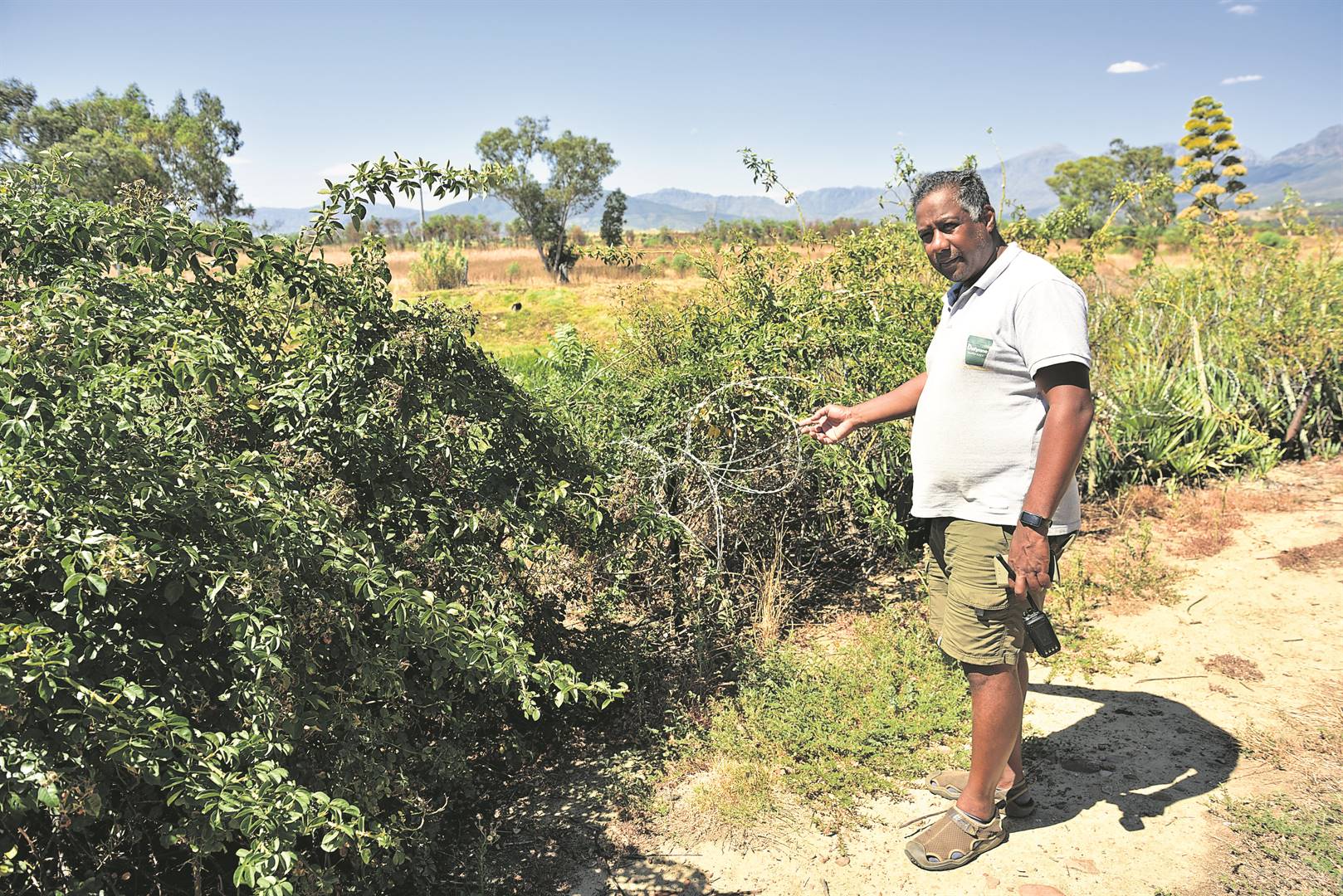
“We do not have electrical fences yet, but razor fencing on the Berg River side – our weak spot!” explains Elton Jefthas, partner at De Fynne Nursery and Fruit Farm just outside Paarl. “It doesn’t stop them but slows them down. They throw cloth over the fences or even dig burrows underneath.
The informal sector vs the criminal sector
Joseph Hendricks of Hendricks Vrugte in Grabouw started his career in fruit as a vendor and has a soft spot for the informal market. “In eradicating the criminal element one must be cautious not to trample on the legal informal vendors. I am selling a lot of fruit to them, but they are legit with permits from their respective municipalities. These guys depend on their income and form a crucial link in the value chain.
“Fortunately we have very little theft, being about 4 km from the N2, where one sees the skelms standing illegally on red and yellow lines, apple in hand, trying to persuade motorists to stop.”
However, Jan van der Merwe, assistant production manager at Hendricks Vrugte, believes he has a solution to help these illegal guys become part of the informal sector: “There are many NGOs in the EGVV [Elgin Grabouw Vyeboom Villiersdorp] with the capacity to help,” he says. “Then there are many farmers as well. And there lies the problem; we have many unemployed people in the area, just as everywhere else in SA.
“My proposal is to get these NGOs to draw up an accumulative database of unemployed people. We ask the farmers to each donate a bin of fruit. The NGOs help the unemployed to be registered with their respective municipalities. And the process is set in motion. They start earning and next round, they buy their stock from the farmers. Now they become part of the legal informal sector.”
Legal or not?
A challenge for developing farmers
“Among all of these are the new guys wanting to make their dreams come true,” says Ismail Motala, chairperson of the Deciduous Fruit Development Chamber SA (DFDC-SA). “There’s nothing worse than overcoming the hurdles of starting up, the weather, Eskom, price hikes and so on, just to see your beautiful crop being depleted by people who didn’t put one cent or a single drop of sweat in to make it happen.
“This boils one’s blood. But taking the law into one’s own hands is not an option. If one manages to apprehend the culprit, he may get violent or suddenly have a few mates coming to help him. If one happens to hold him (and watch out if manhandling him!) until the police, eventually come, they’ll most probably let him go as one bag of fruit is deemed petty. There’s not enough manpower or time to do anything meaningful about it. But the worst of all, there is not only one thief; it is like a plague.”
It is not only fruit
The more I hear, the more I fear. Farming is not for sissies. Jefthas of De Fynne points out that while the one lot is raiding the trees the others are stealing Eskom cables.
“Okay, granted! Eskom will come and fix those cables. But because cables are being stolen all over it takes time before they get to you. And you know what happens after two days of 40+°C and no water on your fruit? Sunburn damage. And do you think those rogues will steal the sunburnt stuff? They’ll pick only your best!”
Nic [SURNAME] at La Plaisante says: “The harvest lasts about four months. But those criminals need money for 12 months. As you can see, the main train track between Cape Town and Pretoria runs through La Plaisante. Come, let me show you something.”
All along the track, at about 10-m intervals there are dug-outs where cable upon cable has been ripped out. Stolen. No wonder the once-proud Blue Train runs no more. I look at the damaged line and [SURNAME’S] beautiful pear orchard next to it.
“And when these pears are ready, they’ll come and steal them too,” he sighs, “and I wonder if there is a way out, by curbing unemployment?
“But you know, I can employ more labourers right now. But nobody’s knocking. Maybe it is just so much easier to steal my stuff. Especially if you’re almost guaranteed to get away with it.”
What can the fruit farmers do to stop the rot?
Daan van Leeuwen Boomkamp, general commander of Drakenstein Farm Watch, crosses my path with a solution. This group of 160 volunteers helps protect up to 200 farms against fires (with a lot of arson cases), medical and animal rescues, and more.
“We used to attempt to help with fruit theft, but it is a lost cause as it stands,” Van Leeuwen Boomkamp said. “Catching a thief red-handed, one can hold him until the police come many hours later, only to tell you the Drakenstein penitentiary is 140% full and the damage is less than R1 000. And he is free to go.”
But using the bylaws of the various municipalities is the way to go, he says. Respectable people within municipal areas must be appointed as peace officers, giving them authority to enforce those bylaws by which they can act against fruit thieves. The legalities are in place. One appoints people from the area to safeguard it, teach them the details of the bylaw and train them in how to apprehend a fruit thief. Take the chairpersons of all the neighbourhood watches and appoint them first. They already have the back-up of their fellow neighbourhood members, but now the bylaws give them the clout to act.
“Fruit thieves in my watch operate in gangs,” Van Leeuwen Boomkamp says, “and if you try to apprehend them you are on very dangerous terrain. I have been shot at. The only way to stop the rot is going the route of the bylaws. We’ve been doing this since 2000 in the Netherlands. It works.”
To find out more: +27 84 7933 654, DrakensteinFW@gmail.com, https://www.facebook.com/DrakensteinFW.NPO/
What can the consumer do?
Driving back from Wolseley one realises there is no golden rule, but a rule of thumb. If one finds vendors in a space next to a road with decent parking, a well-constructed stall and an array of fruit, the chances are they are legit. Consumers can also ask to see a permit before buying.
However, if one finds a solo operator, next to a red or yellow line, waving some fruit in his hand at you, think twice (they must use those spots as the legit vendors occupy the legit spots).
And remember, it is against the law to stop on a national road unless it is an emergency. It is also against the law to sell fruit by meandering through traffic.
Then suddenly one such person comes into view, a man next to the road with a peach in his outstretched hand. I stopped.
“Great peach, where is it from?” I asked him. “A farm just down the road,” he answered. “Do you work there?”
Maybe I looked like a priest for, after a slight hesitation he confessed: “I’ve done a terrible thing. These peaches are not mine. They are from another farmer. I took them and am selling them. Because I am jobless. And hungry.”
I felt sorry for him. “How much?”
“R30 for 15. R2 a peach.”
“Thanks, but no thanks,” I said, knowing a plump peach can easily pop R10 in a supermarket.
“But why?”
“Stolen goods . . .”
Let’s call him Jason. Jason is a criminal. Do not aid and abet Jason.
It’s up to you, the consumer, to help stop fruit theft.
• Gerrit Rautenbach is a freelance print and broadcast journalist and a storyteller.
This article was first published on 28 February 2022 in HORTGRO Newsroom:
https://www.hortgro.co.za/industry-news/fruit-theft-is-out-of-control/