The Brazilian pepper is an unassuming tree, yet a very useful one in its niche in society. And this tree’s niche is to be a pavement tree. It is one of the most popular pavement trees in the northern suburbs of Cape Town.
In Paarl they are not as common as in Bellville, for instance, but there are still a good few of them in gardens and on sidewalks, especially in Groenvlei and Northern Paarl.
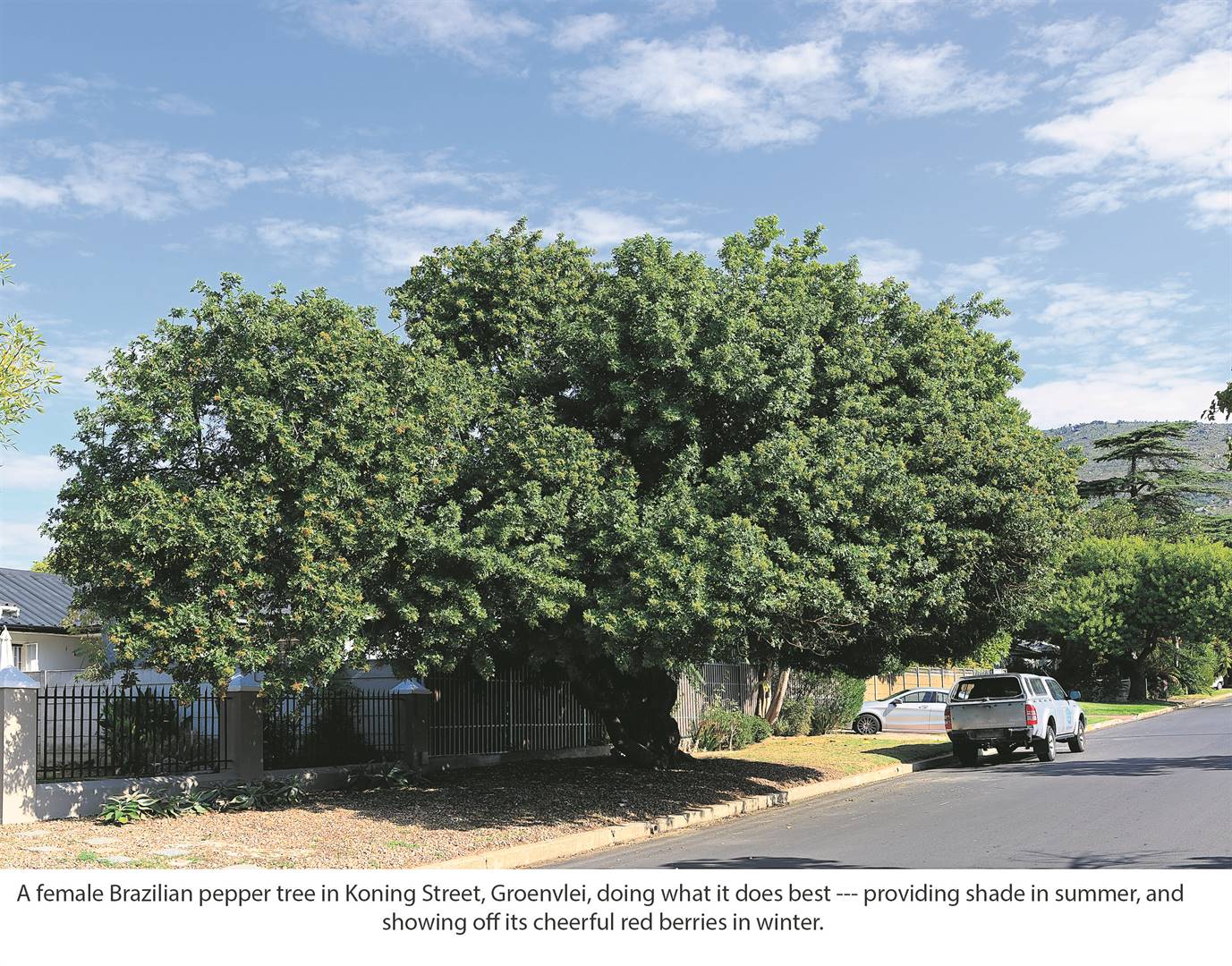
What makes the Brazilian pepper so suitable for planting on a pavement? To begin with, it’s a medium-sized tree, big enough to provide useful, dense shade in summer, but never growing so tall as to create maintenance problems. It usually branches fairly low down, unless pruned to be single-stemmed, and it naturally develops a wide-spreading canopy. It is an evergreen tree, so it doesn’t “mess” and is not known to be easily blown over by strong winds, or to drop branches. It develops a strong root system, but the roots grow mainly downwards rather than spreading out.
Perhaps its most endearing feature is that it is a vigorous, disease-free, fuss-free, tough, drought-resistant tree. It is wonderful to see a tree that wants to grow, unfazed by woolly aphids or downy mildew, untroubled by drought or wet feet, shrugging off poor soil and magnesium deficiency. The Brazilian pepper’s only sin was that it outcompeted our indigenous trees. It was simply too successful. So it ended up being declared a “category 1b” invasive tree in KZN. That means existing trees are not allowed to live out their days in peace, they must be cut down. In the Western Cape the situation was apparently less dire, and the Brazilian pepper was only branded a category 3 offender, meaning existing trees can be left where they are, but no new ones may be sold or cultivated.
For the time being, therefore, we can still enjoy the Brazilian peppers along our streets – here in the Boland at least – but as responsible tree people, I suppose we should prevent new ones from taking root.
As the name indicates, the tree’s native range is Brazil, Argentina and Paraguay. Its leaves are pinnately compound (feather-like with a central axis to which the leaflets are attached), always with an odd number of elliptical leaflets, usually 7 or 9.
The leaflets smell strongly of turpentine when crushed – the specie’s name, terebinthifolius, means “turpentine leaves”. Male and female flowers are borne on separate trees in autumn, and then the trees are popular with bees and other insects. Soon afterwards masses of the small, bright pink-red berries, each about 5 mm in diameter, can be seen on female trees. Each berry contains a single seed, and seed dispersal is done mainly by birds.
The characteristic, wide-domed shape of the tree, and the female trees’ conspicuous clusters of red berries in the winter landscape are distinguishing features of the Brazilian pepper. Another appealing aspect is the characterful, contorted and entwined trunks often seen on mature specimens of these trees.
The much-maligned Brazilian pepper has one valuable attribute that may still earn it a stay of execution.
It has thus far proved to be immune from the polyphagous shot hole borer at least according to the latest list of affected trees that I could find on the internet. With an estimated 65 million trees in urban areas coutrywide that are going to succumb to this tiny beetle by 2030, the day might come when authorities will look with different eyes at a tree that is untouched by the scourge.