On a warm winter’s day tour in Wellington the bus ventured into a fluffy “forest” of cuteness at Quenti Alpaca on the Klein Limietrivier Farm.
There, Linda and Stephen Nessworthy live in the landscapes of Agter Groenberg and have been farming alpaca since 2010.
Walking through a multitude of machinery that’s pumping, spinning, sucking and toiling in an orchestra of functions and loud noises, Linda says: “We have built the only fully worsted industrial mill in South Africa where we process local alpaca.
“We imported the original animals from Chile between 2009 and 2011.”
She proudly boasts about her woolly wonders by saying how genetically diverse the Quenti Alpaca herd is. The population of which sits at 250 alpacas.
“We offer a wide selection of breeding stock, with both herd sire and female alpacas suited to a range of budgets. Prices for young males start at R4 500, while females range from R9 500.”
Alpacas can breed at any time, but Linda prefers to plan births for spring and autumn, as this provides a constant source of new stock. “They are induced ovulators, so it is simple and easy to plan our breeding programme,” she explains.
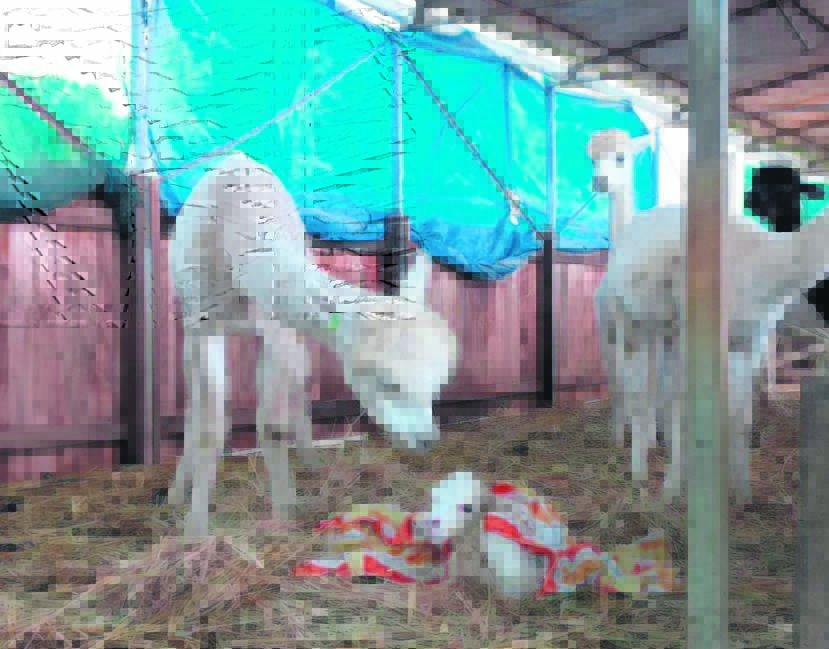
A baby is called a cria and they can be born in sets of twins (although twins are extremely rare).
“They are pregnant for an average of 340 days (11 months), so they will produce one cria a year,” Linda said. “We breed an alpaca from two years of age. If she is well cared for and nourished, she can have around 12 to 14 cria in her life time.”
An alpaca’s life span ranges between 15-20 years of age.
Linda explains females are physically capable of breeding from an even younger age, but they tend to be poor mothers.
“I observed their body language and behaviour. Young babies show submissive behaviour where their little tails would fling up. That’s become my key. When a girl that’s technically old enough to breed still portrays this submissive behaviour I leave her to mature another six months.”
When it comes to wool and fibre quality, Linda breaks it down to a science that determines the best avenues for production.
“The first two years generally provide the best-quality fibre that you’ll get off an alpaca. We are breeding and seeing better quality of fibre for longer. But it’s taken us 10 years of breeding to get there.
“In terms of fibre, we have a low micron average across the herd, generally strong with excellent conformation.”
Luckily, they have a use for even the poorest-quality fibre.
“That’s why we test each animal’s fibre every year and then we batch according to micron,” Linda said. “The coarsest fibre is used for a felted cloth like horse blankets. Alpacas’ fibre naturally repels water and dirt, without adding a resin to it. It makes for durable and warm blankets.”
An alpaca’s utility reach is beyond the supply of wool, such as companionship and protection. As Linda would say, “not all alpaca are created equal.
“Some make wonderful pets and generally, we offer very young males in pairs, as they tame easily and become valuable members of the family.”
Alpaca are quite placid and respond well to human contact. They make excellent pets and can be trained to walk on a lead.
“They are fairly social animals and do not do well in solitary, so we never sell just one as a pet. An adult alpaca with dominant personality traits make excellent protectors of sheep and mohair goats against small predators, like the rooikat.”
They are alert, fast and highly protective of “their” flock. Farmers report up to 85% fewer lamb losses once the alpacas learn the environment.
The cost of maintaining an alpaca depends on too many factors to pin-point. But they are water-wise and gentle on the land.
Are they, too, living-lawnmowers like goats?
“Yes, they will keep grass neatly ‘mowed’ but I have no idea how much an average grazer eats. We also supplement feed milled oats, lucerne and a mineral/vitamin mix.”
Their alpacas are sheared in September after which a fleece sample from each animal is sent to the wool-lab in Gqeberha.
The wool-process.
- First it’s scoured (wash) and air dried.
- Then the fibre is picked for the lubricant/anti-static agent (biodegradable/environmentally friendly) to be applied.
- Carded to lineate fibres.
- Combed to further lineate, remove coarse and short fibres.
- Gilled to blend and ensure correct linear weight.
- Fly-framed to draft into rovings and wind onto tubes ready for spinning.
- Spun to desired linear weight and wound onto cones to remove any faults.
- Folded by twisting multiple single threads together to create finished yarn.

“Our industrial equipment has all been sourced in Europe and carefully reconditioned here,” Linda said. “We make a wide range of products from our herds fibre, like socks, beanies, throws, scarves, knitting yarn, handmade garments, and so on.”
At Quenti Alpaca, the yarn is also hand-dyed in a range of knitting yarn.
“We offer personalised tours of the barn and mill by appointment only, offering visitors a rare opportunity to see from start to finish, how fibre is converted into luxurious textiles.”
At last, Linda shares her journey of cultivating a passion for these big-eyed, walking wool bearers: “I was captivated by articles in National Geographic as a child sitting in the orthodontist’s waiting room. I was fascinated by the Inca textiles, traditions and their alpaca.”